


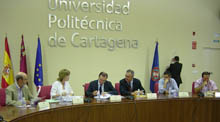


The director of the Biodiversity Foundation, a public foundation of the Government of Spain, under the Ministry of the Environment, Rural and Marine Affairs, Ana Leiva, has signed today in Murcia a collaboration agreement with the Rector of the Polytechnic University of Cartagena, Félix Faura Mateu, to develop a project that promotes employment and good environmental practices, within the framework of the Empleaverde Program. The event was co-chaired by the Government Delegate in Murcia, Rafael González Tovar, who highlighted the importance of this agreement as an engine to boost both job creation and projects that promote sustainable development.
The Biodiversity Foundation, as the managing body of the European Social Fund (ESF), has allocated 434,115 euros to promote job creation and the improvement of the environment in Murcia, within the framework of the Empleaverde Programme.
The objectives of the selected initiatives are: to promote job creation and increase the skills and qualifications of workers; promoting and improving employment and the modernization of enterprises; adapt economic activities to environmental regulations and promote sustainability.
The Polytechnic University of Cartagena has been the recipient of part of the funds, with a project for the consolidation and restoration of old and historic urban green spaces, for an amount close to 199,000 euros. The aim is to promote and improve employment in the environmental sector, through specific training and job reconversion of workers in SMEs or micro-SMEs and self-employed professionals.
Specifically, the project’s actions will be aimed at groups of workers from small and medium-sized enterprises in the area and self-employed workers; that is, landscapers, agronomists, agricultural technicians, biologists, architects, gardeners and agricultural workers, among others. It will also be considered essential that these workers belong to priority groups (women, people with disabilities, immigrants, people over 45 years of age and low-skilled workers), as well as workers located in rural areas, protected areas and biosphere reserves.
The training is expected to increase the skills and qualifications of the recipients – encourage them to adapt to environmental regulations, boosting the sustainability of their economic activity – in order to strengthen their competitiveness in the labour market. At the same time, the application of the knowledge acquired in the consolidation and restoration of green spaces will contribute to remedying the damage suffered, promoting the rational use of heritage in the population and conserving existing natural resources.
The project will generate 9 new jobs, train more than 150 people and the creation of 4 companies is expected.
ENVIRONMENTAL QUALIFICATION IN DIFFERENT SECTORS
Approved within the framework of the Empleaverde Program 2009-2011, other initiatives will be carried out in Murcia that include actions in the agricultural, forestry, energy, construction, fishing, environmental management and sustainable tourism sectors.
These include: the Association’s initiative to promote the rational use of forest products and services (FSC Spain), for responsible forest management, forest conservation and rural development; that of the Confederation of Organizations of Foresters of Spain for the sustainable management of forests, with training actions among owners of forest exploitations and that of the Fernando González Bernáldez Interuniversity Foundation for Natural Spaces (FUNGOBE), which will launch ENPlea Sostenible, in protected areas.
For its part, the Agri-food Federation of UGT also intends to train workers from SMEs and micro-SMEs, in this case, in the food sector, in order to improve their skills in environmental and sustainability issues. The Azti Foundation’s project is also aimed at workers in the food industry: its vocational training actions towards sustainability and eco-innovation will have an impact on the area of beverage production. Meanwhile, COAG Rural Initiative will carry out training in the compatibility of livestock management and wildlife.
In addition, the Technical Association for Waste Management, Urban Cleaning and the Environment (ATEGRUS) proposes a job reconversion of workers to the waste management sector. And, through the Sol Project, the National Federation of Electrical Installations and Telecommunications Entrepreneurs of Spain will seek to stimulate the creation of new business initiatives and train workers in the area of photovoltaic solar energy.
Finally, the Conde Valle de Salazar-Ecoempleo Foundation will direct its actions to people who work in construction and in related industries and sectors, as well as workers in the transport and energy generation sector, as well as professionals and technicians specialized in design and planning in both construction and mobility issues.
THE PROGRAM IN NUMBERS
Through the Empleaverde Programme, the Foundation manages the funds allocated to it by the Adaptability and Employment Operational Programme of the European Social Fund (ESF) for the period 2007-2013. The 49 projects approved in this call add up to an amount of 11.8 million euros.
The empleaverde programme has set goals for the period 2007-2013 to support more than 50,000 people and promote the creation of 1,000 companies in the environmental sector. To this end, it has a total endowment of 44.1 million euros, of which the European Social Fund co-finances between 50% and 80% of the projects, depending on the regions in which they are developed.
Within the framework of these projects, nearly a thousand different actions will be carried out: courses, conferences, information and communication campaigns, personalized advice, among others.
These initiatives will contribute to the creation of almost 150 direct jobs, since the entities plan to hire personnel for their development. In addition, more than 250,000 workers will be involved through the projects and more than 550 economic activities are expected to be launched.
