


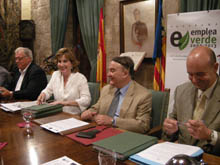


The director of the Biodiversity Foundation, a public foundation of the Government of Spain, under the Ministry of the Environment, Rural and Marine Affairs, Ana Leiva, has signed collaboration agreements today in Valencia with the scientific director of the Institute of Coastal Ecology, Gabriel Soler Capdepón, and with the President of the Federation of Cooperatives of the Valencian Community (FECOAV). José Vicente Torrent Corst, to develop projects that promote employment and good environmental practices in that region, within the framework of the Empleaverde Programme. The event was also attended by the Sub-delegate of the Government, Luis Felipe Martínez Martínez.
The Biodiversity Foundation, as the managing body of the European Social Fund (ESF), allocates 809,141 euros to promote job creation and the improvement of the environment in the Valencian Community.
This investment will serve to develop the projects “Conservation of the Coast and the Marine Environment” of the Institute of Coastal Ecology and “MAYAS” of the environment and sustainable agriculture of the FECOAV, in addition to contributing to the implementation of seven other initiatives aimed at creating employment, increasing the qualification of workers, to the modernization of companies for sustainable development and to their adaptation to environmental regulations.
Approved within the framework of the Empleaverde Programme 2009-2011, several initiatives will be implemented in the Valencian Community that include actions in the agricultural, forestry, energy, construction, fishing, environmental management and sustainable tourism sectors.
Among them, it is worth highlighting: that of the Confederation of Forestry Organizations of Spain, which will be committed to sustainable management with training actions among owners of forest exploitations; ENPlea Sostenible of the Fernando González Bernáldez Interuniversity Foundation for Natural Spaces (FUNGOBE); the initiative of the Agri-food Federation of UGT to train workers of SMEs and micro-SMEs in the food sector; that of the Technical Association for Waste Management, Urban Cleaning and the Environment (ATEGRUS) for the reconversion of work towards this sector, and the Sol Project, of the National Federation of Electrical Installations and Telecommunications Entrepreneurs of Spain.
Likewise, the Federation of Spanish Footwear Industries, FICE, and the Conde Valle de Salazar-Ecoempleo Foundation will focus on issues of eco-innovation, sustainability of transport and materials, as well as improvement of the professional skills of their workers.
FOR A SUSTAINABLE COASTLINE AND AGRICULTURE
The “Conservation of the Coast and the Marine Environment” project of the Institute of Coastal Ecology is mainly aimed at workers in ports and the environmental and fishing sectors, related to coastal rescue and lifeguarding, self-employed workers and the tourism sector. The objective of the project is the modernization and eco-innovation of companies and activities in fishing ports, commercial ports and yacht clubs, which will allow the creation of new jobs.
In this sense, an environmental diagnosis of the ports is required, the adaptation of economic activities to environmental regulations and the design of a specific training and training plan for sustainability, appropriate to the reality of the labour market and the promotion expectations of professionals and workers in the sector.
For its part, the MAYAS Project of the Federation of Cooperatives of the Valencian Community (FECOAV) is aimed at the training and qualification of farmers and workers in the agricultural environment in the Valencian Community, where agriculture also has a great specific weight.
The general objective of the project is to increase the training of all those involved in primary production, in order to achieve an increase in the area, crops and the number of operators in both integrated production and organic production.
Significant improvements are sought in: compliance with the requirements of environmental regulations; production systems, rebalancing soils and optimising the energy balance of agricultural holdings; the environment, minimizing the use of polluting inputs and making a more rational use of natural resources; in the working conditions of farmers and other production professionals and in the organoleptic quality of food and other derived products.
In addition, the corresponding Organic Farming Guides will be prepared for citrus fruits, fruit trees, persimmons, olive trees, table and wine vines, horticultural crops, pomegranate trees, fig trees and nuts. The Guidelines for Cross-Compliance Requirements will also be drafted and provided to all associated workers of cooperatives.
THE PROGRAM IN NUMBERS
Through the Empleaverde Programme, the Foundation manages the funds allocated to it by the Adaptability and Employment Operational Programme of the European Social Fund (ESF) for the period 2007-2013. The 49 projects approved in this call add up to an amount of 11.8 million euros.
The empleaverde programme has set goals for the period 2007-2013 to support more than 50,000 people and promote the creation of 1,000 companies in the environmental sector. To this end, it has a total endowment of 44.1 million euros, of which the European Social Fund co-finances between 50% and 80% of the projects, depending on the regions in which they are developed.
Within the framework of these projects, nearly a thousand different actions will be carried out: courses, conferences, information and communication campaigns, personalized advice, among others.
These initiatives will contribute to the creation of almost 150 direct jobs, since the entities plan to hire personnel for their development. In addition, more than 250,000 workers will be involved through the projects and more than 550 economic activities are expected to be launched.
