




With just three years to go before the deadline given by the United Nations for the protection of at least 10% of the world’s marine area, Spain still needs to rapidly increase the scant 0.5% of protected areas it currently has. To do this, a protection rate of almost 65 km2 per day will be necessary.
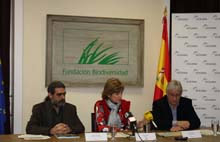
In an event chaired by the Director of the Biodiversity Foundation, Ana Leiva, and the Director of Oceana for Europe, Xavier Pastor, “Proposal for Ecologically Important Marine Areas: South Atlantic and Spanish Mediterranean”, a scientific report resulting from the research carried out by Oceana with the support of the Biodiversity Foundation, was presented today. The study includes a proposal for 25 marine areas, most of which are not protected, and which, given their ecological value, Oceana proposes for protection.
The declaration of new marine protected areas in places such as the dry of Los Olivos (Andalusia), the seamounts of the Mallorca channel (Balearic Islands), the canyons of Palamos and Creus (Catalonia), the dry of Palos (off Murcia) or Cabo de la Nao (Valencian Community), together with the expansion of already protected areas such as Columbretes, Alborán or Doñana are some of the proposals made by Oceana and included in this study on more than fifty sites in the Spanish Mediterranean and adjacent Atlantic waters.
“The work carried out through an underwater robot and a professional team of underwater cameras and photographers has allowed us to obtain new information about important seabeds that were previously unknown,” says marine biologist Xavier Pastor. Oceana has accessed places ranging from the surface to more than 300 meters deep. This has made it possible to find and study gorgonian gardens, sponge fields, kelp forests, mixed phanerogamous meadows, maërl and coralligen beds, etc., as well as the discovery of carnivorous sponges on two Spanish seamounts.
Spain currently has more than 5,000 kilometres of marine waters under different protection figures, but it would be necessary to increase this figure to around 100,000 km2. According to the United Nations Convention on Biological Diversity, in order to halt the loss of biological diversity in the oceans, by 2012, at least 10% of the marine surface must be protected. But, according to the International Union for Conservation of Nature, it would be advisable to increase this percentage to %-30% to meet this goal.
“Not only is it necessary to create new protected areas, but also to expand many of the existing ones. Almost half of the marine protected areas in Spain barely reach 1 km2 of surface, which makes them inefficient for the conservation of certain habitats and species,” says Ricardo Aguilar, director of research and projects at Oceana in Europe and director of the campaign on board the Ranger.
The Spanish Government, through the Biodiversity Foundation, a public foundation of the Government of Spain dependent on the Ministry of the Environment, Rural and Marine Affairs, has launched an ambitious project, LIFE+ INDEMARES, which is funded by the European Commission, to study new potential areas for conservation. In this project, in which Oceana collaborates, 10 marine areas will be investigated, including several of those mentioned above, to propose them for protection through their inclusion in the Natura 2000 Network. However, new areas and more protected area would still be needed to contribute to international objectives.
For this reason, Oceana, with the collaboration of the Biodiversity Foundation, is analysing the seabed in all Spanish waters in order to present a more complete network of protected areas that includes a greater diversity of ecosystems, habitats and marine species.
In the Spanish Mediterranean, Oceana has carried out dives in more than fifty locations, compiling more than 160 hours of filming and 3,000 underwater photographs.
