


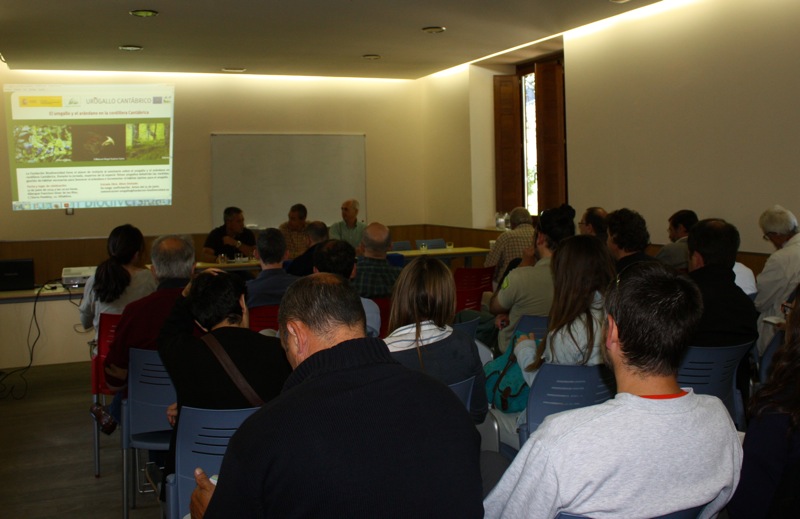
Fifty experts in the conservation and management of the capercaillie habitat have participated today in the conference organized by the Biodiversity Foundation in Villablino (León) within the framework of the LIFE+ Cantabrian Capercaillie project with the aim of exchanging experiences and updating knowledge on the ecology and effectiveness of forest management for the development of blueberries. a key food in the diet of the Cantabrian capercaillie.
The meeting was attended by technicians from the autonomous communities of Castilla y León, Cantabria, Asturias and Catalonia, who are carrying out projects for the conservation of the capercaillie not only in the Cantabrian mountain range but also in the Pyrenees.
The speakers presented their experiences in the conservation and improvement of blueberry trees in these autonomous communities carried out within the framework of the LIFE+ Cantabrian Capercaillie project and in the Gallipyr project, the Pyrenean Network of Mountain Galliforms.
The technician of the Conselh del Val D’Aran, Ivan Afonso, has highlighted the link between the capercaillie and the blueberry and the forestry treatments that have favoured the increase in the coverage of this species and its effect on the capercaillie.
For her part, the researcher from the University of León, Esther Sierra, has shown the effect that herbivores have on the height and cover of blueberry groves, in particular deer and to a lesser extent domestic livestock, especially in the eastern sector of the Cantabrian capercaillie distribution area.
The technicians Froilán Sevilla, from the Junta de Castilla y León, Javier Espinosa from the Government of Cantabria and Teresa Sánchez Corominas, from the Principality of Asturias, also participated in these conferences, presenting the various results obtained from the forestry work carried out in their respective autonomous communities with the aim of promoting blueberries.
In various working groups, the habitat conservation actions promoted to promote the development of the understory and thus increase the sources of food and shelter of the Cantabrian capercaillie, and the clearing of scrub as a measure to improve blueberry populations have been discussed.
The habitat management actions of the LIFE+ Cantabrian Capercaillie were reviewed and planned, together with the rest of the actions of the project, in the Management Committee that was held yesterday in Caboalles de Arriba (León).
The LIFE+ Cantabrian Capercaillie project, coordinated by the Biodiversity Foundation, aims to guarantee a favourable conservation status of the Cantabrian capercaillie ecosystems through habitat restoration and management actions, favour reproductive success and the survival of adults and promote social awareness and public participation, increasing knowledge about the subspecies.
17/06/2014
Blueberries, key to the conservation of the Cantabrian capercaillie
Share on:


17/06/2014
Blueberries, key to the conservation of the Cantabrian capercaillie
Share on:
