


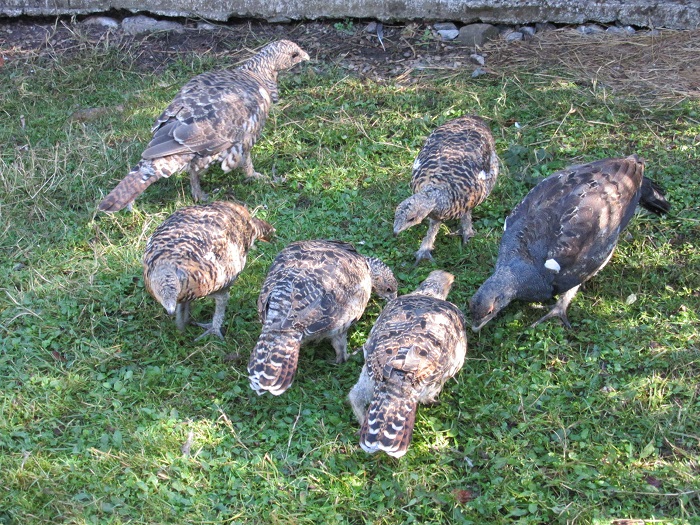


The juveniles of Cantabrian capercaillie born in captivity a couple of months ago will remain in the Sobrescobio breeding center with the aim of reinforcing the breeding stock. This has been agreed by the LIFE+ Cantabrian Capercaillie team, a European project coordinated by the Biodiversity Foundation of the Ministry of Agriculture, Food and the Environment, with the aim of halting the decline of this emblematic subspecies in danger of extinction.
With this measure , the reintroduction of the new juveniles into the natural environment during the autumn is ruled out. The LIFE+ Cantabrian Capercaillie project team considers that it is a priority to renew the breeding stock of the centre to obtain a large population of specimens in future breeding campaigns and thus have a higher number of individuals for future releases. Specifically, three males and five females of Cantabrian capercaillie will join the breeding group. Two of them – a male and a female – come from the partial removal of a clutch from the wild, which will increase the genetic variability of individuals born in captivity.
This year’s captive breeding campaign has been the one that has obtained the best results since the LIFE+ Cantabrian Capercaillie project was launched six years ago. This year nine chicks have been born, of which eight have managed to survive, which represents a high survival rate in this subspecies. The specimen that did not manage to overcome the critical period of the first days was affected by the bacterium Escherichia coli (E.coli), which is normally found in the intestine of animals and caused death. With these eight juveniles, the Sobrescobio center already has 22 Cantabrian capercaillie. Captive breeding is part of a general conservation plan for the subspecies, based on the improvement of its habitat and the wild populations that are currently maintained.
