


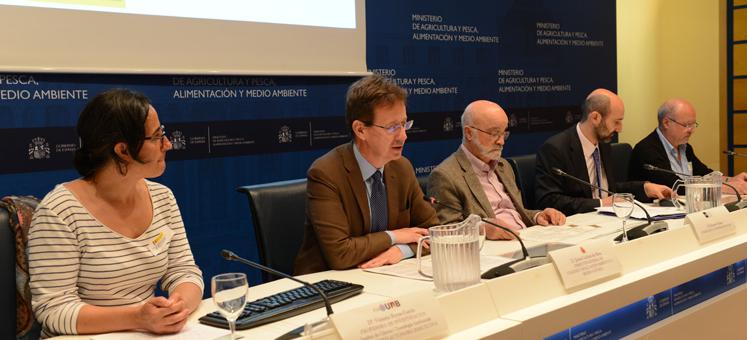


The Ministry of Agriculture and Fisheries, Food and the Environment has today presented the second phase of the Spanish Inventory of Traditional Knowledge related to Biodiversity, a database that compiles and organizes secular knowledge linked to biodiversity, transmitted through oral tradition and which is the result of man’s adaptation to the environment in which he lives.
The Ministry’s Director General of Environmental Quality and Assessment and the Natural Environment, Javier Cachón, presided over the presentation ceremony, where he stressed that “this knowledge is a legacy of knowledge of incalculable and irrecoverable value and constitutes a very useful element for the sustainable management of natural resources and scientific and industrial development”. which is why the Ministry launched the preparation of this Inventory, the first edition of which was published in 2015.
Cachón thanked the participants in the preparation of the Inventory, more than 70 experts and 40 institutions, for their enormous effort. “Especially to the real protagonists, all those people, now very old, who have been generating, maintaining and transmitting their invaluable knowledge, for us to enjoy and pass it on to the next generations”, he stressed.
The Inventory presented today is made up of three volumes and is part of the Spanish Inventory of Natural Heritage and Biodiversity. Collect 707 plant files covering a total of 760 species.
This information is in addition to that provided by the first phase of the Inventory. “We now have information on almost 3,000 plant species with associated traditional knowledge, nearly half of Spain’s floristic diversity. More than 100 reference works have been shelled, analyzed and their data entered in this repository in order to provide information to all interested parties,” explained the director general.
The work, carried out by a team of 70 experts including biologists, anthropologists, agronomists, pharmacists and linguists, has been based on the compilation of previously published traditional ecological knowledge that is relevant for the sustainable use and conservation of biodiversity, the work methodology, with a hierarchical classification of uses (animal feed, human food, medicine, toxic and harmful uses, etc.), has resulted in the database and the informative sheets included in the publications that make up the Inventory.
This second publication of the Inventory is available online. It will soon be available in paper edition from the Ministry’s Publications Service.
You can find more information about the Spanish Inventory of Natural Heritage and Biodiversity here.
