


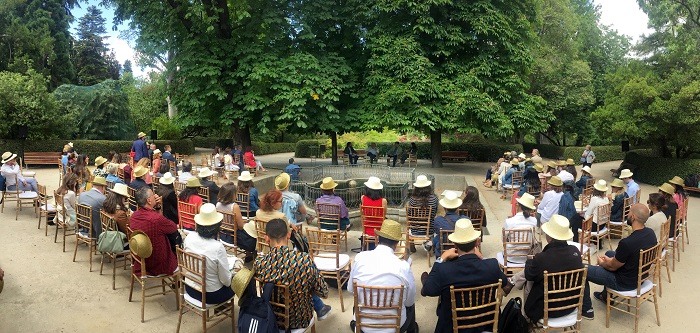


Coinciding with the celebration of World Environment Day, we have organized, in collaboration with the Enaire Foundation, the conference “Art, science and political action in the face of climate change”, which took place at the Glorieta de los Castaños of the Royal Botanical Garden of Madrid.
The acting Minister for Ecological Transition, Teresa Ribera, inaugurated this meeting; accompanied by Beatriz Montero de Espinosa, managing director of the Enaire Foundation; and Esteban Manrique, director of the Royal Botanical Garden. Ribera stressed that climate change is a problem in the history of humanity and despite this, institutions and governments have been behind science.
The first conversation “Glaciers and climate change” was attended by the researcher Eduardo Lastrada; Sonia Castañeda, director of the Biodiversity Foundation; and the photographer Javier Vallhonrat, who exhibits his latest project, La sombra incisa, at PHotoEspaña 2019, the result of three years of work on the La Maladeta Glacier. Castañeda highlighted the importance of glaciers as temperature regulators and as water reserves. Only 10% of the planet is covered by glaciers and it is believed that by 2100 50% of them will disappear.
The second conversation “Forests and climate change” was attended by Joan Pino, director of the Centre for Ecological Research and Forestry Applications; Patricia Riquelme, co-director of the Sierra de Guadarrama National Park; and the photographer Jesús Rocandio, who has stated that photography has always fulfilled the task of denouncing the problems of our time and he, specifically, seeks to raise awareness about climate change.
The closing of the conference was attended by Isabel Bombal, acting Director General of Rural Development, Innovation and Forestry Policy of the Ministry of Agriculture, Fisheries and Food; and the acting Secretary of State for the Environment, Hugo Morán, who pointed out that artists have always been a tool to transfer knowledge to citizens. “Today they translate the knowledge of science into the language of society, in this case climate change and loss of biodiversity,” he concluded.
