


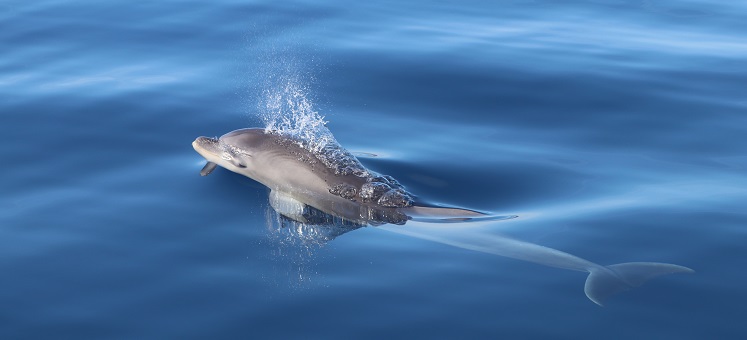


The Tursiops Association embarks to begin the drafting of a network of underwater hydrophones in areas located in the marine Natura 2000 Network, in the Pitiusas Islands, in the surroundings of Ibiza and Formentera. The objective of the entity is to clarify the impact of noise associated with marine navigation on the ecology and distribution of bottlenose dolphins.
This week, technicians from the Tursiops Association embark on board the research sailboat Irifi to begin the drafting of a network of underwater hydrophones in areas located in the marine Natura 2000 Network, in the Pitiusas Islands, in the surroundings of Ibiza and Formentera. The objective of the entity is to clarify the impact of noise associated with marine navigation on the ecology and distribution of bottlenose dolphins.
This action, which is part of the ‘Our Dolphins’ project , has been possible thanks to the validation of the competent authorities, and given the current situation, it is a historic opportunity to continue working on the research and conservation of marine mammals. A context, which makes this vessel the only one in sight in the area, and which will allow underwater anchoring as well as establishing reference values of environmental noise without alterations due to human action.
The research focuses on one of the largest enclaves with the highest maritime traffic in the Mediterranean Sea to answer questions such as the level of affection that the bottlenose dolphin receives due to noise, – as it is a species that relates, lives and feeds through acoustics – and to know if this mammal can coexist with these noise disturbances.
In 2020, the initiative has the support of the Biodiversity Foundation, the Ministry for Ecological Transition and the Demographic Challenge, as well as the collaboration of multiple public and private institutions since it began in 2018.
Precisely, during the first stage of the project in 2018, after anchoring three hydrophones in three areas with different degrees of navigation pressure, these being the Freus de Ibiza-Formentera, the Illots de Ponent and Na Xamena (high, medium and low respectively) it was possible to determine that dolphins have a greater presence in winter than in summer and that they are negatively correlated with anthropic noise.
These results have pushed Tursiops to deepen the research, supported by two scientifically proven premises. According to the entity, in the first hypothesis it is known that there is a local population of bottlenose dolphin in the Pitiusas islands and the second hypothesis holds that each bottlenose dolphin develops a unique signature whistle with which it can be identified.
Due to this approach, the need arises to increase the hydrophone network to a total of six in 2020, so that they envelop the entire archipelago of Ibiza and Formentera. In this way, the entire distribution area of the Pityusic subpopulation of bottlenose dolphins, or at least the most coastal one, would be under sound surveillance.
Regarding the research process, Tursiops indicates that, after the anchoring of the hydrophones, the acoustic files generated are analysed in different ways; In a first phase, underwater noise is quantified and characterized, and in a second phase, the presence of bottlenose dolphins is quantified based on the appearance of whistles.
Subsequently, these whistles are isolated so that later, by calculation techniques based on the capture or recapture processes, information is provided on; the number of dolphins found in the study area, the movements they execute around the Pitiusas islands, how they correlate with noise levels and navigation, as well as the role that the marine protected areas of the Natura 2000 Network play for this species.
