


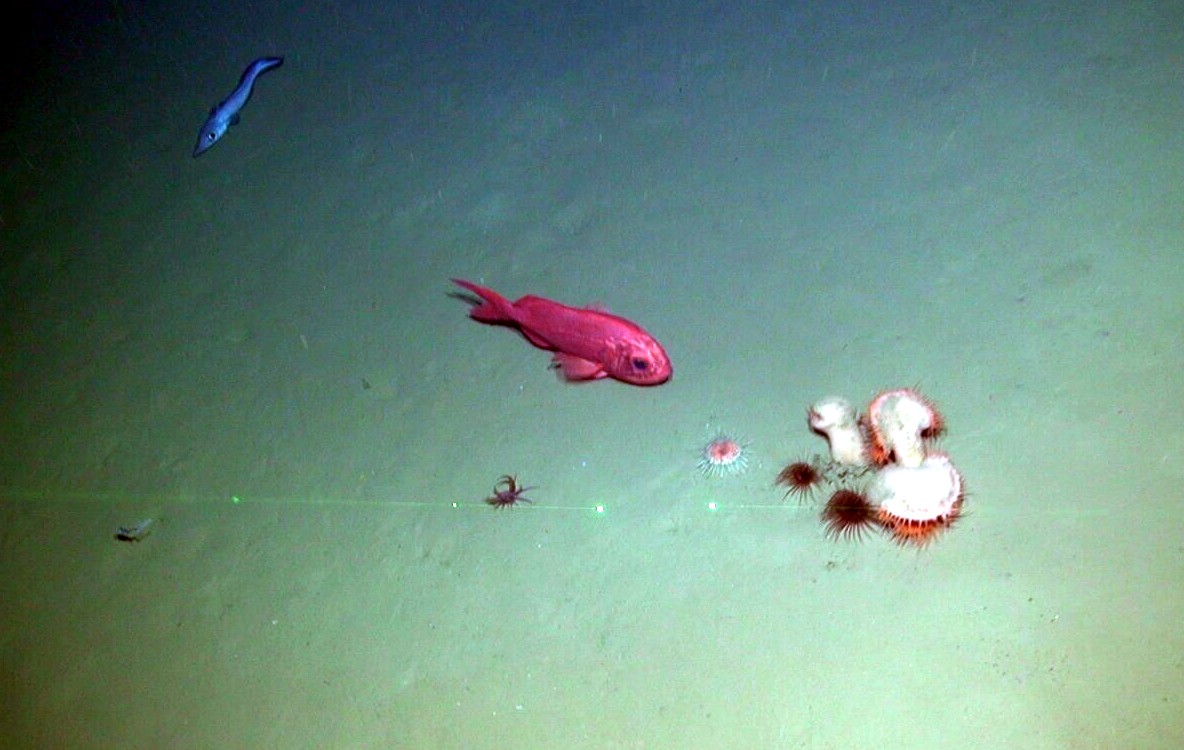


Within the framework of the sixth oceanographic campaign of the LIFE IP INTEMARES project, which ended today in the port of Gijón.
The sixth oceanographic campaign of the LIFE IP INTEMARES project on board the Ramón Margalef vessel, carried out by the Spanish Institute of Oceanography (IEO) and the AZTI Foundation, has ended today in the port of Gijón.
For 15 days, the campaign has explored the canyon system of Cap Bretón, an area located off the coast of the Basque Country in the Cantabrian Sea with the aim of improving prior knowledge of this area and identifying its suitability for its future declaration as a Natura 2000 Network Site of Marine Community Interest (SCI). the largest network of protected natural areas in the world.
The exploration has made it possible to map an area of 2,600 square km between 70 and 2,600 meters deep using high-resolution echo sounders. The researchers also point out that the images and videos taken with the help of an underwater vehicle, as well as the samples collected, have made it possible to begin the study of the vulnerable habitats contemplated in the European directives.
The head of this system of submarine canyons that has been studied reaches depths of up to 4,000 meters, with areas of sedimentary bottoms and large fields of pockmarks with dimensions of 800 meters in diameter and 60 meters deep among its natural treasures. The analysis of the samples taken will allow us to know if there are species linked to these emissions, as well as the physical-chemical characteristics of these depressions.
During the exploration of this oceanographic campaign , the rocky bottoms of the continental shelf have also been studied , where vulnerable benthic communities of yellow corals (Dendrophyllia cornigera) and crown sponges (Phakellia ventilabrum) have been detected. The results of this campaign could shed more light on habitats and other complex biological communities of high ecological value, whose distribution and conservation status are currently unknown.
In the coming months, researchers will carry out an exhaustive analysis of the information collected during this oceanographic campaign. These studies are essential to have the scientific information that allows it to endorse its declaration as a protected natural area and for the preparation of its future management plans.
