


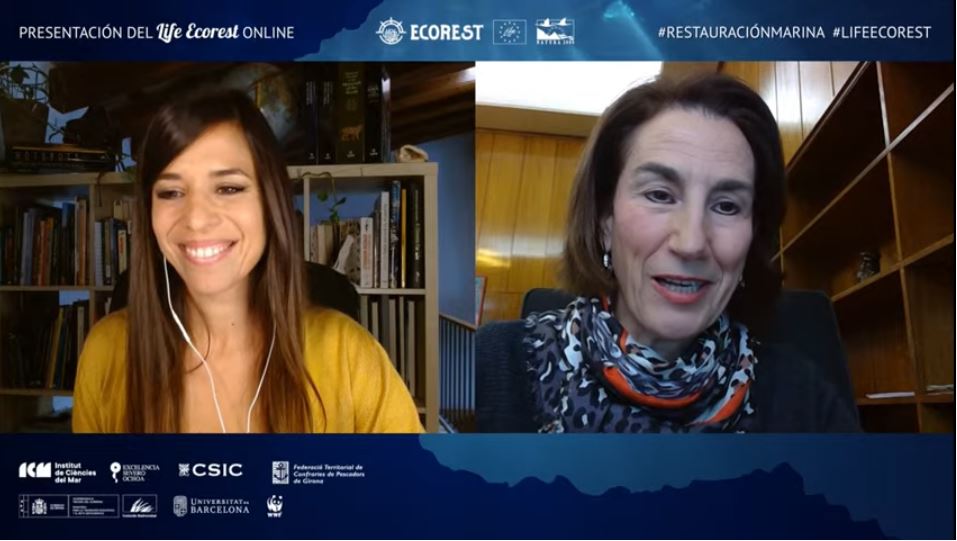


Marine restoration, an ally for the recovery of our seas, has been the protagonist of an event, organized by the Biodiversity Foundation, in which the LIFE ECOREST project has been presented, which aims to restore nearly 30,000 hectares of deep marine habitats in Catalonia with the active participation of the fishing sector.
The event was attended by the Director General of Biodiversity, Forests and Desertification of the Ministry for Ecological Transition and the Demographic Challenge (MITECO), María Jesús Rodríguez de Sancho, who highlighted the role of this tool as “an effective instrument to reverse the degradation of ecosystems, mitigate and promote adaptation to climate change and protect biodiversity for the benefit of people, the climate and the planet”.
In his speech, Rodríguez de Sancho also reaffirmed Spain’s commitment to advancing in the conservation and recovery of marine ecosystems and detailed some of the Government’s main actions in this area, such as the National Strategy for Green Infrastructure and Ecological Connectivity and Restoration, as well as the planned investment of more than 26 million euros for the restoration of marine habitats, with the support of funds from the Recovery, Transformation and Resilience Plan.
In relation to the LIFE ECOREST project, the Director General of Biodiversity, Forests and Desertification has highlighted as one of its main values the importance of sectoral cooperation, “essential to advance in the protection of our seas and our resources”. The project has close collaboration between the scientific community, the fishing sector and different administrations.
The event was also attended by the Director General of Sustainable Fisheries of the Ministry of Agriculture, Fisheries and Food, Isabel Artime, who highlighted the role of the fishing sector in marine conservation projects and the “effort of fishermen in order to guarantee the sustainability of their activity”.
For her part, the Deputy Director General of Fisheries and Aquaculture of the Generalitat of Catalonia, Itziar Segarra, stressed the importance of the participatory management of the fishing sector in the conservation of marine biodiversity in Catalonia.
BENEFITS OF MARINE RESTORATION
For their part, the project partners have shown during the event the benefits of marine restoration and the importance of marine reserves to regenerate habitats and key species such as corals and gorgonians, which act as architects of the seabed.
Specifically, Josep-Maria Gili, professor at the Institut de Ciències del Mar del CSIC (ICM-CSIC), the entity that coordinates the project, explained that active restoration is “a great opportunity to accelerate the recovery of habitats that also favor the recovery of lost functions in ecosystems”. In this sense, he highlighted the innovative role of this project “both for the methodology used and the large spatial area in which it is developed”, as well as for the close collaboration between sectors. “It puts Spanish science at the forefront,” he concluded.
Cristina Linares, professor of ecology at the Faculty of Biology and the Biodiversity Research Institute (IRBio) of the University of Barcelona, focused her intervention on corals and gorgonians, two of the key species of this project, and their fundamental role for the entire ecosystem. “These species act like trees in forests and offer shelter to a large number of species. Therefore, their degradation leads to the loss of important ecosystem functions and services,” he warned.
For her part, Laura Recasens, researcher in the Department of Marine Resources of the ICM-CSIC, addressed the importance of reserves in the regeneration of fisheries resources and the recovery of ecosystems. “Marine protected areas are management tools to recover biodiversity and contribute to the conservation and recovery of habitats punished by fishing impact,” he explained.
The fishing sector has been represented at this event by Antoni Abad, president of the Federation of Fishermen’s Guilds of Girona. Abad has stressed the work carried out by the sector in helping marine restoration and the “important collaboration with all the partners of the project to successfully carry out the planned actions”.
Finally, José Luis García, head of the marine programme at WWF Spain, stressed the need to involve society so that restoration is successful through participatory governance processes. “It is essential to know what their perception is, their interests and the knowledge they can contribute to ensure acceptance, involvement and, ultimately, the long-term viability of the proposed restoration,” he concluded.
AREA OF ACTION
In the area of action of the project, along the coast of Barcelona and Girona, it is estimated that more than 90% of the seabed between 50 and 800 metres deep shows signs of degradation, which hinders the regeneration of natural resources. This area is considered a point of great ecological importance due to the high concentration of endangered, threatened or vulnerable species, including corals and gorgonians.
Therefore, until 2026, the program of actions of the LIFE ECOREST project will serve to try to improve the conservation status of deep-sea habitats and demonstrate the effectiveness of participatory management of the fishing sector.
This initiative, coordinated by the ICM-CSIC, has as partners the Federation of Fishermen’s Guilds of Girona, the Biodiversity Foundation of the Ministry for Ecological Transition and the Demographic Challenge, the University of Barcelona and WWF Spain, as well as the financial contribution of the LIFE Program of the European Union.
