


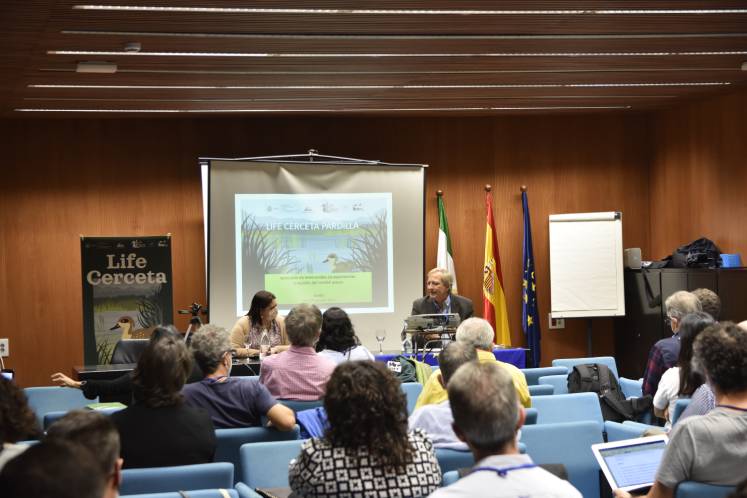


The LIFE Marbled Teal project, which we coordinate from the Biodiversity Foundation of the Ministry for Ecological Transition and the Demographic Challenge (MITECO), has organised a day of experience exchange and training with experts in this species and in the conservation of wetlands, an essential habitat for the survival of the marbled teal (Marmaronetta angustirostris).
During this seminar, held in Seville, the main actions of the project were announced, the current knowledge of the species was updated and priority measures for its conservation were discussed.
The conference, organized with the collaboration of the Ministry of Agriculture, Livestock, Fisheries and Sustainable Development of the Junta de Andalucía, a partner of the project, has had the participation of more than 50 experts in the field of science and management of the species, as well as other participants related to the conservation of wetlands and other threatened ducks.
EXCHANGE OF EXPERIENCES
Specifically, specialists in marbled teal from the Junta de Andalucía, the Miguel Hernández University and the Doñana-CSIC Biological Station have addressed the ecology and use of their habitat, have presented the results of the monitoring of specimens tagged with GPS and have delved into the correct management of wetlands to favor the species.
The conference also served as a meeting point to learn about other projects linked to the marbled teal and wetlands and to highlight the possible synergies and links between them. In this sense, it has had the participation of representatives of the LIFE Marbled Duck, coordinated by the German foundation Stiftung Pro Artenvielfalt, which seeks to recover the marbled teal in Sicily (Italy), and the LIFE Malarial, of the Global Nature Foundation, for the recovery of the aquatic warbler. For its part, WWF has presented its restoration work in the Trebujena lagoon (Cádiz), while the Junta de Comunidades de Castilla-La Mancha has explained the effect that the restoration of the Alcázar de San Juan lagoons (Ciudad Real) has had on this species.
FIRST MEETING OF THE ADVISORY COMMITTEE
After this day of exchange of experiences, the project has also held the first meeting of its advisory committee, a technical and scientific advisory body whose function is to inform and advise the project and evaluate specific technical and socio-economic aspects of its execution. The advisory committee is made up of people from different sectors, such as irrigators, farmers, aquaculturists, hunters, administrations, NGOs, experts in land stewardship or researchers.
On this occasion, the objective is twofold. On the one hand, to share the status of the project and discuss what its approach should be to different aspects of habitat and territory management. Secondly, the committee analyzes and makes recommendations for improvement on the protocols developed in relation to the ex situ conservation program, releases for the purpose of conservation of marbled teal and the operation of breeding centers of the species, which will be presented to the collegiate bodies of inter-administrative coordination for official approval.
RESEARCH, CONSERVATION AND GOVERNANCE
The LIFE Marbled Teal project aims to improve the conservation status of 3,000 hectares of wetlands to reverse the risk of extinction of the most endangered duck in Europe, in a critical situation in Spain.
The project, which is coordinated by the Biodiversity Foundation of the Ministry for the Ecological Transition and the Demographic Challenge, involves the ministry itself, through the Segura Hydrographic Confederation and Tragsatec; the Regional Government of Andalusia, through the Ministry of Agriculture, Livestock, Fisheries and Sustainable Development and the Environment and Water Agency; the Generalitat Valenciana; the Government of the Region of Murcia, as well as the organizations SEO/BirdLife and ANSE. It is supported by the LIFE Program of the European Union and the Directorate General for Water.
