


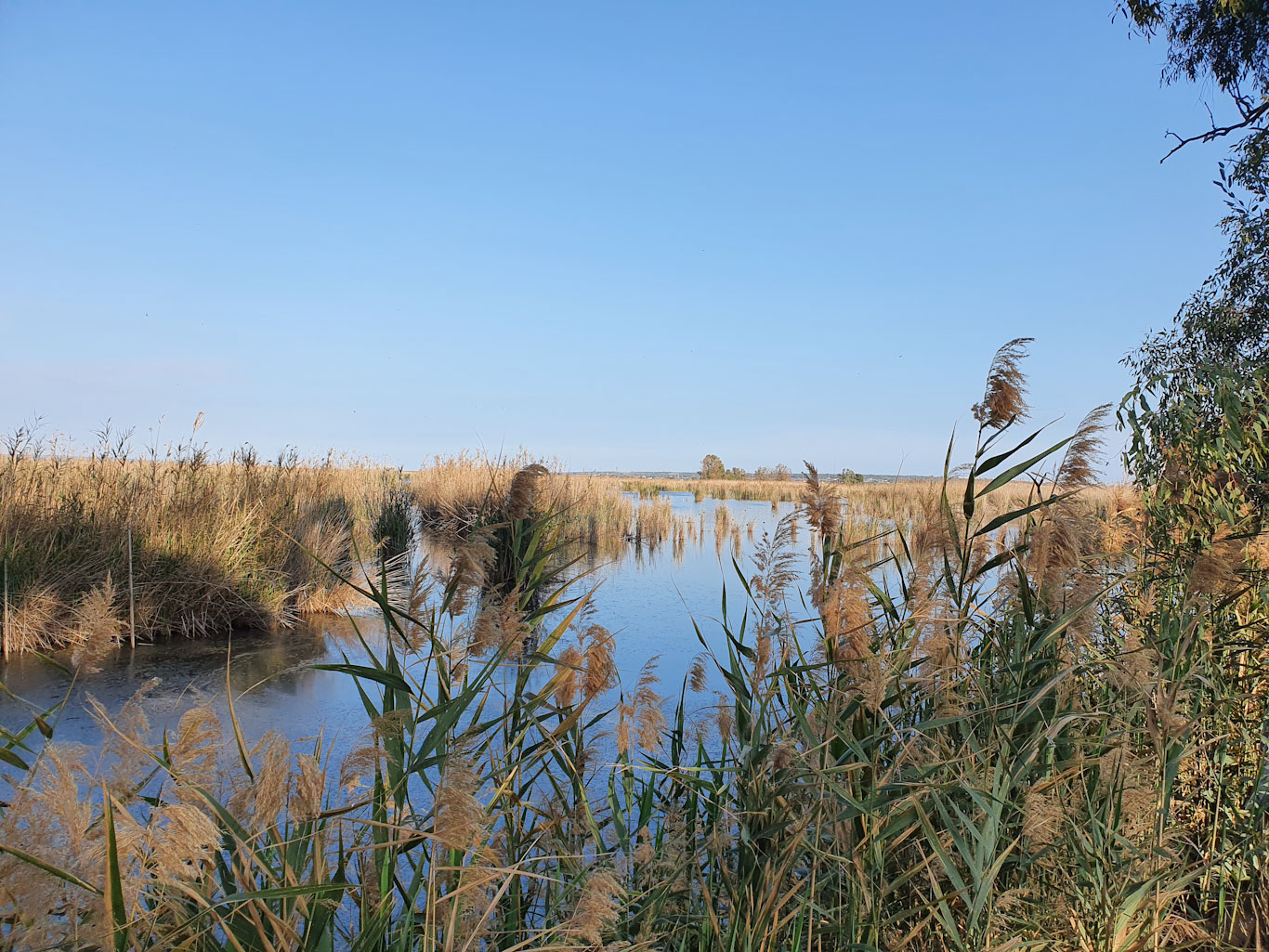


About 55 hectares of wetlands in the El Hondo Natural Park (Valencian Community) have been acquired by ANSE and SEO/BirdLife to improve the habitat of the most endangered duck in Europe, within the framework of the LIFE Marbled Teal project.
Nearly 55 hectares of wetlands in the El Hondo Natural Park (Valencian Community) have been acquired by ANSE and SEO/BirdLife to improve the habitat of the most endangered duck in Europe, within the framework of theL IFE Marbled Teal project, which we coordinate from the Biodiversity Foundation of the Ministry for Ecological Transition and the Demographic Challenge and which has the ministry itself as a partner.
This project aims to recover 3,000 hectares of wetlands to reverse the risk of extinction of the species, in a critical situation in Spain. Habitat loss and degradation is its greatest threat and endangers the survival of the marbled teal, the most endangered duck in Europe.
For this reason, work has begun to acquire a total of 141 hectares of wetlands, which will be accompanied by a set of conservation actions to improve the state of wetlands in the Valencian Community, Murcia and the Guadalquivir marshes in Andalusia.
The first step of this action has been the purchase of 54.54 hectares of what was a single farm called El Espigar or Raja Chica, located in the western area of the El Hondo Natural Park, in the Valencian Community. Specifically, ANSE has acquired 29.26 ha and SEO/BirdLife 25.28 ha of this farm. Together with the almost 90 ha of neighbouring La Raja, they constitute one of the main enclaves for the marbled teal in Spain.
This area has been home to between 20 and 30% of the breeding population of this species in Spain in some years when flooding conditions have been favourable.
The estate consists of four lagoons with wide meadows of aquatic plants. It is covered by salt marshes and reedbeds, which form a border of several sheets of brackish water populated by aquatic plants (submerged macrophytes). This is a very favourable habitat for the teal, but also for a multitude of waterfowl, including the white-headed duck, black-necked grebe, shelduck, coot, pochard, common avocet, little tern or Kentish plover.
Due to their ecological value, these areas of the Natura 2000 Network are recognised as critical sites in the Marbled Teal Conservation Strategy, i.e. areas vital for their survival and recovery.
ENCLAVE FOR THE PROTECTION OF THE MARBLED TEAL
Thanks to this acquisition, the farm will be an enclave for the protection and conservation of the teal. During the development of the project, the ecological conditions of the farm will be improved and its management will be adapted to the water requirements of the species.
Specifically, actions will be carried out for the management of vegetation and the dredging of channels to maintain the surface of the water sheet, which will guarantee adequate flooding throughout the year. Waterfowl hunting will also be prohibited on the farm, so the main threats to the marbled teal in this town will be eliminated. In addition, the public use of this wetland will be favoured, with the improvement of paths and the installation of observatories.
IN CRITICAL SITUATION
The marbled teal is one of the seven species in critical condition in Spain. Until the mid-twentieth century, the marbled teal was abundant in Mediterranean coastal wetlands, especially in Doñana. Butin recent decades its decline has been so drastic that this species of community interest is critically endangered. The number of breeding pairs in Spain, which is almost its only place of distribution in Europe, stood at 45 pairs last year and with a clear trend towards regression.
RESEARCH, CONSERVATION AND GOVERNANCE
To reverse the risk of extinction of the species and promote its habitat, the LIFE Marbled Teal project has undertaken a set of actions to strengthen the status of its populations in the natural environment, improve the state of the wetlands and the scientific knowledge of the species. Until 2025, the participation of sectors relevant to their conservation, such as irrigators or hunters, will also be promoted, as well as environmental awareness and education.
In the LIFE Marbled Teal, which is coordinated by the Biodiversity Foundation of the Ministry for the Ecological Transition and the Demographic Challenge, the ministry itself participates as partners, through the Segura Hydrographic Confederation and Tragsatec; the Regional Government of Andalusia, through the Ministry of Agriculture, Livestock, Fisheries and Sustainable Development and the Environment and Water Agency; the Generalitat Valenciana; the Government of the Region of Murcia, as well as the organizations SEO/BirdLife and ANSE. It is supported by the LIFE Program of the European Union and the Directorate General for Water.
