


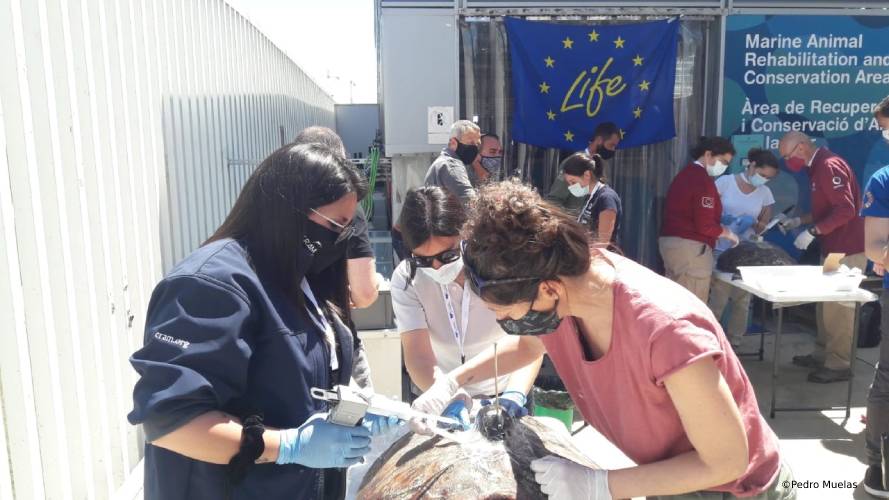


The Biodiversity Foundation of the Ministry for Ecological Transition and the Demographic Challenge (MITECO), in coordination with the Oceanogràfic Foundation, is launching training on techniques for satellite tagging of female loggerhead turtles nesting in Spain. This action, which is one of those planned in the LIFE INTEMARES project, will help to improve the detection of nests to ensure their survival and improve the efficiency in the care of these events. The training also has the participation of the Generalitat Valenciana.
Those attending these sessions are technicians from public administrations and personnel from stranding networks and marine wildlife rescue centers in Andalusia, the Region of Murcia, Catalonia, the Valencian Community and the Balearic Islands, as they are the regions in which nesting events of these marine reptiles have been taking place in recent years. In this course, they receive training on techniques for retention, handling and satellite marking of loggerhead turtle breeding females that are also intended to be addressed, in the coming months, within the framework of the project.
This marking will allow the monitoring of breeding females that arrive on the beaches of the Spanish coast to lay eggs. Given that a female lays several eggs or attempts to lay in the same breeding season and the sections she will select for this are unknown, her marking will allow her successive clutches to be located in that year and thus ensure the viability of the nests.
In addition, these markings will also provide information on which are the resting and feeding areas, allowing planning in the future management actions aimed at their protection, which would favour the implantation of the species on our coasts, improving its conservation scenario.
A ‘vulnerable’ species
The loggerhead turtle (Caretta caretta) is a highly migratory marine species whose populations are in an unfavorable conservation status. For this reason, it is internationally classified as “Vulnerable” by the International Union for Conservation of Nature (IUCN).
Until now, this species nested on the beaches of the western Mediterranean. However, most likely due to the increase in water temperatures in that area, the species is in a process of colonization and expansion of its nesting area. In Spain, sporadic nesting events of the species have been observed on our coasts since 2001, a process that now occurs continuously in the summer months.
In this context, ensuring the detection and survival of the nests of the species with the aim of consolidating new nesting beaches becomes a priority for the conservation of the species at a global level. To this end, the monitoring of breeding females that arrive on our beaches is a key measure to be implemented, since their monitoring will greatly increase the location of nests and protect them from external agents, favoring their success.
Effective management of protected areas
The LIFE INTEMARES project advances towards the objective of achieving an effective management of the marine areas of the Natura 2000 Network, with the active participation of the sectors involved and with research as basic tools.
The Biodiversity Foundation of the Ministry for Ecological Transition and the Demographic Challenge coordinates the project. The ministry itself, through the Directorate-General for Biodiversity, Forests and Desertification; the Regional Government of Andalusia, through the Ministry of Agriculture, Livestock, Fisheries and Sustainable Development, as well as the Environment and Water Agency; the Spanish Institute of Oceanography; AZTI; the University of Alicante; the Polytechnic University of Valencia; the Spanish Fisheries Confederation, SEO/BirdLife and WWF-Spain. It is supported by the LIFE Program of the European Union.
