


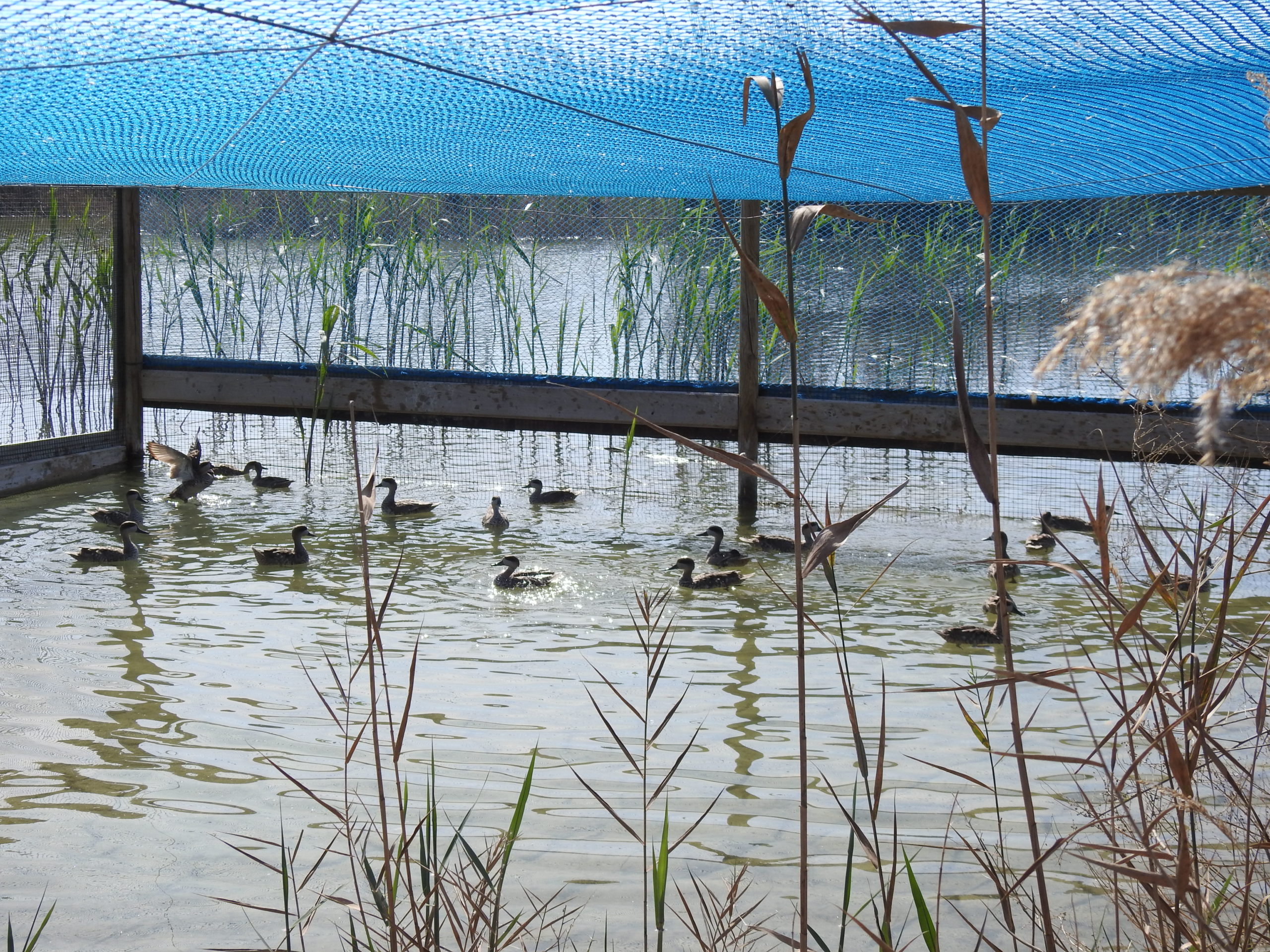


Within the framework of the LIFE Marbled Teal project, whose objective is to recover 3,000 hectares of wetlands to reverse the risk of extinction of this duck, which is in a critical situation in Spain.
Within the framework of the LIFE Marbled Teal project, which we coordinate, 740 specimens of Marbled Teal have been released. The animals, bred in captivity in the two reference recovery centers of the species in the Valencian Community and Andalusia, have been released in wetlands of these regions. The objective of this LIFE project is to recover 3,000 hectares of wetlands to reverse the risk of extinction of the teal, the most endangered duck in Europe, which in Spain is in a critical situation.
In Andalusia, 440 individuals born in captivity have been released at the Cañada de los Pájaros wildlife recovery centre, located next to the Doñana Natural Area. Of these specimens, a total of 360 have been reintroduced into the same Cañada de los Pájaros Concerted Nature Reserve, which is an important refuge, feeding and nesting area for waterfowl, among which the marbled teal stands out.
The rest of the releases in Andalusia have taken place in Punta Entinas-Sabinar, Fuente de Piedra, Laguna de Medina and the Marismas de Trebujena.
In the Valencian Community, the fauna recovery center “La Granja” of El Saler, located in Valencia and dependent on the Generalitat Valenciana, has released 300 individuals born in the spring of 2020 in this reference center in captive breeding of the marbled teal. The specimens have been released in the Natural Park of El Hondo and the Clot de Galvany Natural Park, in Elche; the Marjal de los Moros in Sagunto; as well as in the Alcázar San Juan Lagoon Complex Nature Reserve, in Ciudad Real.
In order to facilitate adaptation to their new habitat, a soft release has been carried out, which consists of placing pre-release cages in strategic places in the wetlands, where they remain in groups of 20 specimens for a week before release.
MONITORING OF RELEASED BIRDS AND CAPTIVE BREEDING PROGRAMME
For tracking in the environment, released specimens are marked with rings. Some of them also have GSM tracking transmitters, which emit a mobile phone signal and allow them to be located at all times.
The specimens released in spring in the Valencian Community usually make very short journeys, some of them could even reproduce in the same locations where they have been reintroduced. At the end of the summer they will begin to move, in some cases, to more distant places, such as Murcia and Andalusia, according to data collected in previous years. Some have even moved during the winter to humid areas of Algeria and Morocco.
Thirty of the 300 specimens bred in the recovery centre of El Saler have been transferred to Italy for release in the reservoir of south-eastern Sicily, within the framework of the collaboration of LIFE Marbled Teal with the LIFE project “Marbled duck, Pantani della Sicilia sud orientale” with the aim of strengthening Italian populations of marbled teal and promoting the exchange of results.
Captive breeding is an action recommended in the National Strategy for the Conservation of the species and an essential tool to strengthen the populations of endangered species. The LIFE Marbled Teal has launched a program with which it is expected to reach at least 1,000 specimens released, doubling the current data.
In Murcia, a population reinforcement program will also begin from the individuals bred in the fauna recovery center “La Granja”, in El Saler.
LIFE TEAL
Over the next five years, the LIFE Marbled Teal will undertake a set of actions to improve the state of wetlands in the Valencian Community such as the Albufera in Valencia and the El Hondo Natural Park in Alicante; the marshes of the Guadalquivir in Andalusia and in wetlands of Murcia, such as the Laguna de la Morera. All these wetlands belong to the Natura 2000 Network, the largest network of protected areas in the world, essential for the survival of the most endangered duck in Europe.
Among the actions planned in the project, work is being done on the acquisition of an area of 141 hectares through the purchase of three farms located in areas considered in the Teal Conservation Strategy as critical places, that is, vital areas for their survival and recovery.
The captive breeding and population reinforcement programme will be accompanied by actions that improve knowledge of the species through monitoring in the natural environment or genetic studies. The participation of relevant sectors for their conservation, such as irrigators or hunters, will also be promoted, as well as the awareness and environmental education of society.
In the LIFE Marbled Teal, which is coordinated by the Biodiversity Foundation of MITECO, the ministry itself participates as partners, through the Segura Hydrographic Confederation and Tragsatec; the Regional Government of Andalusia, through the Ministry of Agriculture, Livestock, Fisheries and Sustainable Development and the Environment and Water Agency; the Generalitat Valenciana; the Government of the Region of Murcia, as well as the SEO/BirdLife organizations and the Association of Naturalists of the Southeast. It is supported by the LIFE Program of the European Union and the Directorate General for Water.
