




World Migratory Bird Day 2021 is an important time to reflect on our own global relationship with biodiversity and highlight the importance of protecting birds and nature to prevent future zoonoses.
Today is World Migratory Bird Day, which takes place twice a year (on the second Saturday of May and October) to raise awareness of the role of migratory birds and the need for international cooperation to conserve them.
Under the slogan “Sing, fly and soar like the birds!” This year focuses on the phenomena of “birdsong” and “bird’s flight” as a way to inspire and connect people of all ages around the world, in a common and global effort to protect birds and the habitats they need to survive.
World Migratory Bird Day 2021 is also an important time to reflect on our own global relationship with biodiversity and highlight the importance of protecting birds and nature to prevent future zoonoses.
At the Biodiversity Foundation we work on the conservation of different species of migratory birds. Currently, through different projects of calls for grants and subsidies, we support 14 initiatives related to this issue, and, since our inception, we have allocated more than 3 million euros to more than 40 projects that have favored its protection and knowledge.
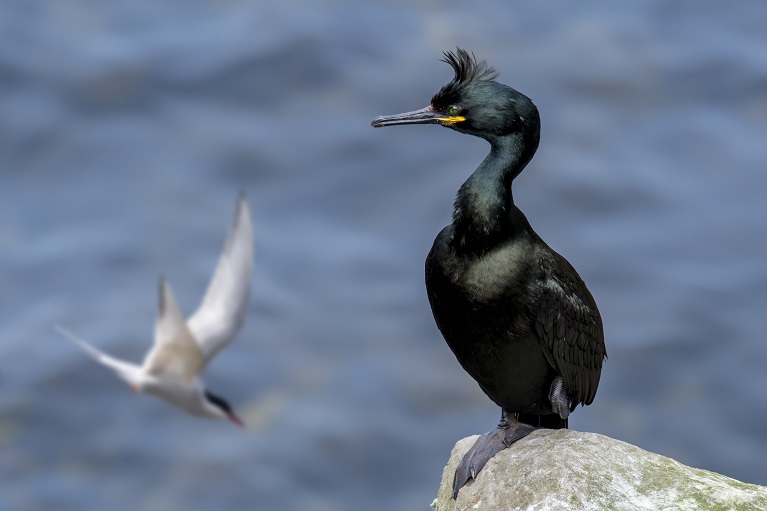
The ENCORAT project, beneficiary of the Pleamar Program call, develops actions to reduce the accidental mortality of the shag ( Phalacrocorax aristotelis) in gillnet fishing gear in the North Atlantic marine demarcation. To this end, the interaction with fisheries is being studied and a method of catch reduction is being experimented with by placing LED lights on the gear, so that it is more easily detectable by birds in the water. The use of space by juvenile cormorants, the sector of the population most affected by these gears, is also being analysed to see the degree of overlap between their feeding areas and those of greater fishing pressure in three areas of Galicia and Asturias, previously identified as being at maximum risk for the species.
On the other hand, the GIC Association has our support for the reinforcement of populations, ecology and biology of the three species of storm petrel nesting in the Canary Islands: the petrel (Pelagodroma marina), the European storm petrel (Hydrobates pelagicus) and the Madeira storm petrel (Oceanodroma castro). The project is applying the tagging of specimens with GPS devices, with the aim of defining the areas in the sea important for these species and their inclusion in the Natura 2000 Network as SPAs. On the other hand, actions are being carried out in the breeding colonies focused on improving both the situation of the three species and to obtain data for their inclusion in monitoring programs. In this sense, nest boxes will be placed and natural nests will be located that allow their monitoring. In addition, camera traps will be installed to detect interactions with other species that compete for cavities or prey on storm petrels.
Finally, the ZEPAPESCA project carries out a historical analysis focused on the management of Mediterranean SPAs in the Levantine-Balearic demarcation. The work focuses on the 8 species of seabirds that use these SPAs as feeding areas during the breeding period and breed in Spain: Balearic shearwater, Audouin’s gull, European storm petrel, Cory’s shearwater, yellow-legged gull, and sandwich, common and tern terns.
