


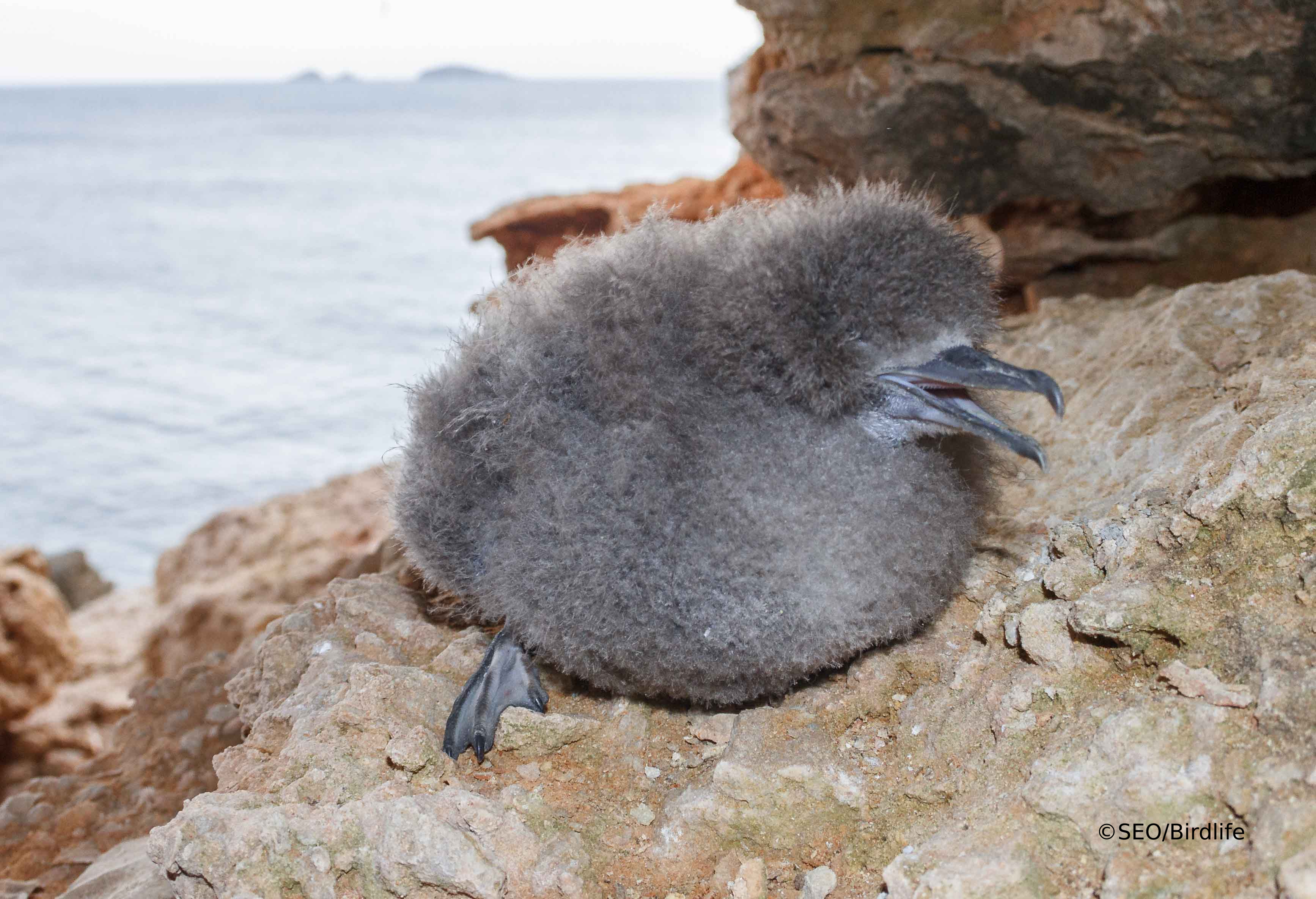


The reproduction period of the Balearic shearwater, the most endangered seabird in Europe, begins and, from the LIFE INTEMARES project, we are starting a campaign to mark specimens that will increase their knowledge through the study of their movements and behaviour. This information will serve to guide the declaration of Special Protection Areas for Birds (SPAs) in the Natura 2000 Network.
SEO/Birdlife, in coordination with the Ministry for the Ecological Transition and the Demographic Challenge and the Biodiversity Foundation, has begun work on marking specimens both in breeding colonies in the Balearic Islands and in Barcelona waters, as well as monitoring work on colonies of this species in the Balearic Islands.
Colonies and feeding areas
These tagging campaigns consist of placing GPS devices in different colonies of the Balearic archipelago, on the islands of Ibiza, Mallorca and Menorca, to know the movements of the breeding individuals and assess how the colonies are related to the feeding areas in the sea.
In general, shearwaters tend to move from their colonies in the Balearic Islands, where they find quiet cliffs and islets on which to breed, to the coasts of the Iberian Mediterranean to feed, as these are more productive areas. However, it is necessary to strengthen research to improve the definition of the areas they use during this time in order to delimit the spaces that best contribute to their protection.
In addition, within the framework of the Pufmed project, which has the support of the Biodiversity Foundation, SEO/BirdLife will also mark shearwaters caught at sea on the central Catalan coast, thanks to the use of new GPS devices that allow the remote download of the data, through mobile phones, without the need to recapture the birds.
Endemic to the Balearic Islands
The Balearic shearwater only breeds in the Balearic Islands, so it is usually considered “endemic” to this archipelago. Itnests in coastal cliffs or areas of debris and small islets, inside caves or in small shoals, which it visits at night.
During its feeding trips, during the breeding season, it can travel several hundred kilometres away, reaching the coasts of the Iberian Mediterranean and North Africa. Once the breeding season is over, in June-July, it crosses the Strait of Gibraltar and is distributed along the Atlantic coasts between northern Morocco and southwestern Great Britain, an aspect that is also being studied within the framework of LIFE INTEMARES, in coordination with AZTI.
Critically endangered
The Balearic shearwater is listed by the IUCN as critically endangered. It is estimated that there are only about 3,000 breeding pairs left, and demographic analyses show a 14% annual decline in their population. If current threats continue, this unique species in the world would disappear in just over half a century.
As it has a high life expectancy in natural conditions, its reproduction rate is low, so the Balearic shearwater is particularly sensitive to threats that cause mortality of adult specimens, among which are mainly bycatch by fishing gear and predation by carnivores introduced into its colonies. mainly cats. Added to this are marine pollution, coastal urbanisation and light pollution, which disorients young when they leave the nest, and new potential threats, such as infrastructure at sea and climate change.
Effective management of protected areas
The LIFE INTEMARES project advances towards the objective of achieving an effective management of the marine areas of the Natura 2000 Network, with the active participation of the sectors involved and with research as basic tools.
The Biodiversity Foundation of the Ministry for Ecological Transition and the Demographic Challenge coordinates the project. The ministry itself, through the Directorate-General for Biodiversity, Forests and Desertification; the Regional Government of Andalusia, through the Ministry of Agriculture, Livestock, Fisheries and Sustainable Development, as well as the Environment and Water Agency; the Spanish Institute of Oceanography; AZTI; the University of Alicante; the Polytechnic University of Valencia; the Spanish Fisheries Confederation, SEO/BirdLife and WWF-Spain. It is supported by the LIFE Program of the European Union.
