


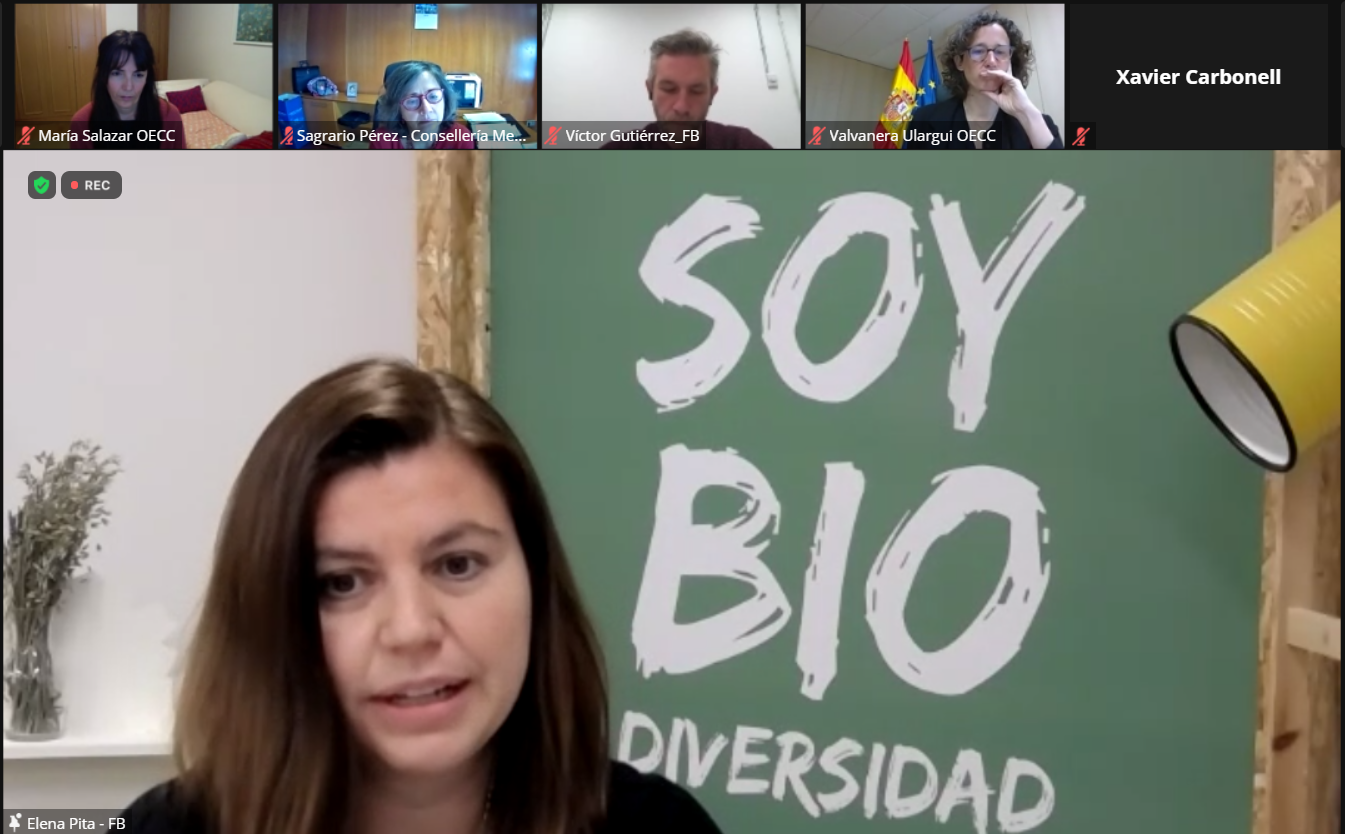


Galicia has been the setting chosen for the first telematic conference on tools for adaptation to climate change with a regional focus organized by the Biodiversity Foundation and the Spanish Office for Climate Change of the Ministry for the Ecological Transition and the Demographic Challenge, together with the Center for University Extension and Environmental Dissemination of Galicia (CEIDA) and the Provincial Council of A Coruña within the framework of the LIFE SHARA project.
The director of the OECC stressed that “adaptation is less known than mitigation, but more important in terms of generating knowledge” and that “we need a set of policies and measures that are easy to apply and that we can generate collectively“. The director of the Biodiversity Foundation remarked that “climate change is one of the most important drivers of biodiversity loss, but it is also relevant to enhance the role of nature as a line for adaptation, the benefits of which are increasingly better known”. The representative of the Xunta has drawn attention to the responsibility and capacity of human beings to reverse climate change, focusing on the fact that “adaptation has to have an eminently local dimension to achieve the desired effects“.
This conference (which has had 80 participants from the public administration, the third sector, companies, research on climate change and citizens) is the first of several that will be held over the course of the coming months within the framework of LIFE SHARA to promote tools for adaptation to climate change with a regional perspective and that will end with a conference at the national level.
During the presentation, the international context, responses to climate change, impacts, risks and adaptation measures, and the National Plan for Adaptation to Climate Change 2021-2030 were presented. Different tools of the AdapteCCa Platform have also been presented, such as the climate change scenario viewer, which highlights its applicability to adaptation plans at different levels, since it allows different projections and scenarios on the impacts of climate change on aspects such as temperature variability or the amount of rainfall, that can be included in these resilience strategies.
All these tools make it possible to create an inspiring climate for the development and creation of new preventive or corrective activities against the effects of climate change and are complemented by the presentation of three initiatives developed in Galicia.
THREE ADAPTATION INITIATIVES IN GALICIA
Sagrario Pérez has told how Galicia is facing the effects of climate change, highlighting the Climate Change and Energy Strategy 2050, whose objective is to achieve a low-carbon society with a resilient territory and aligned with the European Union’s climate neutrality objective by 2050.
For his part, Miguel Pardellas, researcher in Social Pedagogy and Environmental Education, presented the initiative “Decarbonize! Que non é pouco”, which addresses adaptation to climate change through collective memory to involve the population on climate effects. This project, supported by the Biodiversity Foundation, is characterized by adapting methodologies and materials for communication and environmental education to different audiences and by the articulation of joint intergenerational activities to seek a greater impact at the local level.
Finally, Carlos Vales, director of CEIDA, presented the centre’s initiatives to promote adaptation to climate change through training and dissemination actions aimed at different audiences in areas such as carbon sequestration in soil and biomass, waste management, efficient driving, energy efficiency at the local level or good environmental practices in the hospitality industry. among others.
ABOUT LIFE SHARA
LIFE SHARA “Awareness and knowledge for adaptation to climate change” is a project of the Ministry for the Ecological Transition and the Demographic Challenge, through the Biodiversity Foundation, the Spanish Office for Climate Change, the Autonomous Agency for National Parks and the State Meteorological Agency, and of which the Portuguese Environment Agency is also a member. The project is co-funded by the European Commission through the LIFE programme.
The LIFE SHARA project contributes to the development of this framework through communication and awareness of adaptation to climate change through platforms such as AdapteCCa, which has, among other tools, a module of practical cases, an image bank with more than 440 photographs or a viewer of climate change scenarios which, incorporated into management processes, can be very useful in addressing adaptation to climate change in Spain.
Do you want to know more about the LIFE SHARA project? Here you have all the information.
