


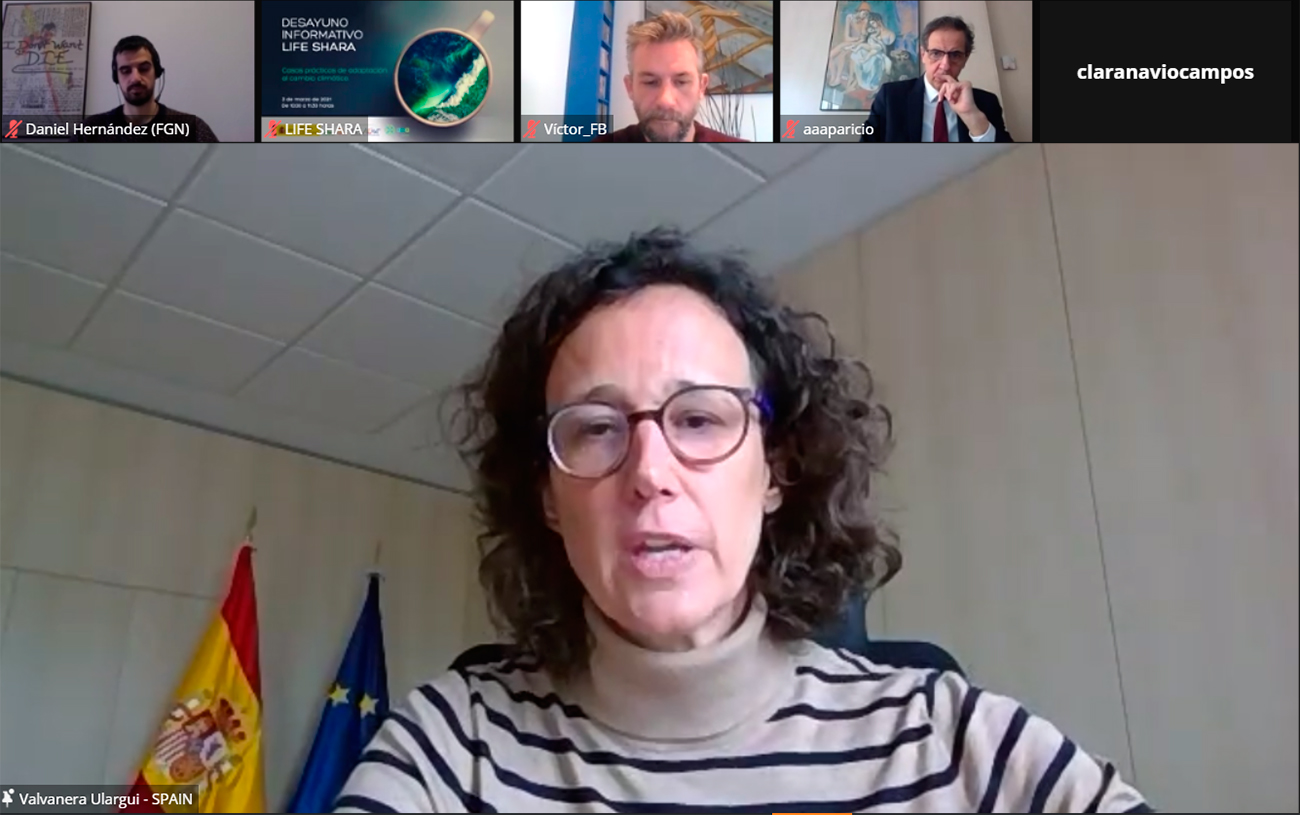


The director of the Spanish Office for Climate Change (OECC), Valvanera Ulargui, presented this morning the novelties developed within the framework of the LIFE SHARA project for the dissemination of inspiring practical cases of adaptation to climate change in Spain, at the fifth informative breakfast of the project. Valvanera Ulargui stressed that, at this time, “we are very aware that without well-planned adaptation it will not be possible to live with the risks and impacts associated with climate change, and develop resilience to be less vulnerable”.
The director of the Spanish Office for Climate Change (OECC), Valvanera Ulargui, presented this morning the novelties developed within the framework of the LIFE SHARA project for the dissemination of inspiring practical cases of adaptation to climate change in Spain, at the fifth informative breakfast of the project. Valvanera Ulargui stressed that, at this time, “we are very aware that without well-planned adaptation it will not be possible to live with the risks and impacts associated with climate change, and develop resilience to be less vulnerable”.
The director of the OECC insisted that “Spain is in the hotspot of climate change, where the impacts and risks to come are going to be significant. This has to lead us to channel more action in a more systematic and escalated way.” For Ulargui, it is necessary to “encourage all programs and actions to incorporate the variable of climate change and to bet on actions with fewer emissions and that best adapt to this phenomenon.”
In addition, he stressed “the importance of the second National Plan for Adaptation to Climate Change, that puts on the table social measures that reach the population, which will have to think about which ones to assume.” On the other hand, he stressed that “the importance of generating knowledge and disseminating it is a fundamental part of our priorities, and that is why we have worked on this module of practical cases of AdapteCCa“.
Thus, the AdapteCCa platform on Adaptation to Climate Change in Spain launches a new module of case studies that compiles more than 40 adaptation experiences promoted by different Public Administrations, private sector entities, organizations and other Spanish entities to address the risks associated with climate change in different geographical areas, socioeconomic sectors and natural systems.
The AdapteCCa practical cases module currently includes 40 examples, “although it is a living model that will incorporate more cases”, Ulargui stressed. Thus, the module includes initiatives in the different areas of the National Plan for Adaptation to Climate Change such as biodiversity, water resources, the agricultural sector, human health and insurance activity, among others. “These are cases that show how adaptation makes economic and environmental sense. The data that show that investment in adaptation avoids future costs is clear, since the profitability of adaptation measures, especially in the water sector in Spain, is enormous,” concluded the director of the OECC.
As for the adaptation measures contemplated, physical measures, including nature-based solutions, can be consulted in AdapteCCa; social measures, which include educational, information and behavioural actions, and institutional measures. In geographical terms, the initiatives range from local to international cases, and address the multiple impacts derived from climate change in Spain, including drought, extreme temperatures, effects on human health, floods, desertification or rising sea levels.
On the other hand have joined the AdapteCC image bankA selection of photographs illustrating the case studies. It is almost 400 images on impacts, vulnerability and adaptation to climate change in our country, which can be downloaded free of charge in order to provide communicators, journalists, communicators and anyone interested, specific resources for the graphic representation of adaptation to climate change.
The AdapteCCa case study module incorporates innovative functionality, as it is connected to the case module of the European Climate Adapt platform, which allows you to consult adaptation experiences from all over Europe that can serve as a reference for the development of measures at the national level.
In addition, an informative publication has been prepared with a compilation of 15 case studies representative of different socio-economic sectors and natural systems, selected from the set of all the cases developed for AdapteCCa, to facilitate the dissemination of adaptation initiatives.
THREE PRACTICAL ADAPTATION INITIATIVES PRESENTED
In the presentation of the new module of practical cases of adaptation to climate change, three specific cases have been described, which have been presented by their protagonists.
Juan Luis Beresaluze, head of the Environment and Green Areas Service of the Alicante City Council, shared the experience of the La Marjal Flood Park, a unique green infrastructure in Spain that prevents flooding while acting as a green recreational area.
The project coordinator at the Global Nature Foundation, Daniel Hernández Torres, has presented the LIFE Agriadapt project for the sustainable adaptation of European agricultural systems to climate change. The project is being developed in several countries. In Spain, it was set up on a rainfed farm in Melque de Cercos, Segovia, a land that has cereal crops, legumes, fallow areas and sheep.
Finally, Alex Richter-Boix, researcher and communication technician at the Center for Ecological Research and Forestry Applications (CREAF), presented Mosquito Alert, a citizen science project to evaluate and control the presence of mosquito species that carry viruses that cause global diseases such as Zika, dengue and chikungunya.
Three very different initiatives that represent the variety of challenges that Spain faces as a result of climate change and that, at the same time, are an example of the different types of measures that can be developed to avoid or reduce present and future damage derived from climate change and build a more resilient economy and society.
One of the objectives of the LIFE SHARA project is to train and raise awareness on adaptation to climate change, as well as to contribute to improving communication on this subject. Along these lines, the project’s informative breakfasts are training spaces aimed at disseminators and communicators in which the most current knowledge on impacts, vulnerability and adaptation to climate change is presented, to contribute to a better communication of the influence of climate change on issues of social and environmental interest.
Do you want to know more about the LIFE SHARA project? Here You have all the information.
