


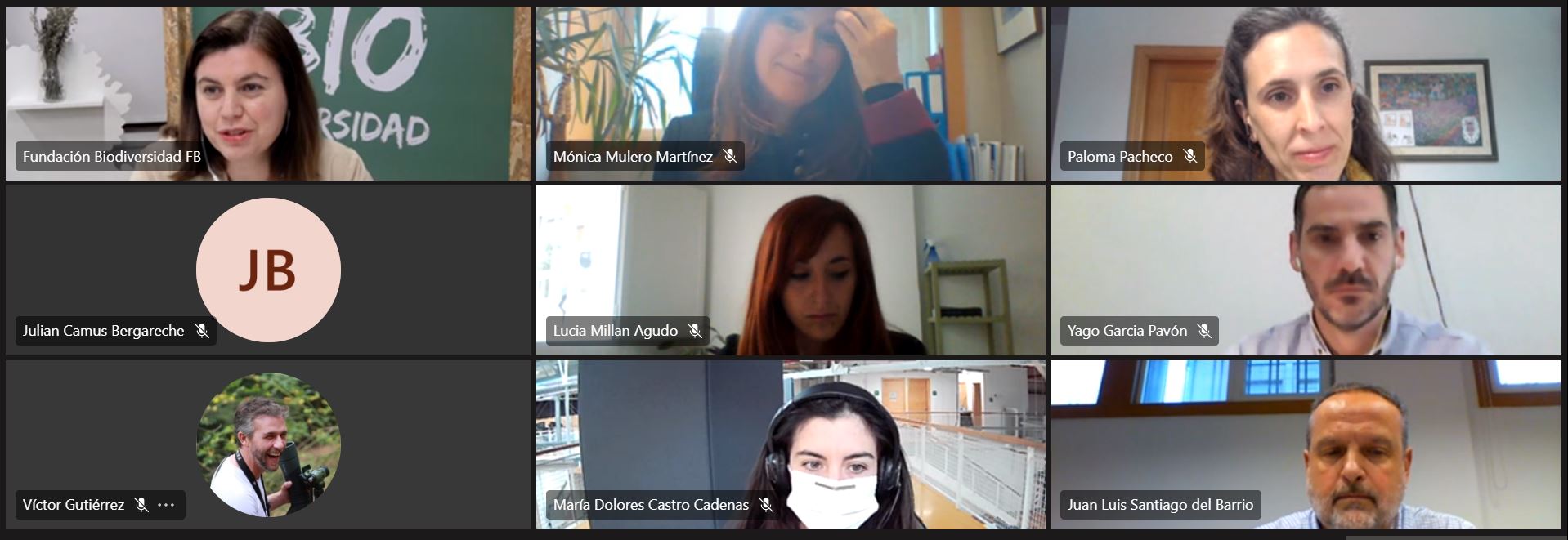


We have started a training course on the protection and conservation of the marine environment aimed at technical staff of the Maritime Rescue and Safety Society (SASEMAR). This initiative is part of the training programme for public administrations that we have launched in the LIFE INTEMARES project, coordinated by the Biodiversity Foundation of the Ministry for the Ecological Transition and the Demographic Challenge.
We have started a training course on the protection and conservation of the marine environment aimed at technical staff of the Maritime Rescue and Safety Society (SASEMAR). This initiative is part of the training programme for public administrations that we have launched in the LIFE INTEMARES project, coordinated by the Biodiversity Foundation of the Ministry for the Ecological Transition and the Demographic Challenge.
In the welcome session, the director of the Foundation, Elena Pita, highlighted the important work of Maritime Rescue in the protection of the sea and thanked the recognition and support of the LIFE INTEMARES project, awarded with the SASEMAR award for its contribution to SDG 14. He also stressed the need to “promote training actions and professional skills” to move towards the effective management of marine protected areas and generate employment. Along these lines, the Biodiversity Foundation’s calls contribute to reinforcing this objective through the Empleaverde and Pleamar programme.
For his part, the Deputy Director General of Terrestrial and Marine Biodiversity of the Ministry for the Ecological Transition and the Demographic Challenge, Miguel Aymerich, highlighted the importance of collaboration with the different operations and bodies that work at sea, such as Maritime Rescue, with the aim of moving towards the goal of achieving 30% of the marine area protected by 2030 and properly managed.
Julián Camus, director of the Jovellanos Comprehensive Maritime Safety Centre (CESEMI), and Juan Luis Santiago del Barrio, Head of Training at Maritime Rescue, also took part, highlighting this pioneering training on campus, the first of others that will be organised along these lines.
The course that begins today aims to provide participants with information and tools that contribute to updating and expanding their knowledge on the protection of the marine environment and its biodiversity in Spain, within the framework of the European Union, and on the effective management of the areas of the Natura 2000 Network.
The course is made up of sessions dedicated to explaining the importance of Spanish marine biodiversity, its protection figures and its current legislation framework. It also addresses the main habitats and marine species present in Spain, their threats and their monitoring within the framework of the European Birds and Habitats Directives, as well as in that of the Marine Strategies. The training also has an impact on the role of the marine Natura 2000 Network and on the management plans of protected areas and their development through participatory processes.
These training sessions, in online format, will also be held on 9 and 11 March.
THE IMPORTANCE OF TRAINING
The course is part of the actions defined in the training strategy of the LIFE INTEMARES project, which lays the foundations for training and training the main users and managers of the marine Natura 2000 Network. Its preparation has had the involvement of 290 people through a participatory process.
In its implementation, 19 training sessions have already been given to public administrations on the management of the Natura 2000 Network and marine biodiversity. In total, more than 2,100 professionals have been trained.
Training is also one of the lines of action of the Biodiversity Foundation, through the Empleaverde Programme, which has launched two calls for subsidies endowed with 10.7 million euros to contribute to a green recovery, and aimed at the unemployed and the training of professionals related to the green and blue economy. with the aim of improving their employability and qualification, as well as two lines of financing aimed at projects to promote entrepreneurship.
EFFECTIVE MANAGEMENT OF PROTECTED AREAS
The LIFE INTEMARES project is moving towards the objective of achieving effective management of the marine areas of the Natura 2000 Network, with the active participation of the sectors involved and with research as the basic tools.
The Biodiversity Foundation of the Ministry for Ecological Transition and the Demographic Challenge coordinates the project. The ministry itself, through the Directorate-General for Biodiversity, Forests and Desertification; the Regional Government of Andalusia, through the Ministry of Agriculture, Livestock, Fisheries and Sustainable Development, as well as the Environment and Water Agency; the Spanish Institute of Oceanography; AZTI; the University of Alicante; the Polytechnic University of Valencia; the Spanish Fisheries Confederation, SEO/BirdLife and WWF-Spain. It is supported by the LIFE Program of the European Union.
