


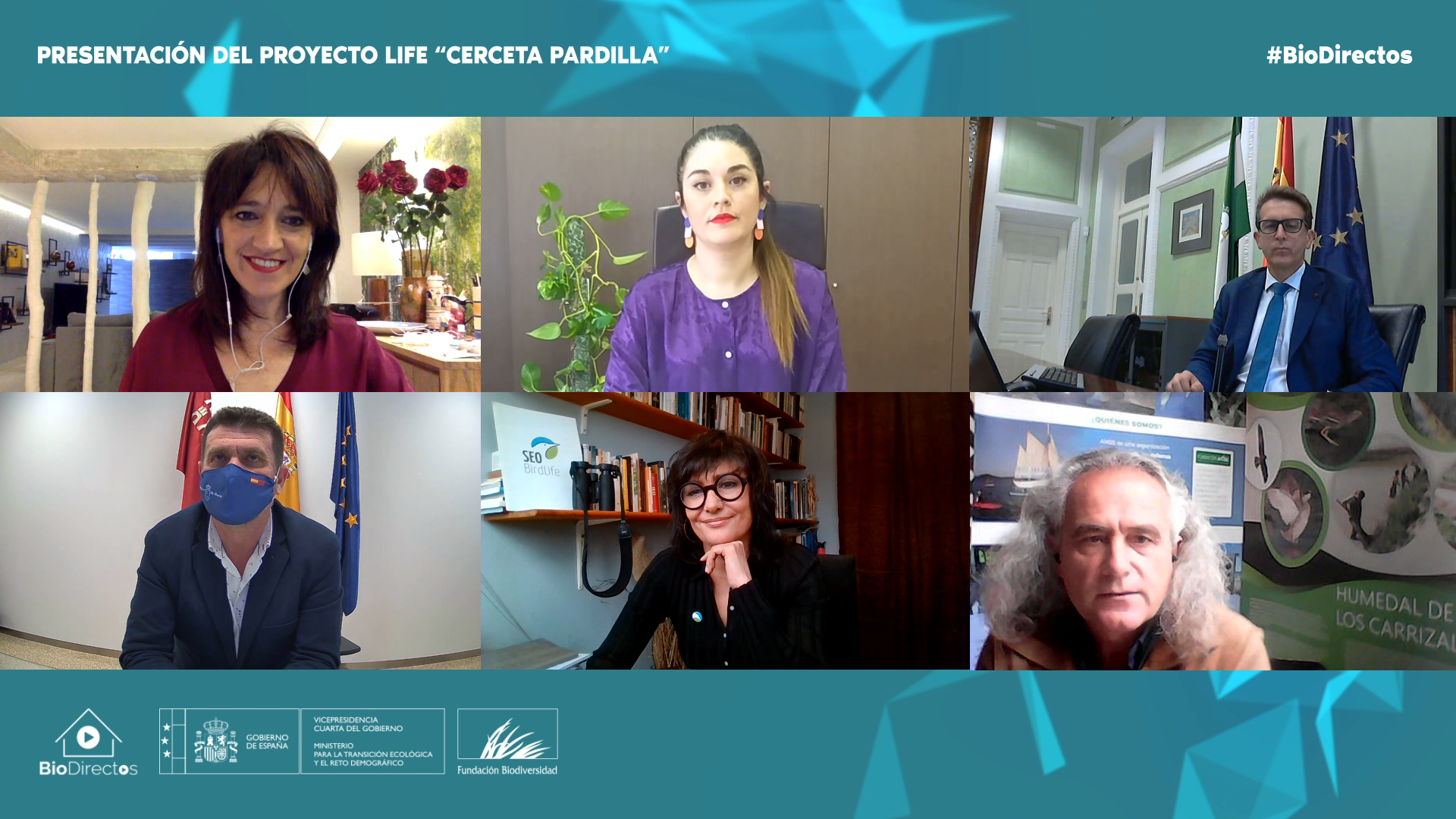


The LIFE Marbled Teal project begins, coordinated by the Biodiversity Foundation of the Ministry for Ecological Transition and the Demographic Challenge, with the aim of recovering 3,000 hectares of wetlands to reverse the risk of extinction of the most endangered duck in Europe.
The Secretary of State for the Environment, Hugo Morán, participated today in the presentation of the LIFE Marbled Teal project. This initiative aims to recover 3,000 hectares of wetlands to reverse the risk of extinction of the most endangered duck in Europe, which is in a critical situation in Spain.
Morán stressed the importance of implementing urgent and coordinated measures to restore essential ecosystems in Spain such as wetlands. He did so during the celebration of a new #Biodirectos, a series of online meetings organised by the Biodiversity Foundation of the Ministry for Ecological Transition and the Demographic Challenge (MITECO).
This meeting was also attended by all partners of the LIFE Marbled Teal project. Thus, the Minister of Agriculture, Rural Development, Climate Emergency and Ecological Transition of the Generalitat Valenciana, Mireia Mollà; the Secretary General of the Environment, Water and Climate Change of the Junta de Andalucía, Francisco Gutiérrez; the general director of the Natural Environment of the Region of Murcia, Fulgencio Perona; the executive director of SEO/BirdLife, Asunción Ruiz and the director of ANSE, Pedro García.
The Secretary of State for the Environment has insisted on the importance of “coordination between the General State Administration, the Autonomous Communities, the scientific community, conservationist entities and socio-economic sectors to implement actions such as those planned in this LIFE project”.
A critically endangered species
The marbled teal is one of the seven species in critical condition in Spain. Until the mid-twentieth century, it was abundant in Mediterranean coastal wetlands, especially in Doñana, but its drastic decline in recent decades places it at imminent risk of extinction. In recent years, the Government has focused its efforts on its recovery.
The number of breeding pairs in Spain, which is almost its only place of distribution in Europe, stood at 45 pairs last year and with a clear trend in regression. Habitat loss and degradation is its greatest threat and endangers the survival of the species. Wetlands are impacted by drought, pollution, the proliferation of artificial barriers and other threats caused by human activities.
Over the next five years, LIFE Marbled Teal will undertake a set of actions to improve the state of wetlands throughout the territory. It will thus act in spaces belonging to the Valencian Community, such as the Albufera in Valencia and the El Hondo Natural Park in Alicante; the marshes of the Guadalquivir in Andalusia, and also in humid areas of Murcia, such as the Laguna de la Morera. All of them are wetlands that belong to the Natura 2000 Network, the largest network of protected areas in the world, and are fundamental ecosystems for the survival of the most endangered duck in Europe.
Among the actions planned in the project, the acquisition of an area of 141 hectares is planned through the purchase of three farms located in areas considered in the Teal Conservation Strategy as critical places, that is, areas vital for their survival and recovery.
Monitoring actions for the species are also planned and Maghreb countries will be involved to improve knowledge about its movements and threats. At the same time, the populations of the species will be reinforced through a captive breeding program and the release of specimens.
The project has two reference centres that successfully breed marbled teals: the Cañada de los Pájaros, in Andalusia, and the El Saler Wildlife Recovery Centre, in the Valencian Community. The breeding programme will be based on the good practices developed in both centres and others that may collaborate in the project.
It will be accompanied by actions that improve knowledge of the species through monitoring in the natural environment or genetic studies. The participation of relevant sectors for their conservation, such as irrigators or hunters, will also be promoted, as well as the awareness and environmental education of society.
In the LIFE Marbled Teal, which is coordinated by the Biodiversity Foundation of MITECO, the ministry itself participates as partners, through the Segura Hydrographic Confederation and Tragsatec; the Regional Government of Andalusia, through the Ministry of Agriculture, Livestock, Fisheries and Sustainable Development and the Environment and Water Agency; the Generalitat Valenciana; the Government of the Region of Murcia, as well as the organizations SEO/BirdLife and ANSE. It is supported by the LIFE Program of the European Union and the Directorate General for Water.
