


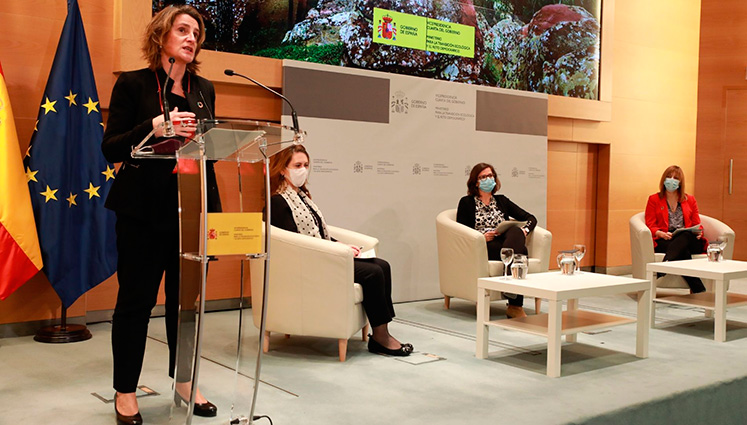


The Vice-President and Minister for the Ecological Transition and the Demographic Challenge, Teresa Ribera, presented this morning the Environmental Profile of Spain (PAE) 2019, which reflects an increase in Spain’s protected area and a decrease in its greenhouse gas (GHG) emissions.
The Vice-President and Minister for the Ecological Transition and the Demographic Challenge, Teresa Ribera, presented this morning the Environmental Profile of Spain (PAE) 2019 which, among other advances, reflects an increase in Spain’s protected area and a decrease in its greenhouse gas (GHG) emissions.
“It is a very valuable document, because it allows us to make solid decisions based on knowledge and the ability to project, and identify the points in which we must make more effort,” said Teresa Ribera. “A well-informed society is the best tool to build resilience,” said Ribera, who also explained that the Ministry “is working to incorporate other indicators that allow us to have a more complete picture of the variables that relate health and the environment.”
The study of the Environmental Profile is carried out annually, in compliance with the obligation established in the Aarhus Convention, with the aim of bringing environmental knowledge closer to citizens and encouraging their participation. In its 16th edition, with a global focus, the text consists of a first section dedicated to the relationship between environment and health and a second chapter organized around four areas of knowledge (air, climate, economic sectors and sustainability) in which 14 environmental and sectoral topics are grouped, and in which the content of environmental information is structured through 71 indicators.
In addition, it includes a specific section on the autonomous communities with disaggregated information on socio-economic aspects, protected land area, land use, air quality, electricity from renewable sources and circular economy, and incorporates, as a novelty, indicators to improve knowledge about the demographic challenge.
The preparation of the PAE has specialized technical support and contributions from various ministries, institutes, agencies, organizations
freelancers, NGOs and other reference agents on environmental information, as well as with statistical sources of international reference.
GHG reduction
The Greenhouse Gas (GHG) Emissions Advance reflects gross emissions of 313.5 million tonnes of CO2 equivalent in 2019, which
which represents a decrease of 6.2% compared to the previous year and 29.3% compared to 2005. However, in 2018 Spain contributed 7.9% of the total GHG emissions of the Member States of the European Union, making it the 6th emitting country although, per capita, it is in 18th position, below the European average.
Emissions from industry (2.9%), agriculture (1.4%), residential, commercial and institutional (3%) and the use of F-gases (5.2%) decreased in 2018, while those from the waste sector (0.7%) and transport (0.7%) increased slightly.
More land area protected
With regard to the protected land area, in 2019 it reached 33.6% of the Spanish territory, which represents an increase of 2.5% compared to the previous year, while the marine area rose to 12.2% after the expansion of the Cabrera Archipelago National Park, which represented an increase of 2% compared to 2018.
There was also an increase in 2019 in the area incorporated into Biosphere Reserves, which reaches more than 12.4% of Spain’s total: of the 18 reserves in 12 countries added in June by UNESCO, three of them belong to Spain (Alto Turia, La Siberia and Valle del Cabriel) and another three have increased their extension and changed their name.
The Environmental Profile collects data on the forest situation, soil erosion and marine waste and litter in our country, as well as mobility and the demographic challenge.
The PAE is available in Spanish and English, on the website of the Ministry for the Ecological Transition and the Demographic Challenge. It will also be accessible through an application available for smartphones and tablets, adapted to Android and iOS systems.
