


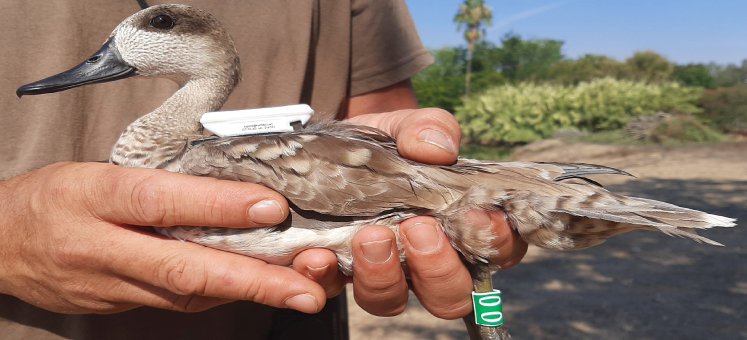


Three specimens of marbled teal have crossed from Andalusia to North Africa, specifically to Morocco and Algeria, in the middle of spring, an unusual movement for this species that usually moves south in winter.
These are the specimens baptized as Patricia, Ernesto and Maribel. The three have departed from locations near the city of Seville and, specifically, Patricia is in the vicinity of Marrakech; Ernesto moves through eastern Morocco, about 60 kilometers south of the city of Nador; and Maribel has arrived in northern Algeria, at the Sebkha wetland in Oran, south of that city.
Thanks to the data obtained from the satellite transmitters, placed within the framework of the LIFE Marbled Teal project, coordinated by the Biodiversity Foundation of the Ministry for Ecological Transition and the Demographic Challenge, it has been possible to have evidence of this unusual displacement, knowing more details, such as that the journey has been made quickly and almost non-stop and that the three departures took place at night.
Labeling with emitters is one of the actions carried out within the framework of this project and that allows us to improve knowledge of the species. The information generated makes it possible to identify the main causes of mortality, to achieve a higher level of knowledge about movements between resting and feeding areas, habitat selection exercised in different periods, as well as movements to areas of North Africa, especially Algeria and Morocco.
THE TRIP TO AFRICA
The marbled teal is a partially migratory species, with a general tendency to move to North Africa at the end of November and return again to Spain between March and April to reproduce. However, it makes opportunistic nomadic movements in search of suitable habitats for reproduction and feeding at any time of the year, thanks to its adaptation to the high fluctuations in habitat availability in Mediterranean natural wetlands.
Since 2019, 54 specimens have been tagged in Andalusia, 17 wild and 29 from captive breeding, 16 of the total within the framework of this project. Of these, four specimens have crossed to Africa, all wild. Specifically, last year a female was crossed, to which are added the three specimens of this year. Currently, data has been received on the locations of 17 specimens, seven of them wild, including Patricia, Ernesto and Maribel.
RESEARCH, CONSERVATION AND GOVERNANCE
The LIFE Marbled Teal aims to improve the conservation status of 3,000 hectares of wetlands to reverse the risk of extinction of the most endangered duck in Europe, in a critical situation in Spain. For this reason, it has undertaken a series of actions to strengthen the status of its populations in the natural environment, improve the state of wetlands and scientific knowledge of the species.
The project, which is coordinated by the Biodiversity Foundation of the Ministry for the Ecological Transition and the Demographic Challenge, involves the ministry itself, through the Segura Hydrographic Confederation and Tragsatec; the Regional Government of Andalusia, through the Ministry of Agriculture, Livestock, Fisheries and Sustainable Development and the Environment and Water Agency; the Generalitat Valenciana; the Government of the Region of Murcia, as well as the organizations SEO/BirdLife and ANSE. It is supported by the LIFE Program of the European Union and the Directorate General for Water.
