

On 9 May each year we celebrate Europe Day, which highlights the unity of the European continent and its achievements in relation to the objective of maintaining peace between its Member States. The date chosen commemorates the anniversary of the Schuman Declaration (1950), which proposed the first major political cooperation agreement between European nations called the European Coal and Steel Community (ECSC), which would end up being the origin of the current European Union.
The Biodiversity Foundation of the Ministry for the Ecological Transition and the Demographic Challenge, in its mission to preserve biodiversity, ecosystems and promote a change in the economic, social and cultural model, is working on different projects supported by EU funds.
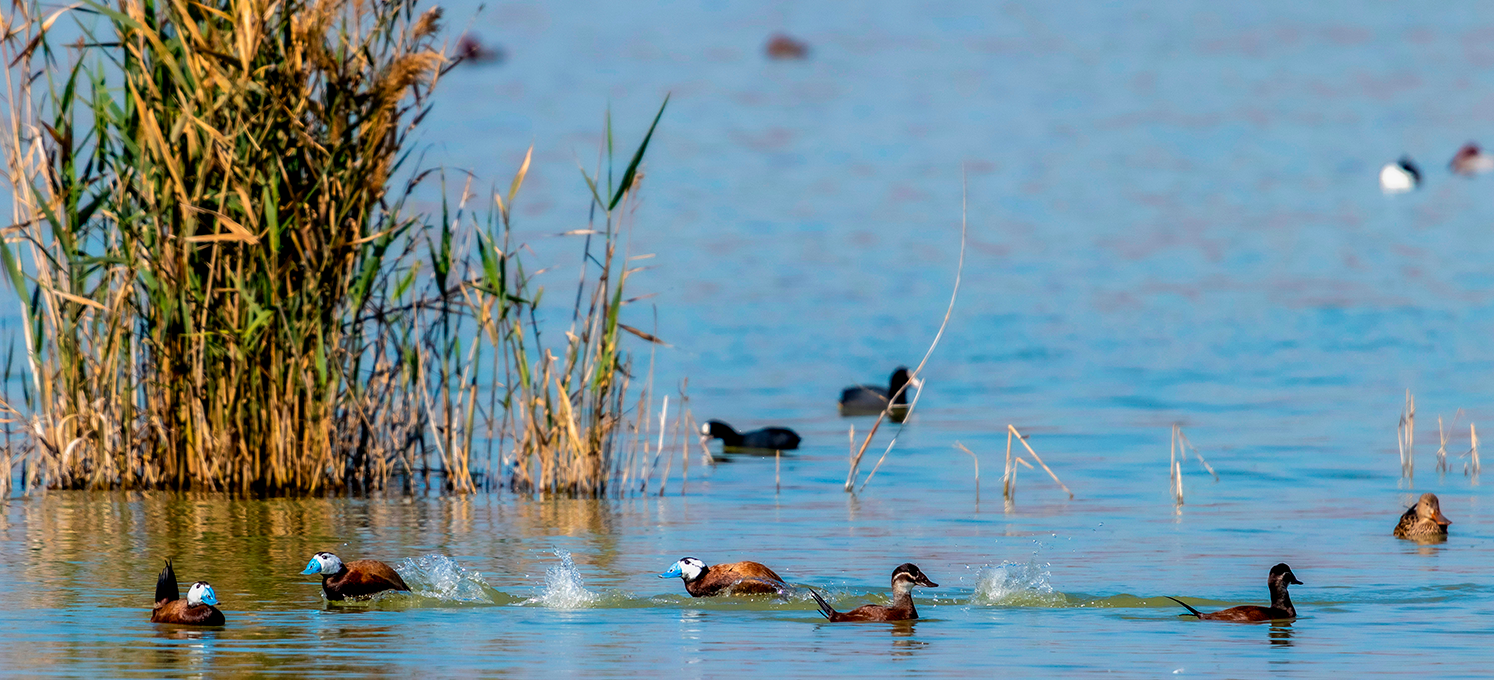
In this way, the Biodiversity Foundation works on various projects that are part of the LIFE Programme, a European Union funding instrument dedicated exclusively to the environment and climate action. Thus, we coordinate the LIFE INTEMARES project that seeks to form a network of Natura 2000 marine areas managed effectively, basing its decision-making on the active participation of the sectors involved and on research and improvement of knowledge. Along the same lines, we coordinate the project LIFE Marbled Teal, which aims to improve the conservation status of more than 3,000 hectares of wetlands to reverse the risk of extinction of the most endangered duck in Europe and achieve at least a total of 125 breeding pairs in our country. On the other hand, we have coordinated the LIFE SHARA, which has made it possible to improve information, awareness and governance in the field of adaptation to climate change in Spain and Portugal and which continues with the After LIFE programme, which will mark the development of the project’s activities.
In addition, the Biodiversity Foundation is a partner in other initiatives framed in the LIFE Programme, such as the LIFE ECOREST project, whose purpose is to restore 29,022 hectares of deep marine habitats in an area of action of great ecological value located along the coast of Girona and Barcelona; or the LIFE A-MAR Know and love the Natura 2000 marine sites to protect them project to improve awareness and knowledge of the Natura 2000 marine network in Italy and Spain. We also participate as partners in the LIFE Bears with a Future project, which aims to facilitate the adaptation of the Cantabrian bear to climate change in the Cantabrian Mountains, allowing the achievement of a favourable conservation status of the species in the medium and long term.
The Biodiversity Foundation also participates as a partner in other initiatives focused on the conservation and restoration of marine ecosystems such as the CetAMBICion project, which has the main objective of reducing cetacean by-catch in European Union fisheries, in particular, in the Bay of Biscay and on the Iberian coast; the MSP-OR project, aimed at supporting the implementation of the Maritime Spatial Planning Directive in its overseas territories; and the MISTIC SEAS 3 project, which has addressed the assessment of the environmental status of the marine environment in the Macaronesia subregion, focusing on the status of populations of mammal, turtle and seabird species common among the archipelagos in this area.
In the same way, the Biodiversity Foundation develops a series of its own initiatives that are supported by European funds. One of them is the Empleaverde Programme, co-financed by the European Social Fund (ESF), which seeks to promote employment and green entrepreneurship, protect the environment and promote sustainability, acting as a bridge between employment policies and environmental policies. Likewise, the Pleamar Programme, supported by EMFF (European Maritime and Fisheries Fund) funds, seeks to support the fisheries and aquaculture sector in its commitment to sustainability and its commitment to the protection and conservation of biodiversity and natural heritage.
Finally, the Biodiversity Foundation has launched six calls for grants over the last year within the framework of the Recovery, Transformation and Resilience Plan (RTRP) and the European Union’s Next Generation EU funds to support transformative projects, based on science and the solutions provided by nature, and that promote the ecological transition and green recovery. The The main objectives of these calls, with a total allocation of around 164 million euros for 2021, focus on the restoration of river ecosystems and the reduction of flood risk in urban environments; the renaturalization and resilience of cities; support for research programmes and projects in the field of biodiversity management; the development of transformative scientific-technical projects for the promotion of the bioeconomy and its contribution to the ecological transition; the reinforcement of stranding and rescue networks for marine species; and support for centres attached to the Convention on International Trade in Endangered Species of Wild Fauna and Flora (CITES).