


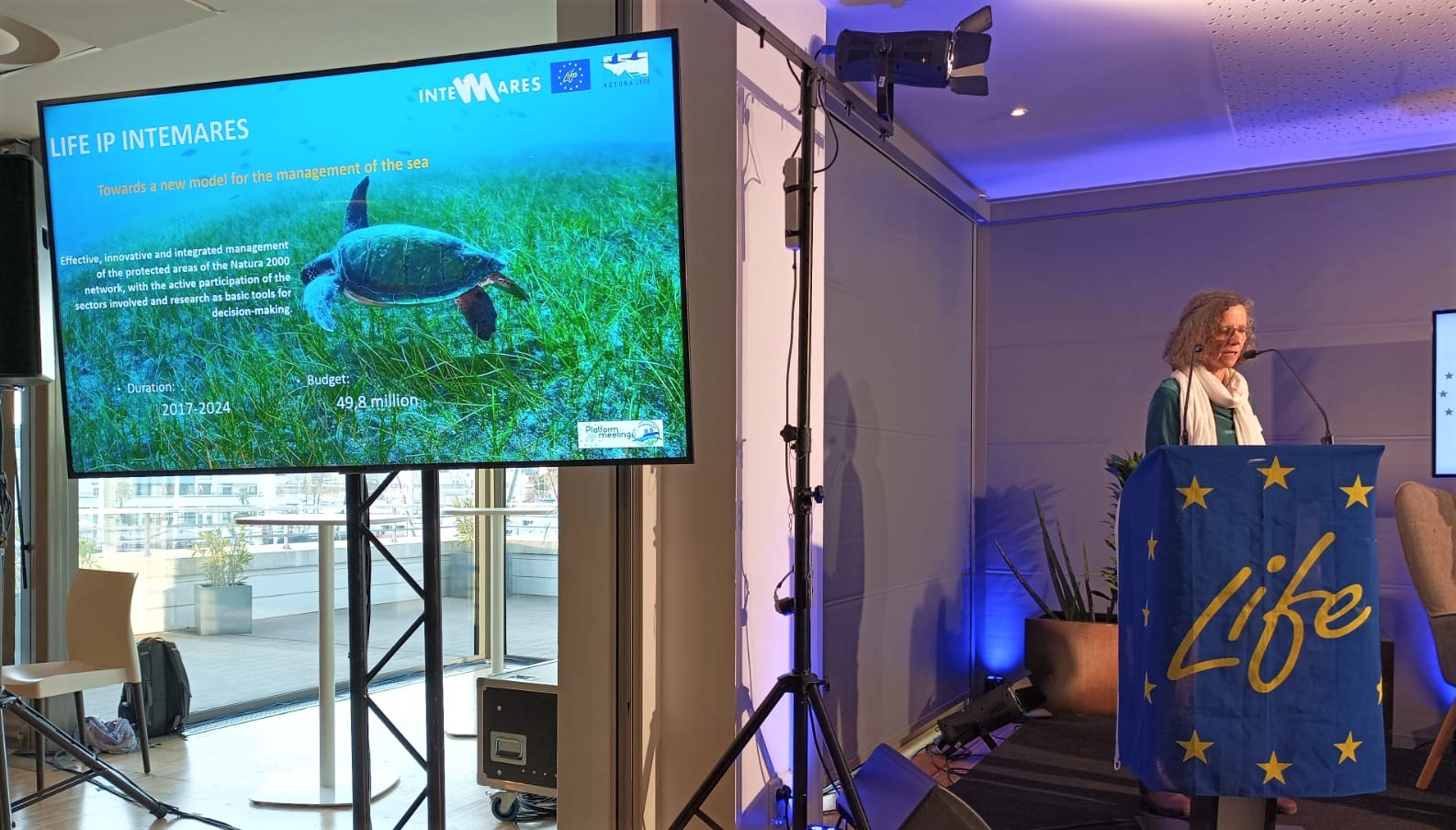


The Biodiversity Foundation of the Ministry for the Ecological Transition and the Demographic Challenge has been participating, since last Tuesday, in the LIFE Platform Meeting, a meeting of projects of the European Union’s LIFE Programme held in La Rochèlle (France) to advance the roadmap set out by the EU’s 2030 Biodiversity Strategy in marine conservation.
Specifically, the meeting, organised by the French Biodiversity Agency through the integrated marine project LIFE Marha and the European Commission, through CINEA, has made it possible for the more than 30 countries and 250 participants to share experiences on areas of strict protection in EU Member States and in other countries, as well as to promote cooperation to move towards compliance with 30% protection of the marine surface by 2030.
The results of the meeting will be used to prepare a support document to help the European Commission implement its protected areas strategy for 2030 and to support managers in their approach to the application of 10% of the marine area with strict protection, in order to comply with the commitment established by the European Biodiversity Strategy.
GOVERNANCE AND SOCIAL PARTICIPATION
Within the framework of this meeting, Spain has committed to continue advancing in the protection and effective management of at least 30% of the marine surface by 2030, which contributes to protecting biodiversity and facing the effects of climate change.
Along these lines, the Biodiversity Foundation has presented, during the meeting, the progress of the LIFE INTEMARES project, which it coordinates with the aim of contributing to the effective management of the marine spaces of the Natura 2000 Network, with participation and science as basic tools.
He also presented the main lines of the project to address the need to move towards compliance with international commitments on marine protection, governed by the availability of rigorous scientific information and the participation of the sectors involved.
Among the priority actions that have also been shared during the LIFE Platform Meeting, governance and social participation stand out, as well as the training of agents involved in the effective management of the Natura 2000 Network.
In addition, some progress has been announced, such as the work that will allow the approval this year of the Master Plan of the Network of Marine Protected Areas in Spain which, in addition to including the common criteria necessary for the coordinated and coherent management of the network, serves as a meeting point for managers of these areas and civil society.
MARINE RESERVES OF FISHING INTEREST
On the part of Spain, the Subdirectorate General of Scientific Research and Marine Reserves of the Directorate General of Sustainable Fisheries of the Ministry of Agriculture, Fisheries and Food (MAPA), which has presented its experience of more than 30 years in the management of Marine Reserves of Fishing Interest, as well as the Spanish Institute of Oceanography (IEO-CSIC), has also participated in the meeting. which has carried out the scientific monitoring of the “reserve effect” in these protected areas managed by the MAPA, within the framework of the agreements of the General Secretariat of Fisheries and the IEO.
In Spain there are currently 12 marine reserves of fishing interest, fundamental tools for preserving natural wealth, conserving species, recovering ecosystems and regenerating fishing resources. These protected areas have as their main objective the support of fisheries and also contribute to the maintenance of artisanal fishing in the area, a sector closely linked to the conservation of marine resources.
For its part, the Regional Government of Andalusia has presented the results of the LIFE Blue Natura project on blue carbon, ecosystem services and their relationship with the protection of marine habitats.
EFFECTIVE MANAGEMENT OF PROTECTED AREAS
The LIFE INTEMARES project is moving towards the objective of achieving effective management of the marine areas of the Natura 2000 Network, with the active participation of the sectors involved and with research as the basic tools.
The Biodiversity Foundation of the Ministry for Ecological Transition and the Demographic Challenge coordinates this project. The ministry itself, through the Directorate-General for Biodiversity, Forests and Desertification; the Regional Government of Andalusia, through the Ministry of Agriculture, Livestock, Fisheries and Sustainable Development, as well as the Environment and Water Agency; the Spanish Institute of Oceanography; AZTI; the University of Alicante; the Polytechnic University of Valencia; the Spanish Fisheries Confederation, SEO/BirdLife and WWF-Spain. It is supported by the LIFE Program of the European Union.
