


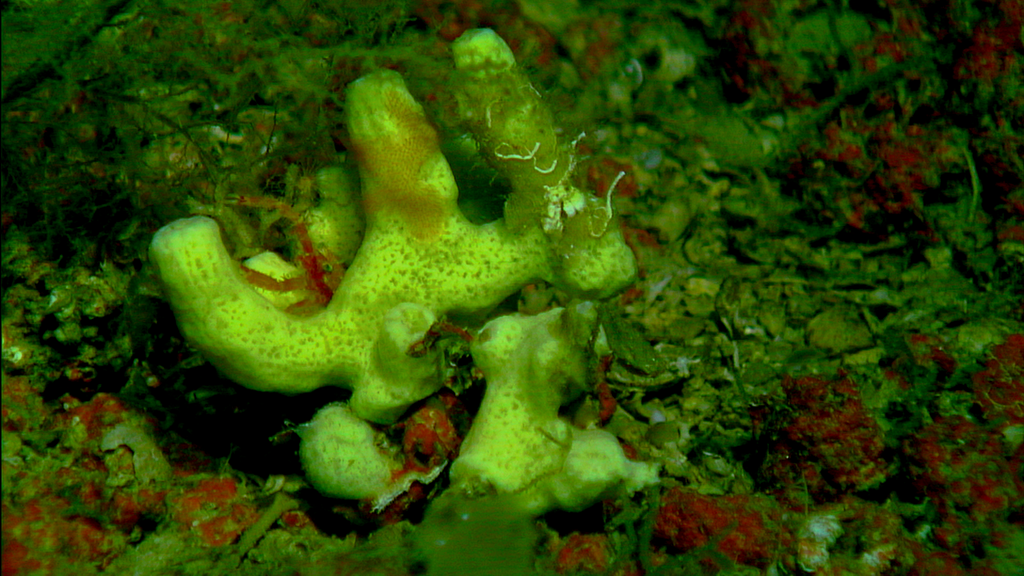


The seamounts of the Mallorca Channel are home to a great wealth and diversity of habitats and species of community interest, as confirmed by the scientific information obtained by the Spanish Institute of Oceanography (IEO, CSIC), within the framework of the LIFE INTEMARES project.
The seamounts of the Mallorca Channel are home to a great wealth and diversity of habitats and species of community interest, as confirmed by the scientific information obtained by the Spanish Institute of Oceanography (IEO, CSIC), throughout the oceanographic research campaigns carried out within the framework of the LIFE INTEMARES project. which we coordinate from the Biodiversity Foundation of the Ministry for Ecological Transition and the Demographic Challenge.
Among the most recent findings, published in the international scientific journal PeerJ, the description of a genus (Foraminospongia) and three species of sponges new to science stands out: Foraminospongia balearica, Foraminospongia minuta and Paratimea massutii.
In addition, the research provides four new records of sponges in the Mediterranean, whose presence was not known until now in this area, as well as other records of sponges, which show the value of the seamounts of the Mallorca Channel as a refuge for biodiversity in the Mediterranean.
In fact, the first results in the Mallorca Channel, published in 2019 in the international journal Journal of the Marine Biological Association of the United Kingdom, were also the discovery of another species: Ophiomyces grandis. In this case, it was a brittle – an echinoderm similar in appearance to the starfish – whose presence in the Mediterranean was unknown until then and which is very abundant in the seamounts of the Mallorca Channel.
These results are part of a doctoral thesis, which is being developed within the LIFE INTEMARES project, co-financed by the Government of the Balearic Islands and the European Social Fund.
HABITATS OF COMMUNITY INTEREST
Within the framework of the project, the Ses Olives and Ausias March seamounts, located to the east of the Pityusic Islands, as well as Mount Emile Baudot, also located to the east of these islands and south of Mallorca, are being studied.
In addition to sheltering fields and gardens with a great diversity of sponges, these seamounts have identified habitats of Community interest, included in the Habitats Directive, which guarantee the maintenance of a favourable conservation status of the designated sites.
This is the case of the maërl bottoms, formed by rhodoliths or calcareous red algae on the summits of the Ausias March and Emile Baudot mountains, are probably the deepest in the western Mediterranean.
Fields of pockmarks, which are widespread and numerous, have also been found around the three mountains and coral bottoms, not only on the rocky outcrops on the slopes of the mountains, but also on the adjacent sedimentary bottoms, where bamboo coral (Isidella elongata) has been found.
In addition, fossil bio-constructions of ostreids have been observed, which form a reef around the three seamounts, at a depth of between 200 and 400 meters.
The information obtained contributes to improving the scientific knowledge of the seamounts of the Mallorca Channel and its adjacent bathyal bottoms, and will serve as a basis for studying a possible declaration of this space as a Site of Community Importance (SCI) within the Natura 2000 Network.
EFFECTIVE MANAGEMENT OF PROTECTED AREAS
The LIFE INTEMARES project is moving towards the objective of achieving effective management of the marine areas of the Natura 2000 Network, with the active participation of the sectors involved and with research as the basic tools.
The Biodiversity Foundation of the Ministry for Ecological Transition and the Demographic Challenge coordinates the project. The ministry itself, through the Directorate-General for Biodiversity, Forests and Desertification; the Regional Government of Andalusia, through the Ministry of Agriculture, Livestock, Fisheries and Sustainable Development, as well as the Environment and Water Agency; the Spanish Institute of Oceanography; AZTI; the University of Alicante; the Polytechnic University of Valencia; the Spanish Fisheries Confederation, SEO/BirdLife and WWF-Spain. It is supported by the LIFE Program of the European Union.
