


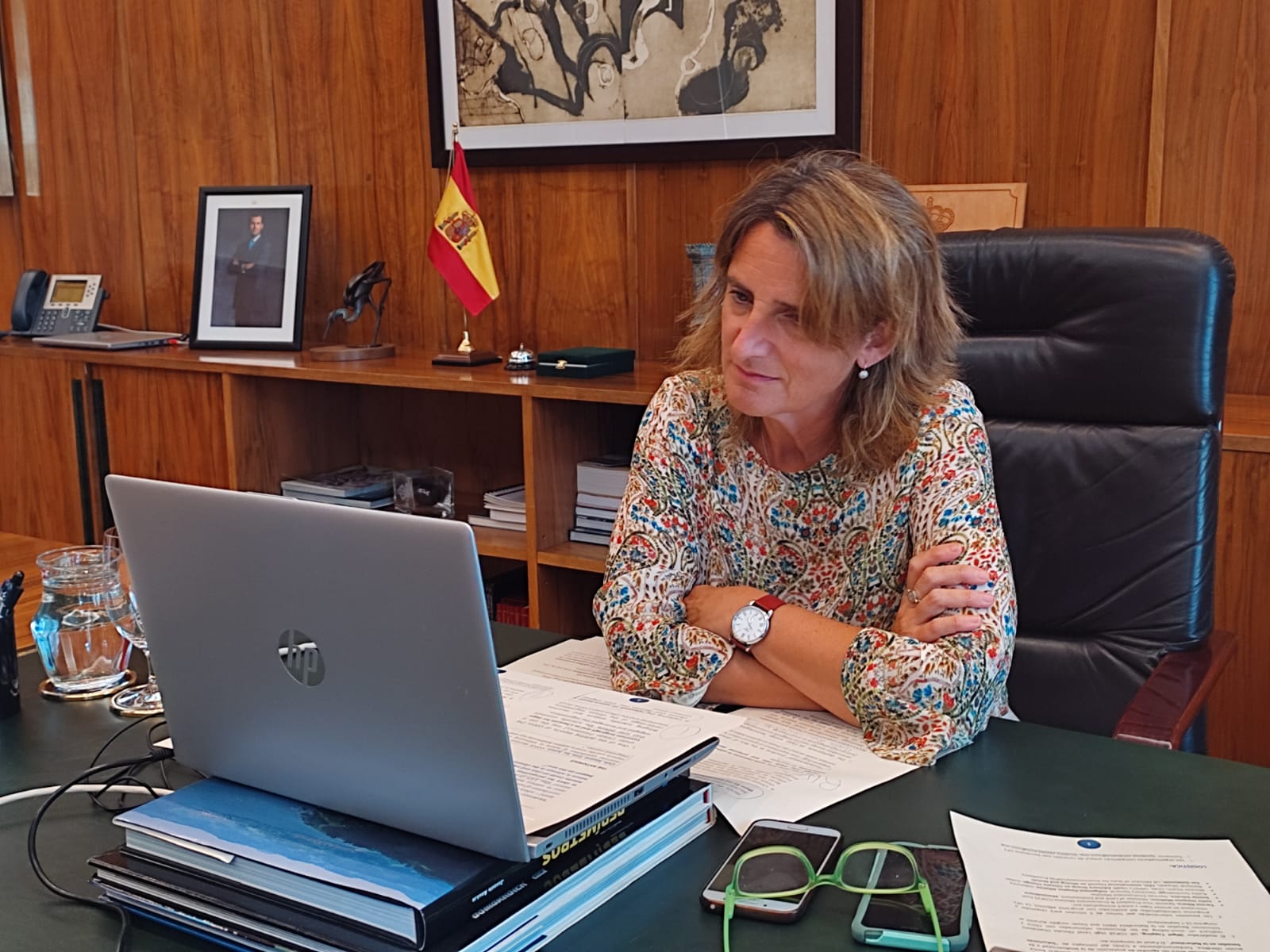


The Vice-President and Minister for the Ecological Transition and the Demographic Challenge, Teresa Ribera, today participated in the closing plenary session of the forum “Mobilising nature and society to address the climate emergency: the way forward”, held during the World Conservation Congress, organised by the IUCN.
The Vice-President and Minister for the Ecological Transition and the Demographic Challenge, Teresa Ribera, today participated in the closing plenary session of the forum “Mobilising nature and society to address the climate emergency: the way forward“, held during the World Conservation Congress, organised by the IUCN.
In her speech, Ribera highlighted the importance of nature-based solutions to mitigate the effects of climate change. In this sense, he explained that “those ecosystem-based approaches are measures that allow us to address biodiversity loss and climate change in an integrated way and also take advantage of the possible co-benefits”.
The vice-president emphasised the link between climate change and biodiversity loss. “Protecting biodiversity requires addressing the climate emergency and vice versa,” he stressed. Another aspect pointed out by Ribera was the need to undertake a change in the economic and social model that allows “restoring the balance with nature and at the same time improving the quality of life of human beings”. In this sense, he pointed out that “the degradation of natural systems resulting from our economic model is a major stressor for health and well-being”.
Human health and its close relationship with the good state of ecosystems has been another of the axes of his intervention. “The COVID-19 pandemic will have lasting impacts on the way we conceive and manage human interaction with the ecosystem,” said Ribera. A paradigm shift that will affect sectors such as energy, food, commerce or the reconfiguration of urban environments and that constitutes “an unprecedented opportunity to promote global change and take a leap towards more sustainable and equitable societies”, said the vice-president.
Ribera stressed the importance of integrating biodiversity into sectoral policies, identifying the resources and budgets needed to achieve the targets and increasing ambition in national emission reduction contributions (NDCs). “The objective is to transform social behaviour to protect the planet, biodiversity and human well-being, from a health, social, economic and financial point of view”, he stressed. Along these lines, the next Biodiversity and Climate Change summits, COP 15 and COP 26 respectively, “will work to increase knowledge and the way to make visible the need to bet on this way of approaching the problem of climate and biodiversity deterioration,” said Ribera.
The IUCN World Conservation Congress, held every four years, brings together thousands of leaders and decision-makers from governments, civil society, indigenous peoples, businesses and academia with the aim of contributing to environmental conservation and promoting nature’s solutions to global environmental challenges. This edition, initially scheduled for June 2020, was postponed to September 2021 due to the COVID-19 pandemic.
