


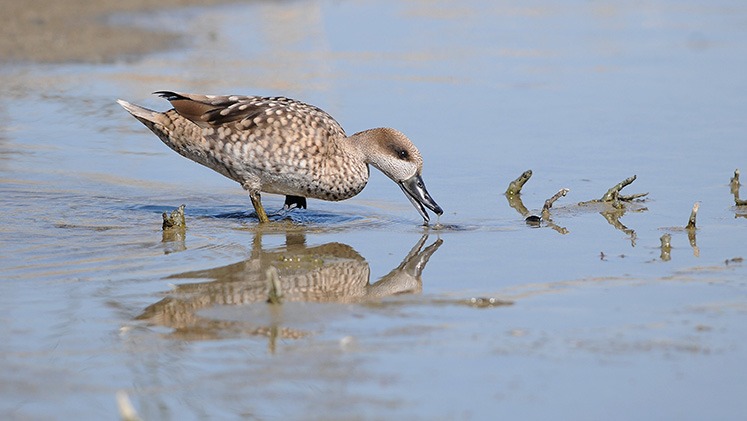


The marbled teal has bred in the wild in three areas where it had not done so for decades. This is a new milestone for the LIFE Marbled Teal project, which began in January this year and is coordinated by the Biodiversity Foundation of the Ministry for Ecological Transition and the Demographic Challenge.
The marbled tealhas bred in the wild in three areas where it had not done so for decades. Several specimens of this species, listed as ‘critically endangered’ in Spain by the IUCN and as ‘vulnerable’ at European and global level, have been sighted accompanied by their offspring in the La Veguilla wetland (Alcázar de San Juan, Ciudad Real), and in the swamps of southeastern Sicily (in Sicily, Italy), both Site of Community Importance (SCI) of the Natura 2000 Network. as well as in the Tagus Estuary (Portugal).
This is a new milestone for the LIFE Marbled Teal project, which began in January of this year and is coordinated by the Biodiversity Foundation of the Ministry for Ecological Transition and the Demographic Challenge, and which includes among its actions the captive breeding of the species and its subsequent reintroduction in priority areas. Both the swamps of southeastern Sicily and the lagoon complex of Alcázar de San Juan are areas selected for the release of specimens of the species, to which the project has contributed.
BREEDING IN THE WILD
During a census of breeding waterfowl in the La Veguilla wetland, three marbled teals accompanied by their chicks have been detected, also locating another 24 adult specimens in different areas of the wetland, specimens bred in the fauna recovery center La Granja de El Saler (Valencian Community). This news confirms that the Alcázar de San Juan lagoon complex is a wetland that meets the ideal conditions to host this species in a critical situation.
For its part, the breeding of at least one female marbled teal, bred in the center of Cañada de los Pájaros (Andalusia) in the Tagus Estuary, has also been a milestone in the conservation of this bird. The marbled teal is a species listed as a rarity in Portugal, a country where its reproduction has not been verified for decades.
In Sicily, an attempt has been confirmed by specimens also from El Saler and sent this year, although in the end it has not prospered. However, the breeding of two other females has been verified. In addition, the tagging of some specimens has allowed us to expand our knowledge about the behavior of the species and its movements.
According to information shared by the LIFE Marbled Duck project, which works for the recovery of the species in Italy, GPS data have confirmed that two teals traveled from Sicily to the Ghadira nature reserve (Malta) on a journey that took them about three and a half hours, to return, a few hours later, to the wetland from which they departed.
IN CRITICAL SITUATION
The marbled teal is one of the seven species in critical condition in Spain. Until the mid-twentieth century it was abundant in Mediterranean coastal wetlands, especially in Doñana, but in recent decades its decline has been so drastic that this species of community interest is critically endangered.
The number of breeding pairs in Spain, which is almost its only place of distribution in Europe, stood at 45 last year, with a clear trend in regression.
RESEARCH, CONSERVATION AND GOVERNANCE
To reverse the risk of extinction of the species and promote its habitat, the LIFE Marbled Teal project has undertaken a set of actions to strengthen the status of its populations in the natural environment, improve the state of the wetlands and the scientific knowledge of the species. Until 2025, the participation of sectors relevant to their conservation, such as irrigators or hunters, will also be promoted, as well as environmental awareness and education.
The project, which is coordinated by the Biodiversity Foundation of the Ministry for the Ecological Transition and the Demographic Challenge, involves the ministry itself, through the Segura Hydrographic Confederation and Tragsatec; the Regional Government of Andalusia, through the Ministry of Agriculture, Livestock, Fisheries and Sustainable Development and the Environment and Water Agency; the Generalitat Valenciana; the Government of the Region of Murcia, as well as the organizations SEO/BirdLife and ANSE. It is supported by the LIFE Program of the European Union and the Directorate General for Water.
