


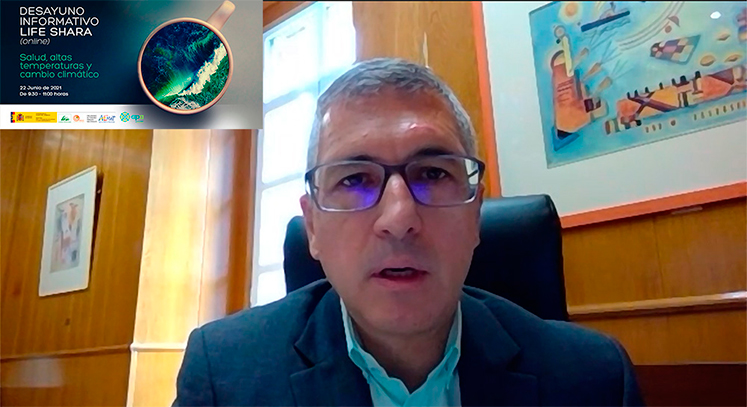


The Secretary of State for the Environment of the Ministry for the Ecological Transition and the Demographic Challenge, Hugo Morán, presented this morning the latest actions carried out in Spain in terms of adaptation to climate change to deal with heat waves and reduce the risk to human health
The Secretary of State for the Environment of the Ministry for the Ecological Transition and the Demographic Challenge, Hugo Morán, presented this morning the latest actions developed in Spain in terms of adaptation to climate change to deal with heat waves and reduce the risk to human health. The presentation took place within the framework of an informative breakfast organised by the LIFE SHARA project, a joint initiative of the Spanish Office for Climate Change, the Biodiversity Foundation, the National Centre for Environmental Education, dependent on the OAPN, the State Meteorological Agency and the Portuguese Environment Agency, to promote awareness and knowledge on adaptation to climate change by strengthening and promoting the National Plan for Climate Change Adaptation to Climate Change.
Spain, due to its geographical location and socio-economic characteristics, is particularly vulnerable to climate change. The impacts of climate change that are already occurring today are expected to worsen in the future as the climate crisis continues to advance. These impacts will exist even if we make the greatest efforts to reduce greenhouse gas emissions
In this regard, the Secretary of State said that “we must continue to work on ambitious and effective adaptation policies, with an effort of coordination and coherence between the different levels of administration, which contribute to reducing risks to human health”.
The informative breakfast was attended by two renowned researchers in the field of health, high temperatures and climate change, who presented the main results of their latest studies: Julio Díaz, scientist at the National School of Health of the Carlos III Health Institute, and Ana María Vicedo Cabrera, environmental epidemiologist at the Research Group Leader Climate Change & Health of the University of Bern (Switzerland).
Ana María Vicedo began her speech by explaining how heat affects human health. “Heat is an environmental stressor,” he said. “Below extreme heat mortality, there are many other more numerous effects. Older people who are exposed to high temperatures can end up hospitalized or even die. The elderly, children and pregnant women are vulnerable groups when coping with high temperatures,” he remarked. A phenomenon that, for this expert, involves “health costs and has an impact on low labour productivity. Therefore, not only do we have to evaluate mortality, but also hospitalizations ”.
Regarding the future, Vicedo predicts that mortality attributed to heat will increase exponentially in the coming decades. “Up to 37% of heat deaths are attributable to climate change, a percentage will increase in the future.” For the epidemiologist, although so far we have adapted to these temperature increases, “the question would be whether we are adapting at an adequate pace. In that sense, cities are the key point to face adaptation.”
For his part, Julio Díaz has clarified that “one thing is mortality due to heat and another is due to heat wave, something that also happens with cold”. From 2000 to 2009, the average temperature in Spain has been 28.7 °C in the summer months, a temperature that will rise at a rate of 1.6 degrees by 2050 and will continue to increase after that date. “If we continue like this, mortality will increase, so the key is adaptation. In this area, science has to provide solutions for decision-making “, he remarked.
Díaz pointed out that “in any country there are geographical variations, so it is important to carry out local studies. We know that old buildings adapt less well to the heat and also areas with lower income levels, so social measures are needed to address this problem”. For this expert, it is key to update prevention plans “and ensure that these plans are local and updated. The actions must be at the local level,” he stressed.
HIGH TEMPERATURES AND THEIR IMPACTS ON HEALTH
Climate change is a phenomenon that affects the health of the Spanish population through direct effects such as heat waves and events such as floods and droughts, but also through indirect effects, including an increase in air pollution, a change in the distribution of disease-transmitting vectors or the loss of water or food quality. In this regard, the World Health Organization has long warned that climate change can lead to the emergence of new epidemic diseases or facilitate their transmission. Adaptation to climate change is therefore not only a matter of ecosystem recovery, but must be addressed from different areas.
Among the impacts on human health that have the greatest impact in Spain is the increase in morbidity and mortality associated with extreme temperatures. Numerous epidemiological studies show a significant increase in mortality above a certain thermal threshold, and it has been shown that extremely high temperatures have a direct impact on mortality from cardiovascular and respiratory diseases.
As a result of climate change, heat waves are becoming more frequent and intense, and affect the most vulnerable population groups to a greater extent, such as the over-65s, children, pregnant women, people with chronic diseases, exposed workers and people at risk of exclusion. However, deaths associated with heat waves in Spain have fallen from 14 to 1% in a decade – to around 1,300 deaths per year – thanks to the prevention plans put in place, the change in habits and improvements in infrastructure.
After the heat wave recorded in the summer of 2003, the National Plan for Preventive Actions against the Effects of Excessive Temperatures on Health was launched, which, since 2004, has been activated every summer, between the months of June and September. The Plan establishes the actions necessary for the detection and control of risk situations, for which several levels of action are defined, and deadlines for their application.
