



SEAMED+. Engineering applied to seagrass restoration: scalability and advanced monitoring.
FEDER
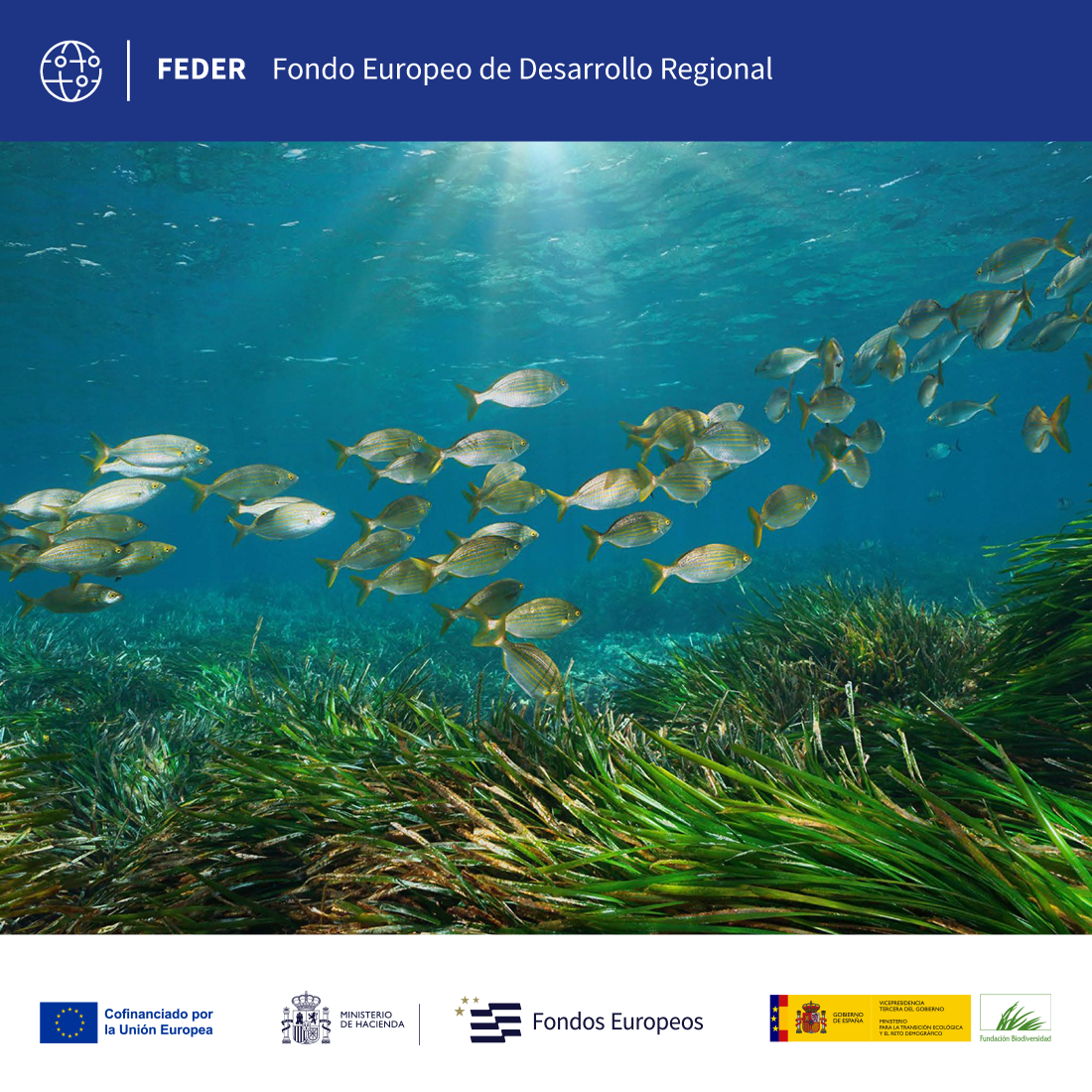
SEAMED+ is an interdisciplinary project that seeks to develop an innovative and scalable system for the restoration of seagrass meadows (especially Posidonia oceanica and Cymodocea nodosa), integrating engineering, biology and marine ecology. The project proposes the design, manufacture and validation of disintegrable prototypes that address the challenge of scalability in restoration by reducing the deployment of exogenous material in the environment. It will include direct monitoring techniques combined with ROV monitoring technologies and proprietary AI-based tools to monitor the evolution of the planting, the automatic recognition of species for the future valuation of natural capital, facilitating the evaluation of ecological success, thus contributing to the improvement of knowledge and management of these habitats. SEAMED+ is aligned with the 2030 Biodiversity Strategy, the consolidation of marine green infrastructure and habitat restoration, within the ERDF’s P2A priority.
Line of action:
Marine ecosystemsStatus:
En ejecuciónLocation:
Catalonia and the Balearic IslandsGeographic scope:
EspañaExecution date:
2025End date:
2028Duration:
01/12/2025 - 30/09/2028Total budget:
€400,206.78Amount of aid from the Biodiversity Foundation:
€196,045.87Coordinating entity:
Chemical Institute of Sarrià (IQS)Mediterranean Institute for Advanced Studies (IMEDEA-CSIC)
The implementation of technological solutions and intelligent monitoring will optimize restoration and monitoring processes, reduce the impact of hazards and generate replicable tools for environmental management. The project will contribute to the scaling up of the restoration and conservation of seagrass meadows, essential habitats for biodiversity and Mediterranean coastal ecosystems. An improvement in the coverage and resilience of Posidonia oceanica and Cymodocea nodosa meadows is expected, as well as a recovery of key species and ecosystem services such as carbon sequestration, coastal protection and improved water quality in the intervention areas. The project will obtain a modular prototype for the restoration of both habitat-creating species, easily scalable, with disintegrable materials that, after the time of rooting of the species, dissolve in the marine environment, leaving the intervention area without foreign elements.
The main objective of the SEAMED+ project is to develop and validate an advanced, comprehensive and scalable technological solution for the restoration and intelligent monitoring of seagrass meadows, with a special focus on Posidonia oceanica and Cymodocea nodosa. The aim is to generate a replicable, robust and adaptable methodology, capable of addressing the challenge of large-scale restoration, optimising the management and planning of these key ecosystems and actively contributing to the conservation and resilience of marine biodiversity, aligning with the main European and global environmental objectives.
Key expected results include:
- The design of an advanced and scalable system for seagrass planting.
- The manufacture and deployment of optimised prototypes in two materials with different disintegration rates, as well as their installation in selected pilot areas.
- The implementation of advanced monitoring technologies through ROVs and the development of an AI tool for the automated analysis of biodiversity and environmental parameters.
- The validation, monitoring and quantification of results, including the validation of remote monitoring methods, the evaluation of restoration success and the associated biodiversity.
- The transfer of knowledge, generation of guides and dissemination of results at the national and international level.

SEAMED+. Engineering applied to seagrass restoration: scalability and advanced monitoring.

 back to search