



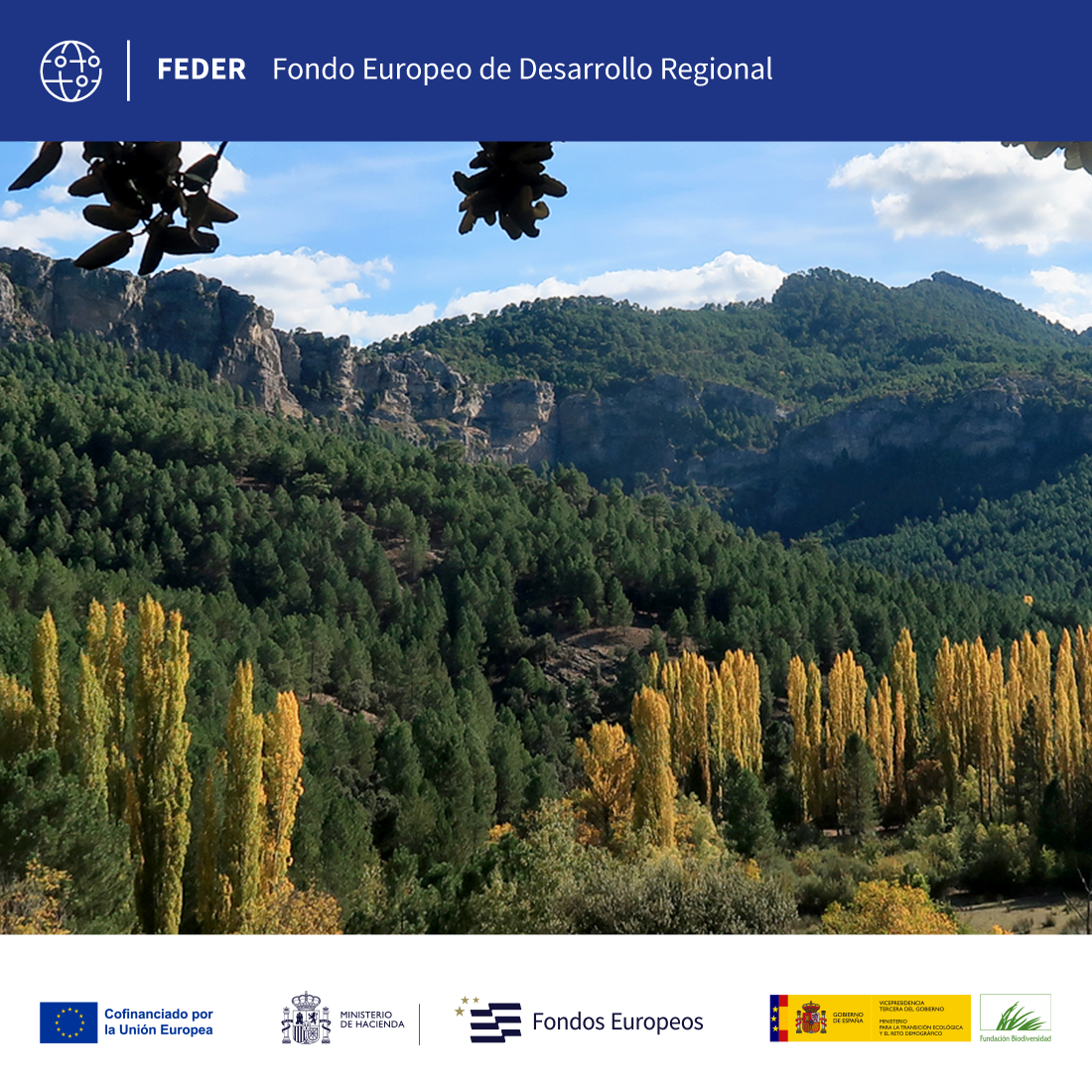
STRENGTHENS. Comprehensive strengthening of the forest bioeconomy in the Sierras of the Southeast Peninsula through regenerative forestry, social innovation and the strengthening of the value chain of wood and ecosystem services.
FEDER
The project works to change the dynamics of forest management in the southeast of the peninsula by giving continuity to the REVIERTE project (PRTR 2023) and extrapolating methodologies to several provinces with similar characteristics. To this end, it organises and promotes communities of owners and irrigators and promotes the characterisation of wood with 4 regenerative silvicultural itineraries of 3,000 ha, achieving the mapping of 70,000 ha. In addition, actions are integrated in water management of 2,200 ha, in certified sustainable forest management of 14,000 ha and in certification of ecosystem services of 300 ha. All this is intended to contribute to the conservation and restoration of degraded habitats, strengthen fire prevention and climate adaptation, as well as achieve results related to green infrastructure and governance with 21,900 hectares improved, 2,000 community members benefited, 283 people trained and 300 hectares PEFC-Water certified.
Line of action:
Terrestrial ecosystemsStatus:
En ejecuciónLocation:
Andalusia (Jaén and Almería) and Castilla-La Mancha (Albacete)Geographic scope:
EspañaExecution date:
2026End date:
2028Duration:
18/02/2026 - 30/09/2028Total budget:
€1,999,959.52Amount of aid from the Biodiversity Foundation:
€1,699,965.59Pablo de Olavide University
Andalusian Institute of Agricultural Research and Training, Fisheries
University of Cordoba
FORTALECE has a great transformative character due to its transversality and action in the wood value chain. It promotes regenerative forestry and the sowing and harvesting of water that, together, will revitalize the landscape with all its people, valuing their work and forest management and employing scientific knowledge. This active and sustainable management will mean a more resilient, better preserved and wealth-generating territory.
- Implement actions to improve green infrastructure and degraded protected habitats in the southeast of the peninsula, with regenerative forestry and historic irrigation.
- To enhance the value chain of wood from tree to building, generating economic and environmental value and an active forest that is resilient to climatic conditions.
- Promote sustainable forest use that generates economic and environmental value, providing the forest-industry value chain with innovative products and tools for its traceability certification.
- Implement ecological restoration actions in degraded areas and planning and management instruments for the improvement of habitats
- Encourage the creation of direct and indirect employment, promoting economic diversification in rural territories and promoting gender inclusion. Incorporate the gender perspective in order to reduce the gender gap in the forestry sector, improve equity in access to training and employment.
- Property organization, forest stocks and design of regenerative and wood quality silvicultural itineraries.
- Strengthening and uniting communities for the sustainability of green infrastructure.
- Implementation of regenerative forestry in the Sierras of the Southeast Peninsula.
- Sowing and harvesting water for the conservation of green infrastructures and fire prevention in the Sierras of the southeast of the peninsula.
- Characterization of wood for high value-added structural products.
- Development and certification of a structural product based on certified local wood.
- Impact on ecosystem services in the Sierras of the Southeast Peninsula.
- Transfer of results and promotion of the Monte-Industria chain. Networking and training.
- Communication and dissemination strategy.
- Coordination, management and follow-up of the project.
- Tools contributed to the wood value chain in the Sierras of the Southeast Peninsula.
- To strengthen the communities of owners and irrigators for the sustainability of green infrastructure in the Sierras of the Southeast Peninsula.
- Environmental improvement of green infrastructure and protected habitats.
- Sustainable wood-based structural elements for construction developed and certified.
- Certify the impact on ecosystem services (water, biodiversity, carbon, fire defense) of the FORTALECE model.
- Reduction of the gender gap, greater equity and improved access to labor in the region’s forest-industry value chain.
- Communication and effective dissemination of FORTALECE and its impact.
- Compliance with the deadlines, actions, deliverables, objectives and quality of the FORTALECE project.
- Application of regenerative silvicultural itineraries (3,000 ha), integrating them into management instruments oriented in four options (quality curves, aptitude maps, rates or mass variables).
- Generation of a water management instrument for 2,200 ha.
- Certified sustainable forest management (14,000 ha for those forests with approved or approved plans) and certification of ecosystem services (300 ha).
- Address the historical hydraulic systems to define irrigation spaces and improve governance (10 participatory management plans, 2 cultural trails of 10 km, 6.5 km of recovered historic ditches, another 200 ha of pasture use and 100 head of cattle), as well as certify 300 ha PECF-Water.
- 900 ha improved green forestry and irrigation infrastructure, 2,000 community members benefited.
- Development of courses and workshops with 283 trained people, creating a Summer School of Advanced Calculation of Wooden Structures and a School of Irrigation.

STRENGTHENS. Comprehensive strengthening of the forest bioeconomy in the Sierras of the Southeast Peninsula through regenerative forestry, social innovation and the strengthening of the value chain of wood and ecosystem services.

 back to search