



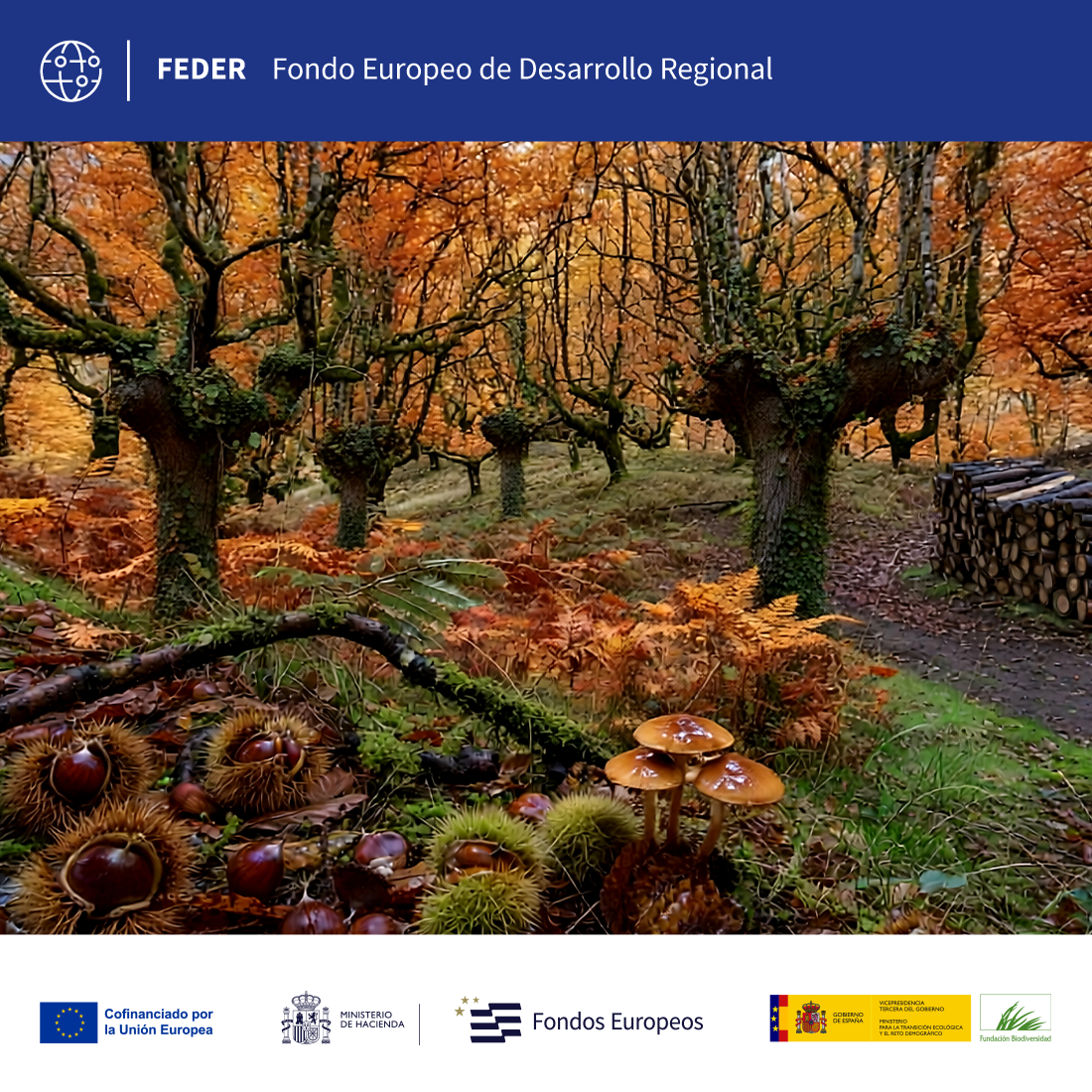
MULTICAS. Management of the multifunctionality of Castanea sativa forests for the reactivation and diversification of the economy in rural areas.
FEDER
This project promotes the diversification of economic uses in rural areas of the northwest of the peninsula, complementing the CARES project (PRTR 2023) and focusing on the use of resin, chestnuts and other resources from a conservation perspective. To this end, it is defining biodiversity baselines in 38 demonstration plots and evaluating improvement and restoration actions for 43.48 ha of green infrastructure. In addition, it promotes the forest and multifunctional management of chestnut groves and mycological resources, and the planning of 20 farms with a participatory governance model. All this is intended to achieve results related to green employment (23 direct jobs), training and transfer (400 people trained), improved profitability (~600 €/ha/year), and reduction of pests and diseases by 30% in pilot areas.
Line of action:
Terrestrial ecosystemsStatus:
En ejecuciónLocation:
Principality of Asturias and Castilla y León (León). 25 municipalities.Geographic scope:
EspañaExecution date:
2026End date:
2028Duration:
18/02/2026 - 30/09/2028Total budget:
€1,578,567.24Amount of aid from the Biodiversity Foundation:
€947,140.34CESEFOR
CETEMAS
The project promotes the bioeconomy, promoting the development, improvement and consolidation of green infrastructure, connectivity, the restoration of degraded ecosystems and multifunctional landscapes, with the aim of increasing biodiversity and its conservation, adaptation to climate change, prevention of forest fires and the fight against desertification, while generating opportunities and employment in rural areas and contributing to the fight against the challenge demographic.
Promote the multifunctional management of chestnut groves through conservation, health recovery and restoration of biodiversity, pest prevention, innovation, the introduction of management models that allow the sustainable valorisation of chestnut resources, and the socio-economic diversification of rural areas to increase climate resilience and green employment in rural areas.
- Establishment of biodiversity baselines in different management and post-disturbance degradation scenarios.
- Design of post-disturbance management and degradation scenarios.
- Design of multifunctional management scenarios for the production of mycological resources.
- Improvement of pest and disease management in chestnut groves through innovative technologies.
- Management proposal and financing mechanisms to implement the proposal.
- Promotion and transfer of knowledge in the use of products from chestnut groves.
- Comprehensive coordination of the project with a technical, administrative, financial and gender equality approach.
- Restored forest ecosystems and improved biodiversity, with an improvement in the productive structure and opportunities for economic development for chestnut management and socio-economic promotion and dynamisation.
- Establishment of biodiversity baselines (flora, fungi, birds and bats) in different management and degradation scenarios in a network of 38 demonstration plots as a scientific and technical reference, and generating a biodiversity catalogue of 300 taxa.
- Evaluation of the effects of different silvicultural and restoration treatments, achieving 43.48 ha of improved green infrastructure.
- Creation of forest and multifunctional management scenarios for the production of the mycological resource, as well as the productive diversification of chestnut stands, improving the overall profitability in the medium to long term by approx. 600 € ha/year.
- Improvement of pest and disease management in chestnut groves through innovative technologies, reducing their incidence in pilot areas by 30%. Updating farm cartographies, and property studies, a multifunctional management plan for 20 chestnut farms and generating a participatory governance model with grouped management agreements and the creation of groups.
- In addition to carrying out actions to promote and transfer knowledge, training in management techniques for 400 people, publications, workshops and resources, and 23 direct green jobs in key sectors (planting, forestry, plant health, biotechnology, etc.).


MULTICAS. Management of the multifunctionality of Castanea sativa forests for the reactivation and diversification of the economy in rural areas.

 back to search