



COLZAGA. Agroecological use of rapeseed to improve soils, biodiversity and obtain usable by-products in livestock farms in Galicia.
FEDER
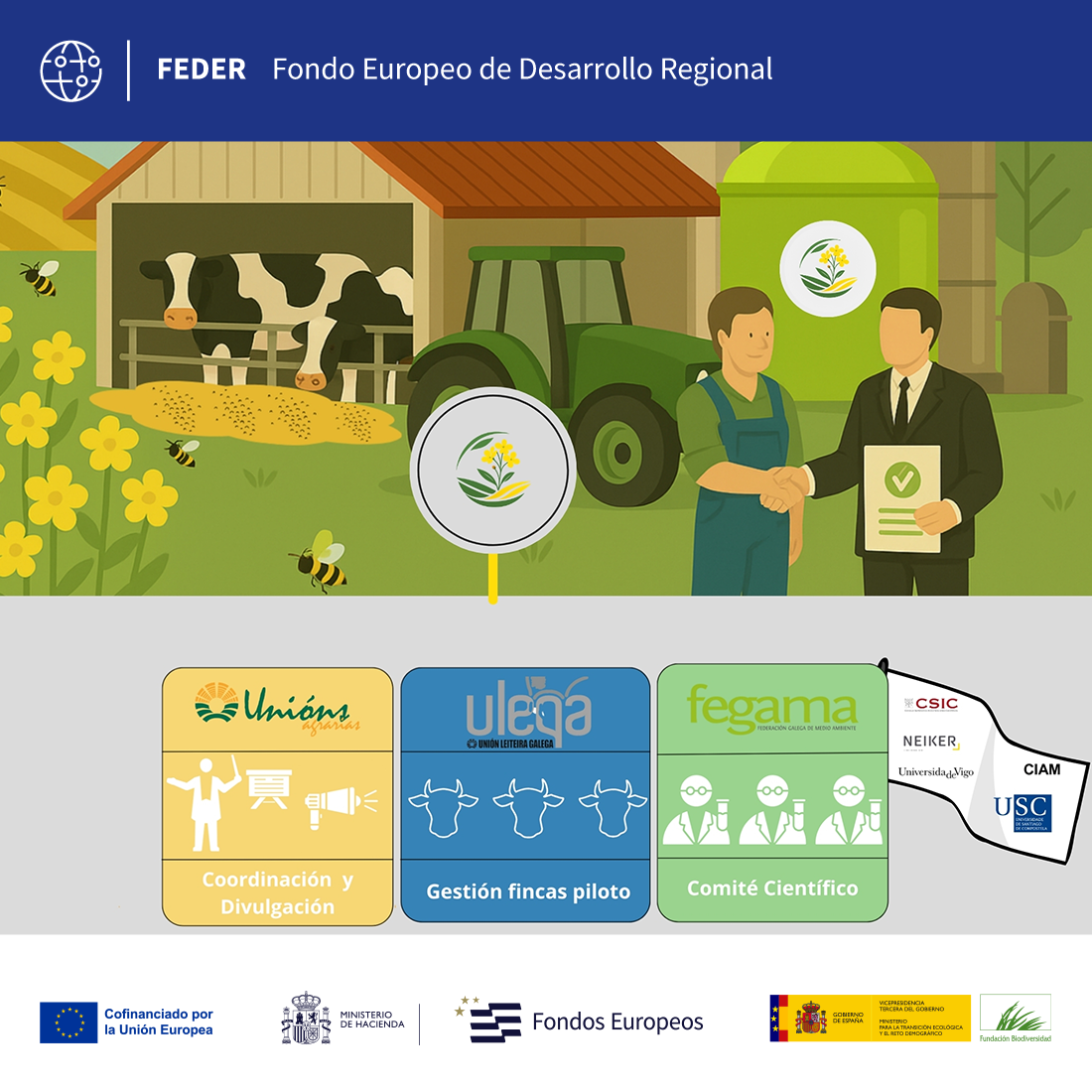
The project focuses on promoting and validating an agroecological model in dairy farms in Galicia based on the implementation of rapeseed in rotation as a circular bioeconomy strategy to reduce emissions, improve the soil, increase biodiversity and valorise by-products. To this end, it will update knowledge on rapeseed cultivation, implement this crop in at least 20 pilot farms and test a food mix with rapeseed on at least 10 farms. In addition, it will promote a platform as a tool for training and environmental certification, along with a plan for the continuity and scaling of the project.
Line of action:
Terrestrial ecosystemsStatus:
En ejecuciónLocation:
Galicia (A Coruña, Lugo and Pontevedra)Execution date:
2026End date:
2028Duration:
18/02/2026 - 30/09/2028Total budget:
€903,115.74Amount of aid from the Biodiversity Foundation:
€541,869.44Unión Leitera Galega
Galician Federation of the Environment (FEGAMA)
To validate an agroecological model based on rapeseed cultivation on livestock farms in Galicia, which contributes to improving the sustainability of the production system by reducing inputs and generating valuable by-products, as a strategy to move towards a circular bioeconomy with a multi-impact approach; environmental, social and economic. Replicable, adaptable to other crops, and transferable to different livestock and agricultural regions.
- Introduce rapeseed cultivation in rotation with traditional fodder, to improve soil structure and promote biodiversity.
- Reduce greenhouse gas emissions (CO2 and methane) associated with livestock production, through the use of rapeseed by-products in animal feed.
- Promote energy self-sufficiency of farms through the use of rapeseed oil.
- To design and validate a technical model for implementation in the livestock field, as a digital tool for the certification of good agricultural practices and their valorisation before the industry and the consumer.
- Generate and transfer adapted technical knowledge through an open digital platform, informative materials and specialized training
- Promote gender equality, prioritising the participation of women in pilot farms, training actions and governance bodies.
- Establish the basis for the replicability of the model in other regions.
The COLZAGA project is structured around 6 main actions aimed at validating a circular bioeconomy model in livestock farms, through the agroecological use of rapeseed as a strategic rotational crop.
- Coordination and fulfillment of commitments. establishes a solid and collaborative governance system between the grouped entities, as well as with the Scientific Advisory Committee. It will include periodic meetings, technical-administrative monitoring, progress reports and internal evaluation mechanisms, ensuring the coherence and traceability of all actions.
- State-of-the-art and modelling, aims to collect and update technical and scientific knowledge on rapeseed cultivation, as well as its integration into livestock systems. By writing a report on the agronomic value of rapeseed and analysing the different models of forage use that exist on Galician farms. Based on this information, a conceptual model of circular bioeconomy (CRM-Rapeseed) will be developed, the basis for guiding both the pilot stations and the digital and training tools.
- Pilot development; Plots, farms, focuses on the implementation of rapeseed cultivation in at least 30 representative livestock farms. It will include the technical monitoring of plots, collection of agronomic, livestock and energy data, and validation of environmental, productive and economic benefits.
- Development of the CRM-Rapeseed platform, will allow the integration of the results of the previous actions through the creation of an open digital environment with a double approach: training, through technical and informative content, and applied, through environmental certification tools and analysis of the technical, economic and environmental potential of implementing rapeseed according to different levels of involvement within the farms.
- Training and dissemination, includes the realization of at least 9 training cycles, 18 practical workshops, 18 awareness days and a final technical seminar. A specific pedagogical itinerary will be designed.
- Communication, replicability and continuity, will develop a multichannel strategy to make visible the progress and achievements of the project. It includes digital newsletters, informative materials, media presence, and a roadmap for the scalability of the COLZAGA model in other regions. In addition, it contemplates the design of an institutional and territorial continuity plan and the deployment of a network of allies for its implementation after the execution phase of the project.
- Proposal to promote and validate an agroecological model in dairy farms in Galicia, based on the implementation of rapeseed cultivation in rotation, as a circular bioeconomy strategy that reduces emissions, improves the soil, increases biodiversity, optimizes the use of resources and valorizes by-products: Biodiesel and rapeseed-based livestock feed, thus contributing to the sustainability of the activity.
- To update knowledge on rapeseed cultivation in Galicia, to develop a circular bioeconomy model (CRM-Rapeseed) that serves as the basis for pilot stations and digital and training tools.
- Implement rapeseed cultivation in at least 20 representative pilot farms.
- Test a food mix with rapeseed on at least 10 farms (in 5 farms different mixtures of acquired rapeseed and diesel will be tested for agricultural machinery and at the end of the project the rapeseed produced could be used as biofuel).
- Development of the CRM-Rapeseed platform, for training and environmental certification tool, which calculates the potential of implementing rapeseed cultivation individually for each farm. Around 1,500 individual plans generated by CRM-Colza are planned.
- Development of 9 training cycles and a pedagogical itinerary, 18 practical workshops, 18 awareness days and a final technical seminar and the results of the project will be made visible through a communication plan, and a roadmap for the scalability of the COLZAGA model. 200 trained farmers are expected.
- An environmental certification will be generated from the modeling, to promote a higher price in the sale of milk, although without detailed technical monitoring.

COLZAGA. Agroecological use of rapeseed to improve soils, biodiversity and obtain usable by-products in livestock farms in Galicia.

 back to search