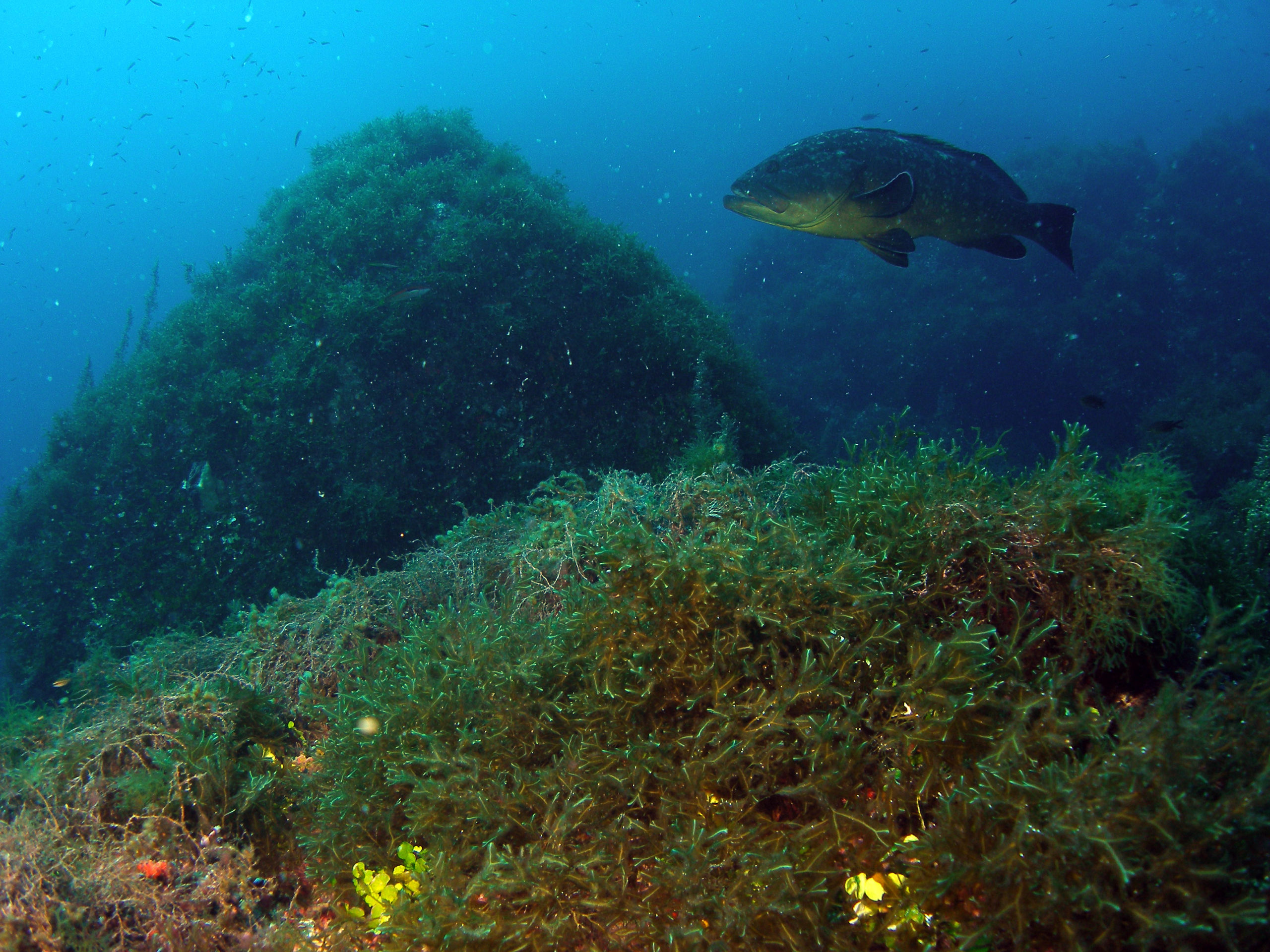


The Columbretes Islands are a series of small islands and islets of volcanic origin that are located on the northern limit of the Gulf of Valencia, 28 miles from the Gulf of Oropesa and just over 50 kilometers from the coast of Castellón. This space becomes a resting area for a multitude of birds on their migrations between Africa and Europe, and a breeding ground for endangered species such as the Audouin’s gull (Larus audouinii), the Cory’s shearwater (Calonectris diomedea) or the Eleonora’s falcon (Falco eleonorae).
In addition, on the seabed there are steep cliffs with sedimentary areas that present a diverse and well-preserved range of habitats: banks of the endemic Mediterranean coral Cladocora caespitosa; meadows of Cymodocea nodosa; coralligenous bottoms dominated by gorgonians and sponges; rhodolith bottoms, and extensive communities of photophilic and brown algae, among which the deepest species of the genus Cystoseira and the endemic algae Laminaria rodriguezii stand out.
INDEMARES has found that the ecosystems present within the protected boundaries have a much better state of conservation than those outside these limits, allowing their regeneration and their action as a nursery for the surroundings. Certain fishing gear can cause habitat disturbances and indirectly affect community structure, leading to a decline in species abundance and community conservation status.
In addition, the results of the LIFE+ INDEMARES project in the Columbretes Islands have shown that the acidification produced by carbon dioxide in the water allows the effects of climate change on the seas to be studied. Due to the gas emanations existing in some areas of these Islands, the physical-chemical characteristics of the water are modified, which influences the distribution of species and communities.
All this research has made it possible to demonstrate the need to expand the existing SCI.