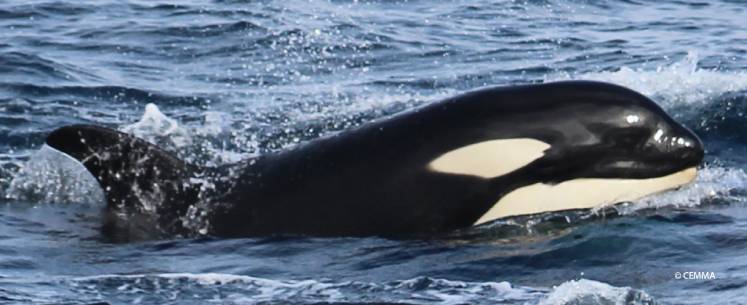


As part of the actions of the LIFE INTEMARES project, which we coordinate through the Biodiversity Foundation of the Ministry for Ecological Transition and the Demographic Challenge, a study has been launched on the interaction of killer whales with boats to propose prevention, action and management measures.
The Coordinator for the Study of Marine Mammals (CEMMA), specialized in the field, is the entity in charge of developing this scientific study on the recent episodes of interaction of the population of the killer whale (Orcinus orca) with manned boats, especially sailboats, in the waters of Galicia and the Strait of Gibraltar. in order to determine their possible causes and define and prioritize the most appropriate measures to try to minimize both these episodes and their consequences.
Due to their diet, centered on bluefin tuna, orca interactions have historically been related to the professional fishing sector. However, since July 2020 there have been episodes of interaction with medium-sized sailboats, with persistent approaches and even ramming the hull and rudder of these vessels, causing material damage.
In all the cases of interactions that have occurred since July 2020 analyzed, no aggressive attitude on the part of cetaceans towards humans has been identified. It should also be noted that only 15% of the episodes have had material consequences on the vessels that have prevented navigation.
MOST FREQUENT EPISODES IN 2021
From the first cases, close coordination has been maintained between the Directorate-General for Biodiversity, Forests and Desertification, the Directorate-General for Merchant Marine and the Society for Maritime Rescue and Safety (SASEMAR).
In order to guarantee the integrity of people and killer whales, in September 2020, the Directorate General of Merchant Marine, based on the recommendation of the Directorate General of Biodiversity, Forests and Desertification, prohibited the navigation of sailboats of a length less than or equal to 15 meters in the area between Ferrol and Cedeira. from the coastline to 11 nautical miles.
In the same way, given that these events have occurred more and more frequently since the beginning of the 2021 summer season in the area of the Strait of Gibraltar and Gulf of Cadiz, it has also been necessary to establish temporary restrictive measures for navigation in this area. For all these reasons, and with the aim of improving regulatory and conservation measures for the species, which always guarantee the safety of people, it is necessary to analyse the possible causes that are modifying the behaviour of the species and design and prioritise measures to minimise these episodes.
This study also has the scientific support of the recently constituted Specific Working Group for this issue, created within the International Whaling Commission at the proposal of the General Directorate of Biodiversity, Forests and Desertification, with great knowledge of the behavior of killer whales, which analyzes the cases in detail.
UNPRECEDENTED INTERACTIONS
The interactions of juvenile killer whales with boats of various types, to satisfy their curiosity, are common in the waters of the Strait of Gibraltar and the coast of southern Portugal, in recent years. On the other hand, interactions with sailboats are considered unprecedented due to the physical contact of the specimens with the structure of the ships.
Currently, the killer whale is included in the List of Wild Species under Special Protection and in Annex IV of the Habitats Directive. Precisely, the population of the Gulf of Cadiz-Strait of Gibraltar is included in the category of “Vulnerable” in the Spanish Catalogue of Threatened Species, so specific protection measures must be established. To this end, in 2017 the Orca Conservation Plan was approved, which includes the priority lines of work to improve the conservation status of the species in our waters.
EFFECTIVE MANAGEMENT OF PROTECTED AREAS
The LIFE INTEMARES project advances towards the objective of achieving an effective management of the marine areas of the Natura 2000 Network, with the active participation of the sectors involved and with research as basic tools.
The Biodiversity Foundation of the Ministry for Ecological Transition and the Demographic Challenge coordinates the project. The ministry itself, through the Directorate-General for Biodiversity, Forests and Desertification; the Regional Government of Andalusia, through the Ministry of Agriculture, Livestock, Fisheries and Sustainable Development, as well as the Environment and Water Agency; the Spanish Institute of Oceanography; AZTI; the University of Alicante; the Polytechnic University of Valencia; the Spanish Fisheries Confederation, SEO/BirdLife and WWF-Spain. It is supported by the LIFE Program of the European Union.