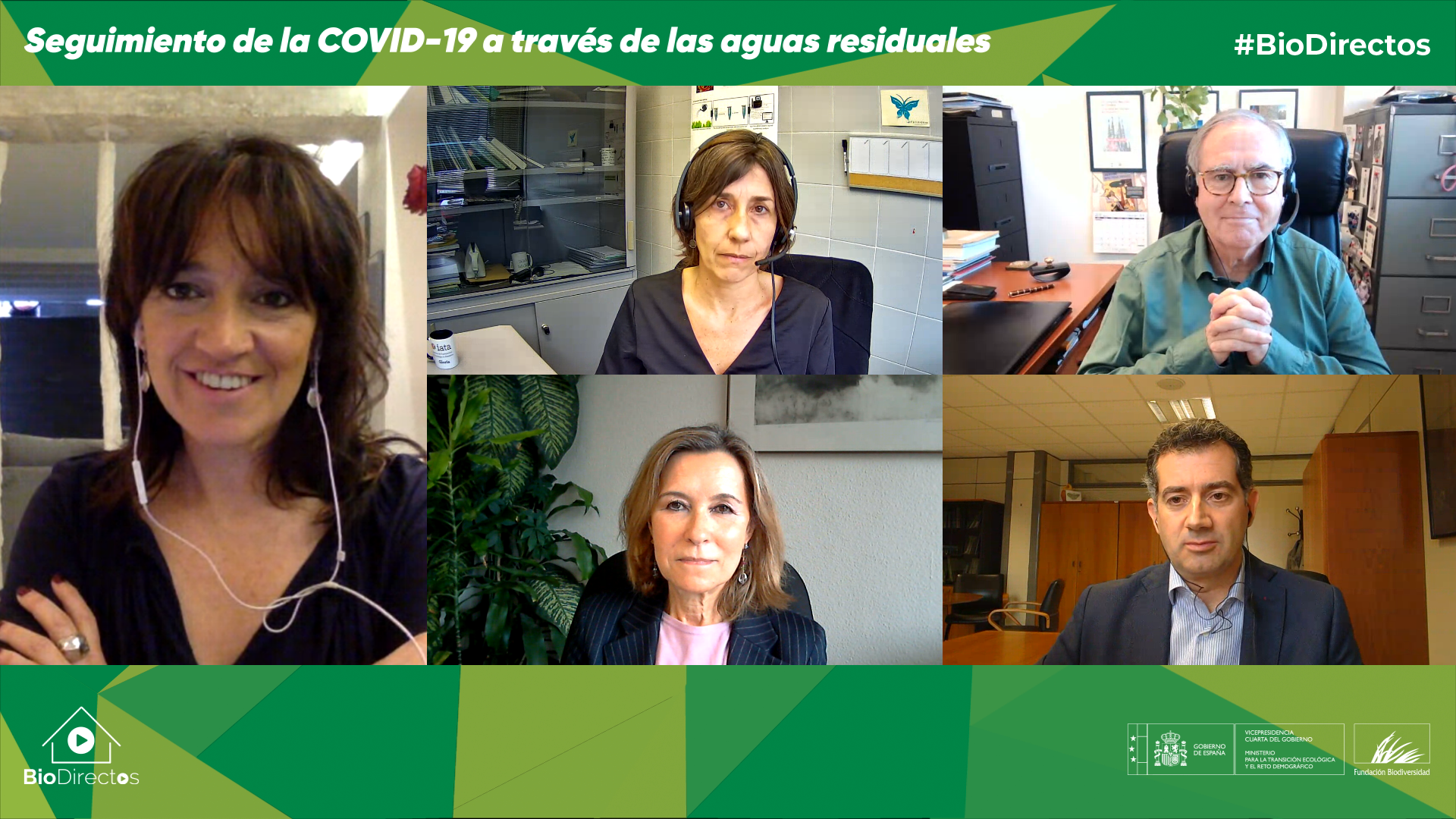


The eighth #Biodirectos “Monitoring COVID-19 through wastewater” was attended by experts involved in the monitoring work
Today the eighth edition of the #Biodirectos series was broadcast. During today’s program “Monitoring COVID-19 through wastewater”, the monitoring work that different administrations are carrying out on COVID-19 through wastewater analysis was presented.
The meeting was attended by Francisco Javier Sánchez Martínez, Deputy Director General of Water Protection and Risk Management of the Directorate General of Water of the Ministry for Ecological Transition and the Demographic Challenge, who presented the results of the VATar-COVID-19 project. Sánchez Martínez stressed the importance of collaboration between administrations and scientific organisations, as well as the existence of a platform for the exchange of information and public access that shows the degree of evolution of the virus compared to the previous week, which helps to anticipate.
The VATar-COVID-19 project (Surveillance and Early Warning System for COVID-19 in wastewater) is developed by MITECO and the Ministry of Health, with the support of the Higher Scientific Research Council, attached to the Ministry of Science and Innovation, CEDEX and the Autonomous Communities. The project aims to identify the presence of people infected by COVID-19 through wastewater from treatment plants. To this end, the presence of fragments of SARS-CoV-2 RNA (the virus that causes COVID-19) in the water entering the treatment plant is determined. Sampling is carried out in wastewater treatment plants (WWTPs).
MITECO publishes weekly on its website the results of the samplings carried out in the treatment plants that are part of the project. These results are a very useful tool for monitoring and controlling the pandemic and for monitoring the effectiveness of the measures that are being taken in each of the territories.
#Biodirectos was attended by four experts involved in the monitoring work that different administrations and entities in the scientific field are carrying out on COVID-19 through the analysis of wastewater.
Professor Albert Bosch, Professor of Microbiology and director of the Enteric Viruses Group at the University of Barcelona, analysed the message of SARS-CoV-2 in wastewater in his speech, and pointed out that the analysis of this water makes it possible to anticipate outbreaks, validate confinement measures and help to take measures for de-escalation. He also stressed that thanks to the study of wastewater it is possible to know the evolution, the levels of circulation of the virus and compare its incidence over the weeks.
The doctor Gloria Sánchez Moragas, CSIC senior scientist at the Institute of Agrochemistry and Food Technology, pointed out that many methodological advances have been made in a short time but there are still challenges in which to continue advancing, such as finishing polishing the technique, with which methods the quantification of the virus in wastewater samples is standardised; to see how future mutations in the virus genome may affect the detection system, or how to normalize results to be able to compare the information between the different WWTPs and correlate the levels of SAR in wastewater with the number of infected people.
For her part, Covadonga Caballo Diéguez, Deputy Director General of Environmental Health and Occupational Health of the Directorate General of Public Health of the Ministry of Health, shared her reflections on the control of SARS-CoV-2 genetic material in wastewater, highlighting the importance of the VATar-COVID-19 project as an early warning tool, a barometer of the evolution of the trend of the virus and the situation of the epidemic.
#BIODIRECTOS
#Biodirectos is a series of online meetings organized by the MITECO Biodiversity Foundation, which began on May 22 of this year and whose objective is to raise awareness of the important role that biodiversity plays in relation to human health, as well as to highlight the opportunities offered by a green reconstruction after the global crisis generated by COVID-19.
More than 30 experts from various fields have participated in the eight meetings held this year, with the aim of seeking solutions to the main challenges we face as a society, such as the health and environmental crisis, 20 entities and administrations and have had a follow-up of more than 55,000 views.