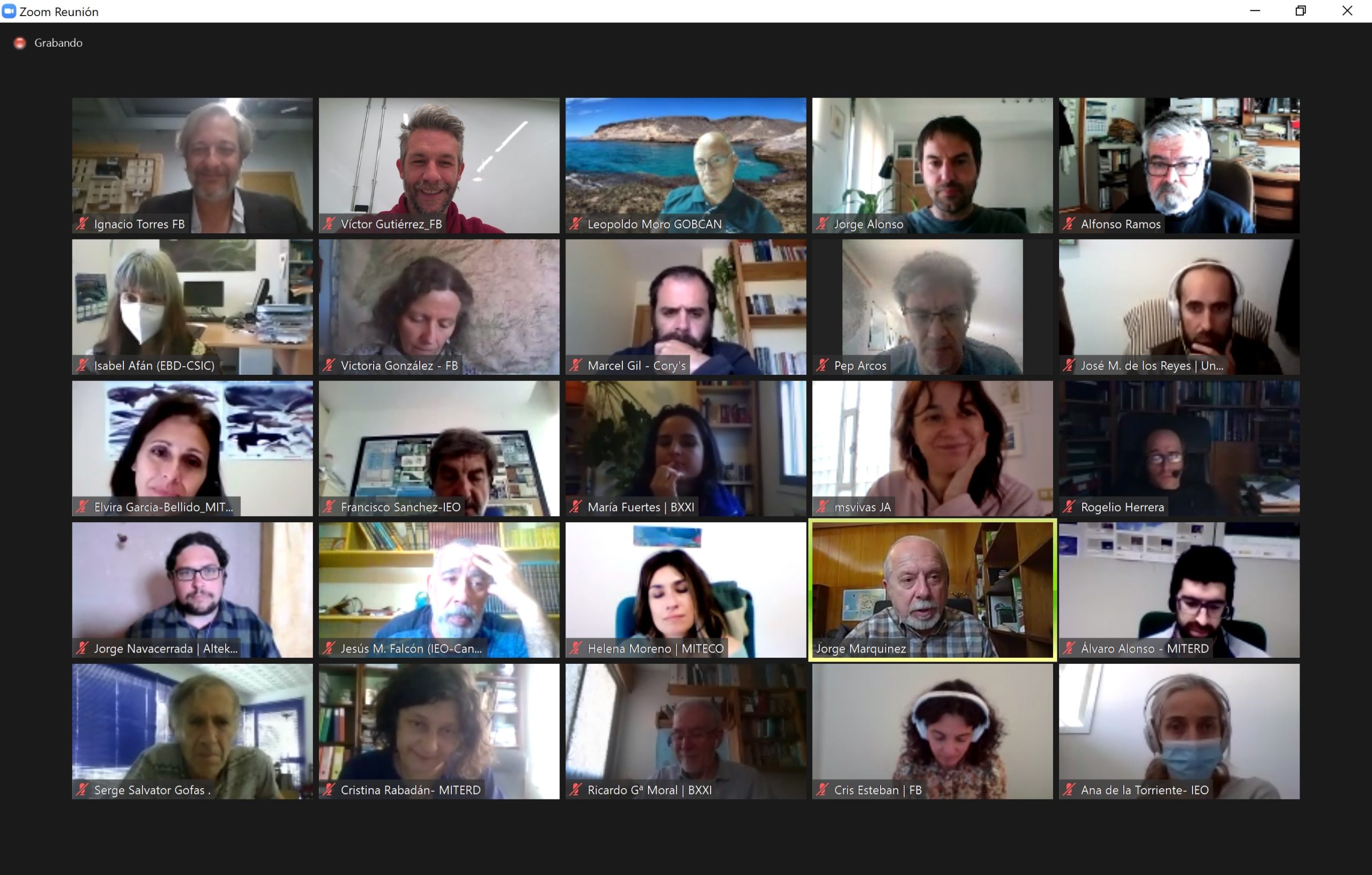


The Director General of Biodiversity, Forests and Desertification of the Ministry for the Ecological Transition and the Demographic Challenge, Jorge Marquínez, has closed the meeting of the scientific committee of the LIFE INTEMARES project, which we coordinate from the Biodiversity Foundation, attached to MITECO, and which advances towards the objective of achieving an effective management of the marine spaces of the Natura 2000 Network.
The meeting, which we have organised together with WWF-Spain, a partner in the project and held on 24 and 25 March, was attended by more than 40 scientists and experts in habitats, species and birds of the European Directives in the different marine demarcations.
This scientific committee is part of the participatory process promoted in recent years to analyse the inadequacies of the Natura 2000 Network, with the aim of achieving a coherent and representative network.
During the committee, possible relevant areas to be declared as marine protected areas have been analysed, which include new spaces, expansion of existing ones and areas in which, a priori, values of interest have been identified, but for which it is necessary to expand knowledge.
In his speech, the Director General of Biodiversity, Forests and Desertification highlighted the importance of science to advance in the commitment to reach 30% of protected and well-managed marine areas by 2030, a goal acquired in the Declaration of Climate and Environmental Emergency of the Government of Spain and in the Biodiversity Strategy of the European Union.
Towards 15% of marine area protected by 2023
In just a few years, Spain has gone from protecting less than 1% of the marine surface to more than 12% today. Thanks to this great achievement, Spain is one of the few European countries that has exceeded the threshold of 10% coverage to which it committed itself in the Convention on Biological Diversity (CBD).
With the LIFE INTEMARES project, Spain sets itself the goal of reaching a coverage of more than 15% of the marine protected area by 2023, thanks to a scientific and participatory process with the involvement of sectors and civil society.
To this end, 17 oceanographic campaigns have already been carried out within the framework of the project for the subsequent delimitation and declaration of new marine protected areas that are of strategic importance for the protection of marine habitats and species.
In this line, Jorge Marquínez has valued the work of researchers, who contribute to increasing knowledge of the marine environment to focus it on management.
On a scientific basis, the management plans for marine protected areas will be drawn up and approved in a participatory manner and with the contribution of all the sectors involved, in order to achieve the conservation of the good environmental status of our waters as well as a coordinated, coherent and effective management of marine protected areas under state jurisdiction. Management instruments for the conservation of protected marine species will also be approved.
Effective management
The LIFE INTEMARES project is moving towards the objective of achieving effective management of the marine areas of the Natura 2000 Network, with the active participation of the sectors involved and with research as the basic tools.
The Biodiversity Foundation of the Ministry for Ecological Transition and the Demographic Challenge coordinates the project. The ministry itself, through the Directorate-General for Biodiversity, Forests and Desertification; the Regional Government of Andalusia, through the Ministry of Agriculture, Livestock, Fisheries and Sustainable Development, as well as the Environment and Water Agency; the Spanish Institute of Oceanography; AZTI; the University of Alicante; the Polytechnic University of Valencia; the Spanish Fisheries Confederation, SEO/BirdLife and WWF-Spain. It is supported by the LIFE Program of the European Union.