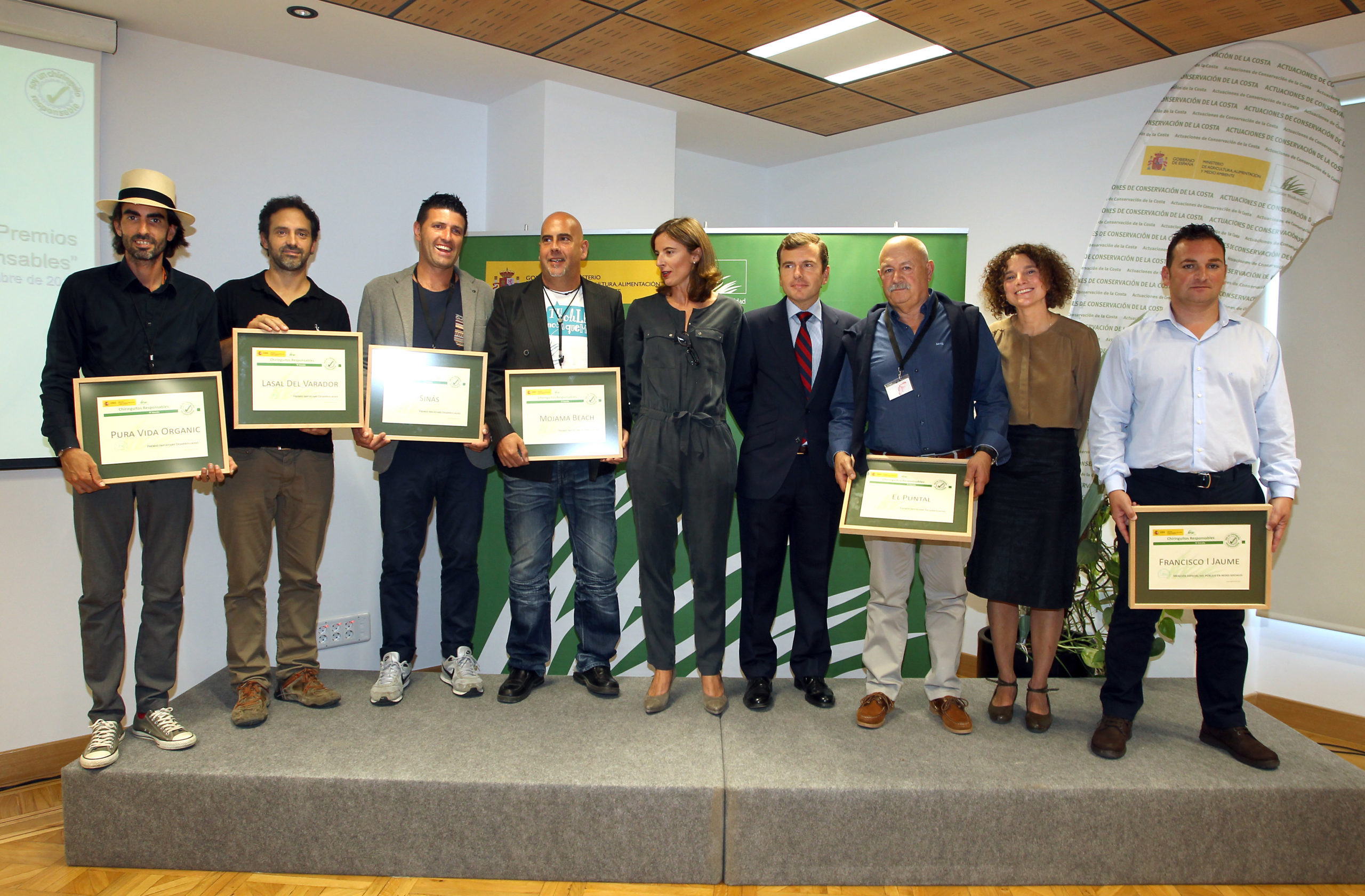


The Secretary of State for the Environment of the Ministry of Agriculture, Food and the Environment, Pablo Saavedra, presided over the presentation of the IV Responsible Beach Bar Awards, which already involve almost 700 of these hospitality establishments in the protection and conservation of our coast. This was highlighted by Saavedra, accompanied at the event by the general director of Sustainability of the Coast and the Sea, Raquel Orts, and by the director of the Ministry’s Biodiversity Foundation, Sonia Castañeda.
The Responsible Beach Bar Awards, promoted by the Ministry through the Biodiversity Foundation, recognize the best environmental initiatives adopted by beach bars to contribute to the conservation of the natural environment where they carry out their economic activity.
The winners in the “Developed Initiatives” category were the beach bar “El Puntal” in Somo (Cantabria), “Lasal del Varador” in Mataró (Barcelona), “Mojama Beach” in Chiclana de la Frontera (Cádiz), “Pura Vida Organic Restaurant” in Alcossebre (Castellón) and “Sinás” in Raxó (Pontevedra).
In addition, the “Special Mention of the Public on Social Networks” award has been given to the “Francisco I Jaume” Beach Bar in Ses Salines (Mallorca). Ten beach bars were eligible for this mention, and the votes, which have been made through Facebook, were open until August 31. Nearly 5,000 votes have been received, of which more than 1,500 have gone to the winning beach bar. “This data shows the involvement not only of the sector but also of the users of the beach bars themselves, who are the first interested in enjoying a clean and sustainable beach,” said Saavedra.
This year, a total of 88 establishments from the 10 coastal communities of Spain have applied for the awards, a figure that represents a record of participation and the expansion of the geographical scope of the beach bars responsible and that means the implementation of more than 200 initiatives.
After the awards ceremony, Saavedra insisted that “it is possible to reconcile the enjoyment of the beaches and their ecosystems with the economic activity that is carried out on them” and highlighted the “great quality” and the “large number of interesting initiatives” that the beach bars have carried out and that “improve every year”.
In 2012, the Ministry, through the Biodiversity Foundation, launched the Decalogue of Good Environmental Practices to guide beach bars to improve the management of space and resources. Saavedra has described this initiative as “a success” since during the legislature nearly 700 establishments aware of the conservation of the coastline have joined.
To support compliance with the Decalogue, the ‘Responsible Beach Bar Awards’ were created, which have sought throughout these four editions “to reward the work that the beach bars have carried out in their relationship with the environment”. A total of 263 beach bars have participated in these four editions, which have developed more than 500 initiatives to protect the Spanish coasts.
The Secretary of State also highlighted the “good reception” that this initiative is having abroad, since Cyprus has launched the campaign of responsible beach bars with “our same philosophy and image”.