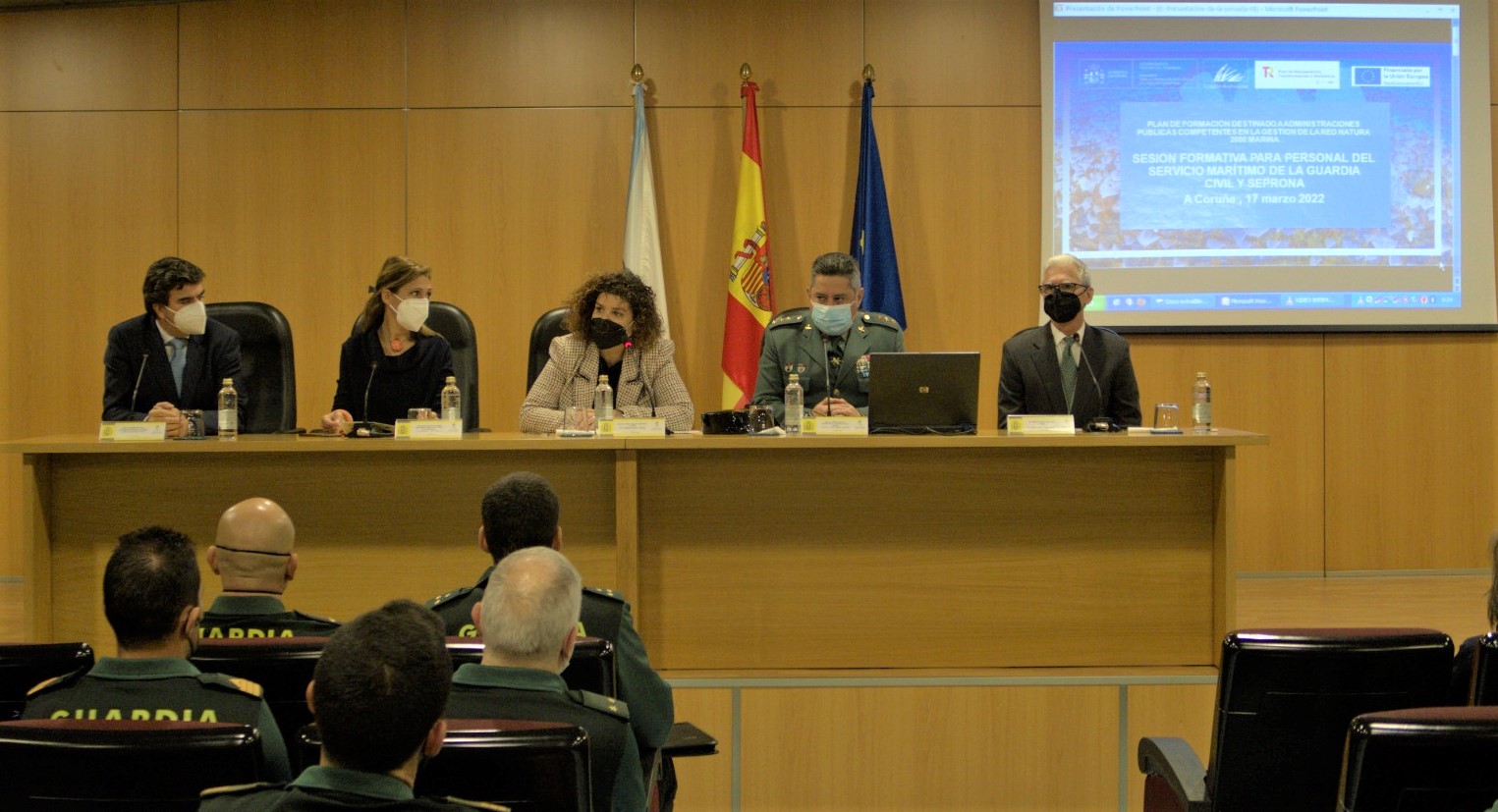


The Biodiversity Foundation of the Ministry for the Ecological Transition and the Demographic Challenge (MITECO) has reinforced the training programme for the staff of the public administrations responsible for the management of the marine Natura 2000 Network and other recipients, within the framework of the LIFE INTEMARES project.
The Biodiversity Foundation of the Ministry for the Ecological Transition and the Demographic Challenge (MITECO) has reinforced the training programme for the staff of the public administrations responsible for the management of the marine Natura 2000 Network and other recipients such as teachers and companies related to the marine environment. This programme began in the LIFE INTEMARES project, which we coordinate, and is now being promoted thanks to the funds of the European Union NextGenerationEU, through the Recovery, Transformation and Resilience Plan.
The first training session, held on March 17, was attended by the Provincial Maritime Services of the Civil Guard of the North Atlantic Marine Demarcation and personnel from SEPRONA of A Coruña. Among the contents of the training, the characteristics of marine biodiversity, the challenges of its conservation, the role of the marine Natura 2000 Network in Spain as the main instrument for the conservation of biodiversity, and the main aspects of the surveillance tasks that the State security forces can carry out in terms of the protection of marine biodiversity were addressed.
Along these lines, the importance of the Natura 2000 Network, the largest and most complex network of protected areas in the world, which, with nearly 27,000 areas, contributes to guaranteeing the long-term survival of the most vulnerable species and habitats in Europe and to halting the loss of biodiversity, has been highlighted.
Stakeholder involvement and empowerment
The training programme in the marine Natura 2000 Network aims to meet the need to promote a more coordinated and effective management of the marine environment through the involvement and training of key actors, a priority that has been identified in the training strategy developed within the framework of the LIFE INTEMARES project. Likewise, these trainings are aimed at advancing in the effective management of the marine protected area, a commitment reflected in the 2030 Biodiversity Strategy and in the objectives of the RTRP.
Specifically, the trainings that will be addressed over the next two years will focus on the regulations and principles of governance for the management of the Network, application of technologies for the monitoring and monitoring of pressures in the marine environment, techniques applied to improve the knowledge of cetaceans, turtles and other marine species, as well as species of fishing interest and marine ecology, among others. Among the many recipients of these trainings are managers of protected areas, formal and informal education teachers, workers of companies related to the marine environment, prosecutors or state security forces and bodies.
In the first stage of implementation of the strategy, from 2017 to date, 19 training sessions have been given to public administrations on the management of the Natura 2000 Network, which have had more than 2,300 participants.
Effective management of protected areas
The LIFE INTEMARES project is moving towards the objective of achieving effective management of the marine areas of the Natura 2000 Network, with the active participation of the sectors involved and with research as the basic tools.
The Biodiversity Foundation of the Ministry for Ecological Transition and the Demographic Challenge coordinates this project. The ministry itself, through the Directorate-General for Biodiversity, Forests and Desertification; the Regional Government of Andalusia, through the Ministry of Agriculture, Livestock, Fisheries and Sustainable Development, as well as the Environment and Water Agency; the Spanish Institute of Oceanography; AZTI; the University of Alicante; the Polytechnic University of Valencia; the Spanish Fisheries Confederation, SEO/BirdLife and WWF-Spain. It is supported by the LIFE Program of the European Union.