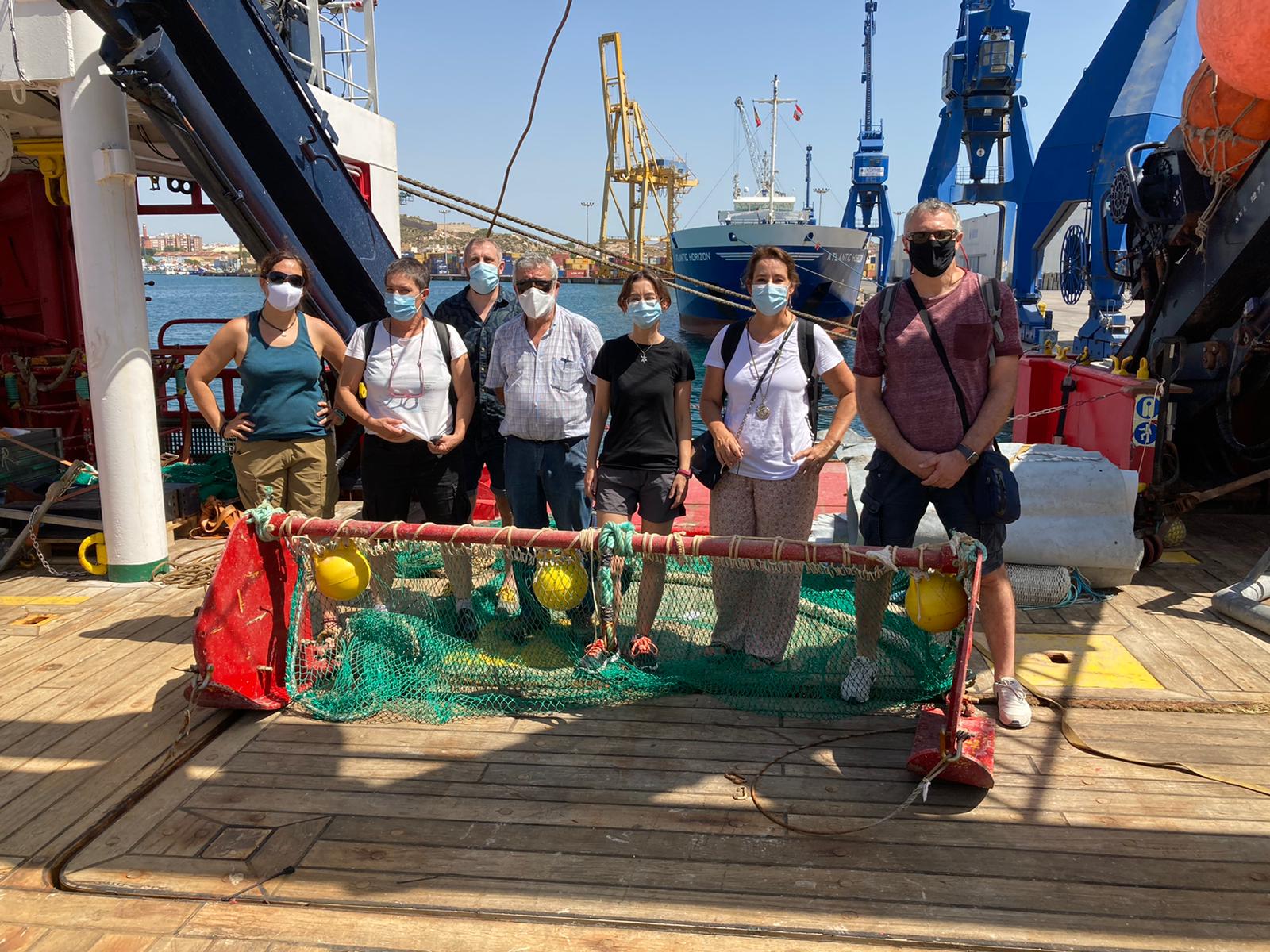


A solid scientific basis is sought for the possible declaration of this area as a new marine protected area through the figure of Site of Community Importance within the Natura 2000 Network.
A new research campaign of the LIFE INTEMARES project begins on the continental slope of Murcia and south of Alicante, which will complete the unprecedented detailed information obtained in the seabed of the Escarpment of Mazarrón, Seco de Palos and the area of seamounts in the south of Alicante in two previous oceanographic campaigns.
These expeditions aim to achieve a solid scientific basis for the possible declaration of this area as a new marine protected area through the figure of Site of Community Importance (SCI) within the Natura 2000 Network.
In this campaign, researchers from the Spanish Institute of Oceanography (IEO) and the University of Alicante (UA), partner institutions of this project through the Joint Research and Development Unit (UMID UA-IEO), will explore different areas of the continental slope of Murcia and southern Alicante until August 18.
On this occasion, they will focus on locating and mapping various types of habitats of community interest, especially rocky reefs with coral, gorgonian and sponge forests, as well as soft corals. Also targeted in this campaign are underwater structures produced by gas escapes, known as pockmarks.
To do this, they will use technologies that allow high-resolution images to be obtained, videos, photographs and samples to be collected at depths of up to 2,000 meters. The information obtained will be complemented with indirect point sampling. Environmental variables will also be obtained by collecting data on water temperature and salinity.
The scientific information obtained will contribute to progress towards the goal of protecting 30% of the marine surface by 2030.
EFFECTIVE MANAGEMENT
The LIFE INTEMARES project advances towards a better knowledge of marine protected areas, with the aim of achieving an effective management of the marine spaces of the Natura 2000 Network.
The Biodiversity Foundation of the Ministry for the Ecological Transition and the Demographic Challenge coordinates this integrated project, in which the Ministry’s Directorate-General for Biodiversity, Forests and Desertification, IEO, CEPESCA, SEO/BirdLife and WWF-Spain participate as partners. It has the financial contribution of the European Union’s LIFE programme, among other sources of funding.