The work of the LIFE+ Cantabrian Capercaillie project has managed to reduce the noise level of the electrical substation of the Port of Panderruedas. The work carried out within the framework of the LIFE+ Cantabrian Capercaillie project has managed to reduce the noise level of the electrical substation of the Port of Panderruedas (León) by up to four times. In this project, which is coordinated by the Biodiversity Foundation of the Ministry of Agriculture, Food and the Environment, the actions to protect the species from the acoustic impact of the transformer substation have already been completed.
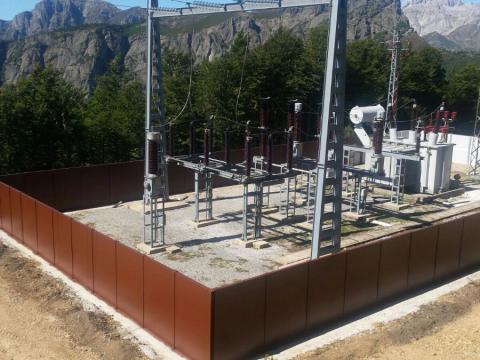
To this end, acoustic screens have been installed on the outer perimeter of the electrical substation. The work has made it possible to reduce the noise to 50 dBA, a low sound level, equivalent to the sound of a refrigerator in good condition.
The transformer substation is located in the area known as Collado la Vieja, near the Port of Panderruedas, in the Special Protection Area for Birds (SPA) Picos de Europa Castilla y León. It is a windy area, so the height of the metal screens does not exceed two meters.
This action, carried out by the Interregional Consortium for the integrated management of the Picos de Europa National Park, is part of the project’s actions aimed at minimising the risk of electrocution, noise and the nuisance caused by the electrical infrastructures to the Cantabrian capercaillie.
In 2014, it was possible to isolate the live elements of the Collado la Vieja transformer substation, built more than 20 years ago in order to mitigate the impact of the power line as it leaves the valley. The installation of bird protections in the low-voltage part of the transformer reduced the risk of electrocution.
The transformer substation belongs to the Navarro company, which has collaborated from the beginning in all actions to correct electrical infrastructures for the conservation of the Cantabrian capercaillie.
The actions framed in the LIFE+ Cantabrian Capercaillie have made it possible to protect the Cantabrian capercaillie from the risk of mortality by electrocution in the area of Collado la Vieja and therefore, improve the habitat of the capercaillie in the Picos de Europa SPA.
Preliminary actions
86 kilometres of power lines run through the territory of Picos de Europa that belong to various companies. Currently, more than 50% of these infrastructures have been signposted or corrected.
To contribute to the conservation of the Cantabrian capercaillie, Iberdrola and the company Navarro have carried out various protection measures. On the one hand, in 2003 Iberdrola collaborated in the signalling with bird savers of a 4 km section of power lines in the Valdeón Valley in order to increase visibility and prevent bird collisions. In addition to this action, 2 km of overhead line has been buried and various works carried out between 2010 and 2012 to improve the line that provides energy to the valley and that crosses caurogallant areas. For its part, the Navarro company signaled a 12 km high voltage line in 2005.
All these measures have led to an improvement in the critical area of the capercaillie, declared in this area. In total, bird savers have been installed in 20 km to reduce or eliminate the risk of bird collision, 2 km of overhead lines have been buried and the location of the Panderdieruedas Outdoor Transformation Centre has been changed to a less visible location and the cables have been buried to eliminate the risk of electrocution.
The LIFE+ Cantabrian Capercaillie, coordinated by the Biodiversity Foundation, has as its fundamental objective to stop the decline of this subspecies exclusive to the northwest of the Iberian Peninsula and promote its recovery. The project, 50% co-financed through the LIFE+ programme, the European Union’s financial instrument for the environment, has as partners the autonomous communities of Cantabria, the Principality of Asturias and Castilla y León, the latter through the Natural Heritage Foundation of Castilla y León; the Interregional Consortium for the Coordinated Management of the Picos de Europa National Park; Tragsa and Tragsatec, SEO/BirdLife and with funding from the Autonomous National Parks Agency and the Iberdrola Spain Foundation.
26/09/2015
Panderruedas port reduces its noise level to protect the Cantabrian capercaillie
Share on:


26/09/2015
Panderruedas port reduces its noise level to protect the Cantabrian capercaillie
Share on: