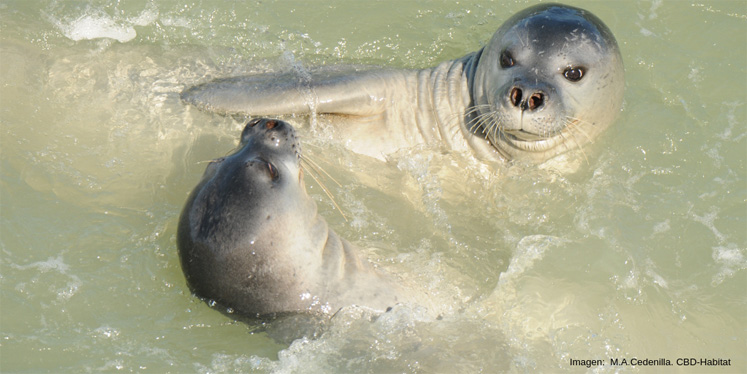


The Ministry for Ecological Transition is finalising the procedure for the reintroduction of the monk seal in Fuerteventura.
The Ministry for Ecological Transition is finalising the procedure for the reintroduction of the monk seal in Fuerteventura. In a meeting that took place today on the island with representatives of the Cabildo and the Government of the Canary Islands, the Ministry has presented the Demographic Feasibility Study for the reintroduction of the monk seal in the waters of this Canary Island. This is the previous step for the Canary Islands Executive to prepare the final project for the reintroduction of this species in the archipelago – where it became extinct decades ago due to human persecution – which must subsequently be submitted to the State Commission for Natural Heritage and Biodiversity and the Sectoral Conference on the Environment for approval. It is estimated that the first translocations of specimens could take place throughout 2019.
The demographic feasibility study identifies Fuerteventura as an ideal place for a translocation trial of monk seal specimensfrom the population of Cabo Blanco, near Nouadhibou, in Mauritania, the most important colony of this species in the world. In order to have these monk seal specimens, the Ministry for Ecological Transition and the Ministry of Environment and Sustainable Development of Mauritania signed a declaration of intent in 2015 for the recovery of extinct species in both countries. Thanks to this agreement, preliminary projects are being carried out for the reintroduction of five species, four Sahel-Saharan antelopes in Mauritania and the monk seal in Spain, all of which are in danger of extinction worldwide.
Although other possible sites for the reintroduction of this pinniped were studied, the truth is that the eastern Canary Islands have a fundamental strategic character for the conservation of the monk seal, as they are geographically located between the populations of this species in Mauritania and Madeira and have the capacity to establish a genetic bridge between them in the future that prevents their isolation. as outlined in the Action Plan for the Conservation of the Mediterranean Monk Seal in the Eastern Atlantic (UNEP/CMS).
Guaranteed food
Specifically, the place proposed as ideal to carry out the reintroduction is the Jandía Natural Park, in Fuerteventura. Experts consider that this area offers ample available feeding habitat, sufficient for a group of reintroduced individuals, and that the threats are minimal, since fishing activity is carried out on a small scale and the use of certain gears, such as trawling and the use of gillnets, which are a major source of mortality for many populations of pinnipeds, is prohibited. including monk seal seals.
Likewise, the good state of conservation of the territory as a whole, with a low density of inhabitants, with moderate and, for the most part, respectful tourism, and protected areas with great extension and naturalness, marine productivity and a very notable degree of isolation, make Fuerteventura the ideal candidate for a reintroduction trial.
The U.S. National Oceanic and Atmospheric Administration (NOAA) is collaborating in this project through its Hawaiian Monk Seal Research Program, and the U.S. Marine Mammal Commission (MMC). The Hawaiian archipelago is home to Hawaii’s only population of monk seals, which is much like ours. A successful translocation project has been carried out there, which can serve as a model for this trial in the Canary Islands.
Do you want to know what major marine environmental conservation project the Biodiversity Foundation is working on?
We invite you to follow our twitter @FBiodiversidad and through the hashtag #Intemares we will keep you informad@ of all the news and actions of LIFE IP INTEMARES, the largest marine environment conservation project in Europe, coordinated by the Biodiversity Foundation. Shortly, in addition, all the information about the project will be available on a new website on which we are working.