

Results of the report “Impacts and risks derived from climate change in Spain”
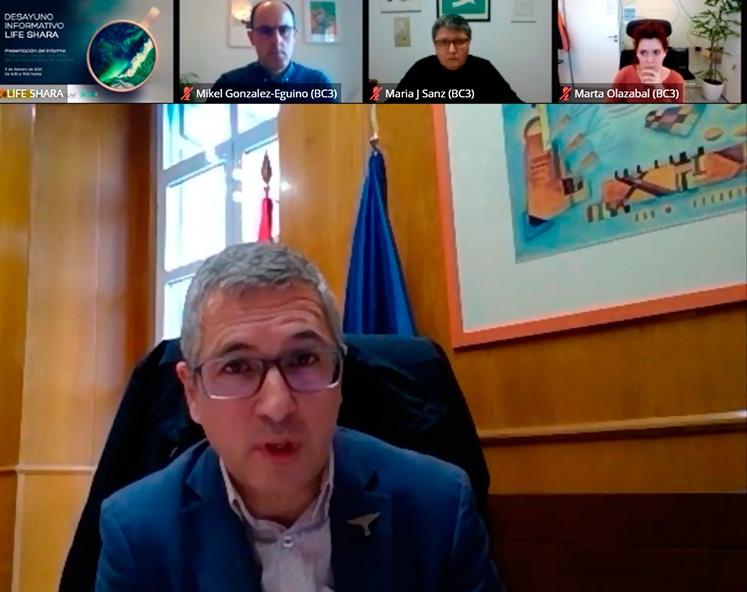
The report “Impacts and risks derived from climate change in Spain”, the results of which were presented within the framework of the project’s fourth informative breakfast LIFE SHARA presents a joint vision of the main impacts of climate change on various sectors and natural systems in Spain, and which are a priority for the National Plan for Adaptation to Climate Change (PNACC). This study has been prepared by the Ministry for the Ecological Transition and the Demographic Challenge, with the technical coordination of the Basque Centre for Climate Change (BC3),
The text, prepared within the framework of the PNACC, includes the contributions of 17 authors and addresses the multiple risks arising from climate change in Spain, risks that simultaneously affect a wide range of socio-economic sectors and natural systems.
IMPACTS AND RISKS OF CLIMATE CHANGE
María José Sanz, Scientific Director of the BC3 and coordinator of the work, considers that “the report seeks to make a synthesis of the impacts of climate change in different sectors in Spain by presenting the risks” and highlights that “an increase in maximum and minimum temperatures, longer heat waves and that rainfall will be reduced in the last decades of this century are expected. All this will be accompanied by an increase in extreme phenomena”.
The founder and director of ICATALIST, Elena López Gunn, one of the authors of the report and who has focused on the impacts and risks of climate change on water resources, insists that one of the effects of climate change is the reduction of water resources, a phenomenon that will have “great impacts on agriculture. In addition, he stresses that it is a phenomenon that can have repercussions in many more sectors in our country.
For her part, Elena Ojea, from Future Oceans Lab, of the University of Vigo, has addressed the repercussions of climate change on the marine environment in the infoem. Impacts that he summarises in ” increases in water temperature, rising sea levels, changes in salinity and waves. These are the impacts that have been observed in recent decades and that point to the fact that by the end of the century the temperature of surface seawater will have increased by at least two degrees.” A scenario in which there will be “changes in the ecological balance and a decrease in fishing productivity”.
Marta Olazábal, a researcher at the BC3, has worked on the incidence of climate change in urban areas. “The greatest impacts are going to be on human health . Aspectos como la pobreza energética y los tipos de construcción se verán afectados”. Olázabal insiste en la necesidad de “evaluar de forma más profunda estos cambios en áreas urbanas y sus efectos en la vida en la ciudad”.
Mikel González, also from BC3, discussed the impacts and risks of climate change in the energy sector. One of the connections that is of most concern is the production of hydroelectric energy, since climate change can reduce water resources, affecting the hydroelectric potential of our country. On the other hand, there could be “an increase in electricity demand for air conditioning consumption due to the increase in temperatures”.
Elena Pita, director of the Biodiversity Foundation , highlights the relationship between climate change and biodiversity. The role of nature is fundamental in all aspects of mitigation and adaptation to climate change, because of how it affects it and because of its potential to contribute to the solution to it.”
The director of the Spanish Office for Climate Change, Valvanera Ulargui, explains that “knowledge of this report is essential to be a more resilient and less vulnerable country to climate change. We must find the solution together and we must land the messages in society.”
A COMMITMENT TO DISSEMINATE KNOWLEDGE
One of the The objectives of the LIFE SHARA project are to train and raise awareness on adaptation to climate change, as well as to contribute to improving communication on this subject. Thus, these informative breakfasts of the project are spaces aimed at disseminators and communicators in which the most current knowledge on impacts, vulnerability and adaptation to climate change is presented, seeking to contribute to an adequate communication of the influence of climate change on issues of social and environmental interest.