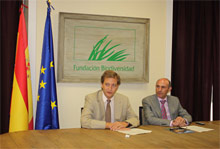


The general director of EUROPARC-Spain, José Vicente de Lucio, and the head of the Studies and Projects Department of the Biodiversity Foundation of the Ministry of the Environment, Rural and Marine Affairs, Ignacio Torres, today presented the results of the work of these four years of collaboration for protected areas in Spain.
At the event, which took place at the headquarters of the Biodiversity Foundation, the creation of new tools that will facilitate the work of managers was highlighted and the Work Programme for protected areas 2009-2013 was pointed out as an unavoidable contribution to Spain’s commitment to the Convention on Biological Diversity.
Since 2005, the Biodiversity Foundation has supported EUROPARC-Spain in the implementation of conservation projects aimed at improving access to information and the effectiveness of management in protected natural areas, as well as promoting the exchange of good conservation practices.
The Federation of Natural and National Parks of Europe, EUROPARC, is a pan-European organization established in 38 countries, which has been working for protected areas since 1973. In the Spanish section of this Federation – an active member of the network since 1993 – all the administrations responsible for the protected areas of the Spanish State are represented.
EUROPARC-Spain and the Biodiversity Foundation, together with the Fernando González Bernáldez Interuniversity Foundation for Natural Spaces (FUNGOBE) carry out intense work to guarantee the preservation of species, ecosystems and landscapes in protected areas. It is also a matter of making conservation compatible with the sustainable use of the natural resources that the spaces provide.
CONSERVATION, MANAGEMENT AND PROMOTION
Protected natural areas are home to the best of our natural and cultural heritage. The Biodiversity Foundation and EUROPARC-Spain have joined forces with the primary purpose of collaborating permanently for the conservation of biodiversity and thus helping to conserve the Natural Heritage of our country.
Hence the importance of training and raising awareness among the different park managers regarding good conservation practices as well as the homogenization of management criteria. In this sense, one of the tasks of the common project of these entities has been to guarantee the exchange of experiences between the managers of protected areas and facilitate access to scientific and technical knowledge.
The task of promoting the exchange of knowledge between the technicians who work directly in the design and implementation of biodiversity conservation actions in protected areas has been carried out in the holding of thematic seminars and personnel exchanges between parks with similar management objectives. It should also be noted that some tools have been developed, such as the Observatory of Protected Areas, a benchmark on the state of natural areas that enjoy protection figures at the state level; WIKI conservation, an up-to-date database containing information on conservation plans and projects, and the Documentation Centre for Natural Spaces, located in the Science Library of the Autonomous University of Madrid.
On the other hand, a Conservation Standard has been developed, aimed at managers of protected areas, which also aims to become a useful tool for all professionals involved in the design, execution and evaluation of conservation projects committed to the quality of their work. Because compliance with quality standards and good practice protocols will ensure that conservation efforts are carried out in accordance with the most efficient procedures, and that these contribute to achieving the objectives set.
Finally, the implementation of systems for monitoring and evaluating the effectiveness of management in protected areas is one of the challenges for the coming years. EUROPARC-Spain is already on this path, with the publication of the Yearbook on the state of protected areas and through courses on monitoring and evaluation systems, manuals and a proposal for evaluation indicators for application in protected areas of the State. More information on this can be found in www.redeuroparc.org