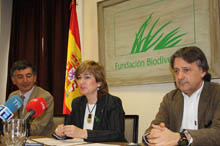


On the occasion of the celebration of Earth Day, the director of the Biodiversity Foundation, a public foundation of the Government of Spain, under the Ministry of the Environment, Rural and Marine Affairs, Ana Leiva, presented today in Madrid the project “Assessment of Millennium Ecosystems in Spain”, together with the Vice-Rector for Campus and Environmental Quality of the Autonomous University of Madrid (UAM). Javier Benayas, and the director of the Project, Carlos Montes.
In this event, linked to the celebration of Earth Day, the importance of this study was highlighted, which will take as a reference the model developed by the United Nations in the “Millennium Ecosystem Assessment” program to analyze, for the first time in Spain, the health of our aquatic and terrestrial ecosystems.
What is the state of Spanish ecosystems? What benefits do they provide to society? How do the changes that have been made to ecosystems affect our economy, health, culture, and overall well-being? These are some of the questions that this initiative of the Biodiversity Foundation and the Autónoma, Complutense and Alcalá de Madrid universities aims to answer, in which it has been possible to involve a large work team, made up of the best specialists in different areas of the biophysical and social sciences, with the intention of achieving a broad scientific consensus. key to decision-making.
The project aims to collect and organize a large part of the scientific knowledge that has been accumulating in recent years on the relationships between nature and society in our country. As explained by the professor of Ecology at the UAM and director of the Project, Carlos Montes, the objective is, fundamentally, to analyze the set of goods and services that ecosystems provide us.
To this end, there will be different specialists who are experts in the field, one for each aquatic or terrestrial ecosystem in Spain. They, and their teams, will be in charge of coordinating and collecting all the existing information to later analyze it and draw conclusions.
The first results will be announced at the end of 2009 in a report that will help to classify all the goods and services provided by Spanish ecosystems and their benefits for human health. The data will be made available to the scientific community and society in general through a website created for this purpose.
Through this Project, the aim is to transfer the information available at all times to managers and technicians, as well as to inform society about the way in which the degradation of ecosystems affects their quality of life.
Ecosystems are the basis of human well-being, and the economic, social, cultural and political future of today’s and tomorrow’s societies depends on their proper functioning. So much so that according to the United Nations Program, ecosystems provide us with two thirds of the services and resources that contribute to human well-being, and there is a close relationship between ecosystems and development.