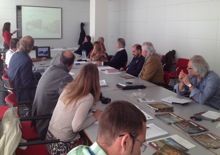


The Biodiversity Foundation of the Ministry of Agriculture, Food and the Environment has chaired the meetings of the scientific and breeding committees of the LIFE+Cantabrian Capercaillie project, in which the progress obtained throughout the project has been analysed and the steps to be taken within the framework of the conservation actions and captive reproduction of the capercaillie have been defined. This meeting, held at the headquarters of the Government of Asturias in Oviedo, was attended by the Director General of Natural Resources, María Serafina Álvarez Murias.
The Scientific Committee of the LIFE+ Cantabrian Capercaillie includes the beneficiary partners and experts from the universities of León, Valladolid, Oviedo and the Polytechnic University of Madrid, research centres such as the Institute for Research in Game Resources of the Spanish National Research Council (IREC-CSIC) or the Spanish Society for the Conservation and Study of Mammals (SECEM). Specialists in captive breeding of species similar to capercaillie have participated in the Breeding Committee.
The Scientific Committee has analysed the results of silvicultural treatments – clearings and clearings – carried out within the framework of the programme to increase the availability of optimal habitat for the subspecies, favouring the development of species of interest to the capercaillie. Progress has also been presented for the correction of the electrical substation of Collado La Vieja (Picos de Europa National Park), to reduce its noise impact and the nuisance generated to the subspecies.
In addition, the experts discussed the methodology used to estimate the populations of competitors and predators of capercaillie in the mountain range, the methods of capture and control and the monitoring of the plans executed in Cantabria and Castilla y León, highlighting the importance of reducing, especially, wild boar densities.
Likewise, the need to evaluate the effectiveness of these measures in the medium and long term in relation to the state of the Cantabrian capercaillie populations has been stressed, trying to compare their success in relation to the areas where no intervention has been carried out.
In relation to the captive breeding programme, the Breeding Committee has examined the operating protocols of the breeding centre and genetic reserve of Sobrescobio, discussing the methods of natural and artificial incubation, the diet of the chicks and the techniques for preparing the juveniles for release. The ultimate objective is to obtain specimens prepared for release into the wild environment and that can be part of the wild population, improving the results obtained in the last two years.
The project LIFE+ Cantabrian Capercaillie, coordinated by the Biodiversity Foundation, has as its fundamental objective to stop the decline of this subspecies exclusive to the Northwest of the Iberian Peninsula and promote its recovery.