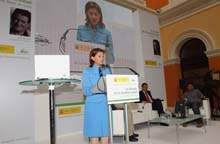


The Biodiversity Foundation, a public foundation of the Government of Spain, under the Ministry of the Environment, Rural and Marine Affairs, joins this year the celebration of World Biodiversity Day, presenting the work of the prestigious nature photographers Joel Sartore and Andoni Canela. It is about reflecting on the value of the image as a means of environmental awareness.
Commitment to the natural environment is particularly important in a country like Spain, which is home to a very representative sample of the planet’s biodiversity and has a long list of endemic species.
Although, due to its latitude, Spain is considered a temperate climate zone, the diversity of its territory prevents us from speaking of a physically homogeneous country. The variety of its mountain ranges, valleys and plateaus, the orientation of its coasts (bathed by different bodies of water) and the confluence of at least three clearly differentiated climatic zones, make Spain the country with the greatest biodiversity in the entire European continent.
Spain has 10,000 different plant species that represent 80% of those existing in the European Union and almost 60% of those found throughout the continent, of which 6,500 are native plants and 1,500 are endemic, that is, unique species in the world.
In association with plant communities, communities of vertebrates and invertebrates have thrived in the peninsular territory, making up the most abundant sample of European biodiversity. With a total of between 50,000 and 60,000 animal species, it represents more than 50% of the existing species in the European Union. Birds of prey such as the imperial eagle or felines such as the Iberian lynx have their only habitat in Spain.
In response to the need to preserve this ambitious legacy, a large part of the Spanish territory is protected under some legal figure. The Natura 2000 Network, which encompasses all the sites that according to the European Union should be protected for their natural interest, includes more than 12 million hectares of Spanish territory. It is the same as saying that 25% of the country is considered to be of great interest to Europe and is legally protected.
This concern to conserve the natural values of the territory opens a window of opportunities for the economic reactivation of rural areas. Environmental policies are contributing, for example, to the transformation of the countryside, by promoting development models that make agricultural activity compatible with nature conservation. Thus, during the last decade, organic farming has grown in Spain more than in any other part of the European Union and already occupies one million hectares, which translates into job creation (organic farming represents 20% of jobs in the environmental sector). Something similar could be said of other sources of green employment such as forest management, clean technologies, or renewable energies. According to the director of the Biodiversity Foundation, Ana Leiva, “the protection of natural spaces will lead to an increase in employment in the next five years, going from 4,000 direct jobs to 10,000”.
In addition, the natural values of the territory are closely linked to the maintenance of unique landscapes and the cultures that have made them possible, as well as to other social functions related to education, research and leisure.
To halt the loss of biodiversity and get the different governments of the Earth to assume their environmental commitments, at the beginning of the century an international project was launched under the name of “Countdown 2010”. This initiative of the World Conservation Union (IUCN) works to halt the loss of biodiversity, setting 2010 as the first goal for achieving goals.
This campaign owes its creation to the observation, by scientists, of the existence of an accelerated loss of biodiversity, both in Europe and in the rest of the world, comparable to that which wiped out the dinosaurs 65 million years ago.
To date, more than twenty European institutions have supported the initiative, from the Council of Europe to the Ministries of the Environment of the United Kingdom, Italy and Spain.
In April 2006, the Biodiversity Foundation joined the “Countdown 2010”, and currently supports this campaign by working on more than 400 projects for the conservation and sustainable use of natural resources, as well as transferring to all public sectors the need to stop the loss of biodiversity.
The Spanish presidency of the European Union during the first half of 2010 is a unique opportunity to continue advancing in this line and combat one of the three major environmental problems on a global scale: the disappearance of species linked to the progressive deterioration of natural ecosystems.
In the words of photographer Joel Sartore: “Animals show us an incredible variety of shapes, sizes, colours and behaviours. But many are now in danger of extinction, to a large extent, because of the action of Man. Do we want to live in a world without them? It’s crazy to think that we can destroy species after species and ecosystem after ecosystem without affecting humanity.”