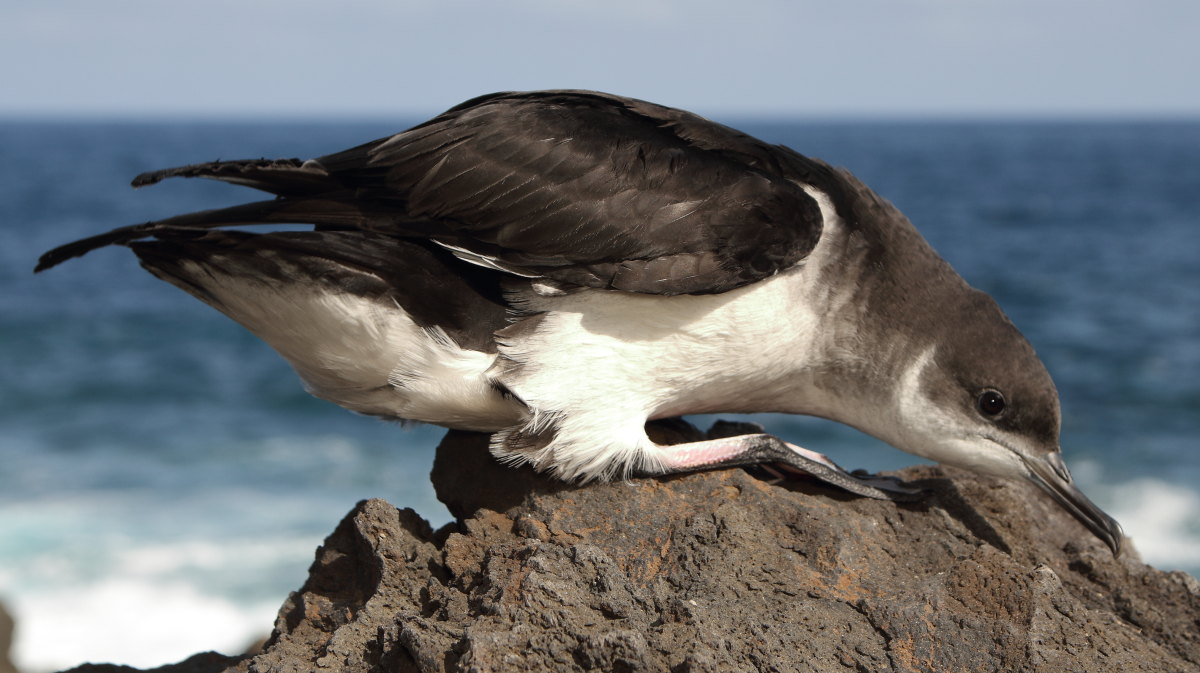


A scientific study exposes the differences between the shearwater of the Canary Islands and its counterparts in the North Atlantic and proposes their cataloguing as an endemic subspecies to promote the conservation of the breeding population in the archipelago. The research, published in the journal Avian Biology, has direct relationship with the LIFE INTEMARES project, through which actions are carried out to locate and monitor breeding colonies of this bird to reinforce their protection.
In an attempt to expand knowledge of the species in the Canary Islands, Spanish and Portuguese researchers have identified the main differences between Canarian specimens and their counterparts in the North Atlantic.
After studying the breeding cycles, vocalizations, size, color and shape of the Pichoneta shearwaters, they conclude that Canarian individuals should be categorized as an endemic subspecies of the archipelago, since their life cycles are completely adapted to the Macaronesian region.
Their breeding season begins up to two months earlier than the rest of their Atlantic neighbours and, in addition, they are darker and smaller. According to the analyses carried out, there is also an incipient genetic differentiation, a key factor in improving its taxonomic classification.
IMPROVED KNOWLEDGE OF THE SUBSPECIES
The study has also served to identify the main threats of the shearwater in the Canary Islands, whose population is estimated at a few hundred breeding pairs and most of the existing nests are unoccupied.
Populations have been reduced due to the predation of eggs, chicks and adult specimens, by mammals introduced into the nesting area, such as rats and feral cats; light pollution; as well as the collision with power lines or the competition for nests with the Atlantic Cory’s shearwater, larger in number and size.
With the aim of improving knowledge of the species, within the framework of LIFE INTEMARES also We have installed 32 nest boxes in enclaves of potential reproduction of the species, among other measures, such as the control of predation or the installation of sound players to attract specimens. In a short time, the first individuals have already appeared in the area and it is expected that in the coming years these areas are consolidated as nesting areas for the species.
EFFECTIVE MANAGEMENT OF PROTECTED AREAS
The LIFE INTEMARES project advances towards the objective of achieving an effective management of the marine areas of the Natura 2000 Network, with the active participation of the sectors involved and with research as basic tools.
The Biodiversity Foundation of the Ministry for Ecological Transition and the Demographic Challenge coordinates the project. The ministry itself, through the Directorate-General for Biodiversity, Forests and Desertification; the Regional Government of Andalusia, through the Ministry of Agriculture, Livestock, Fisheries and Sustainable Development, as well as the Environment and Water Agency; the Spanish Institute of Oceanography; AZTI; the University of Alicante; the Polytechnic University of Valencia; the Spanish Fisheries Confederation, SEO/BirdLife and WWF-Spain. It is supported by the LIFE Program of the European Union.