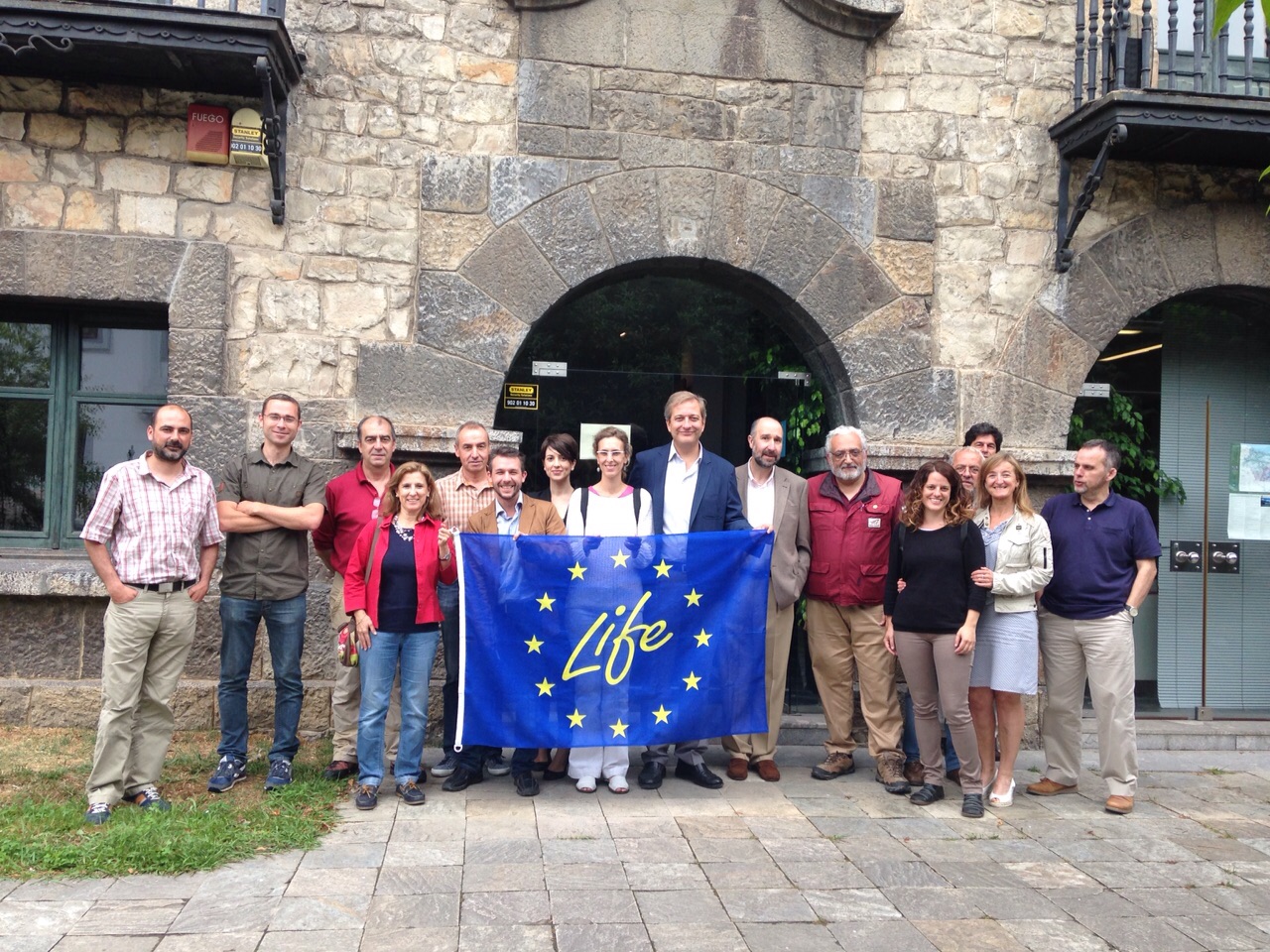
The Management Committee of the LIFE+ Cantabrian Capercaillie held its tenth meeting today, in Cangas de Onís (Asturias), in which the latest advances of the project coordinated by the Biodiversity Foundation of the Ministry of Agriculture, Food and Environment in order to stop the decline of this endangered species and contribute to its conservation were addressed.
During the meeting, the actions carried out in this first half of the year were analysed, including habitat management to create a more favourable environment, improving safety, shelter and the availability of food for the Cantabrian capercaillie.
To date, 32 km of dangerous livestock fences have been signposted and a total of 367 hectares have been acted upon, adding the actions of the land stewardship programme. Within the framework of this initiative, a network of collaboration has been forged between owners, non-profit entities and other agents through the signing of 29 agreements that have allowed the development of 18 projects that have had the involvement of the local population.
Likewise, the actions planned for the second half of the year have been discussed. A set of initiatives that include the management of the capercaillie habitat and control of predators and competitors, the breeding center, the capture and radio monitoring program, and the reinforcement and custody programs.
Among these actions, work will continue to reduce the impact of the electrical substation located in the Port of Panderrueda, in the Collado de la Vieja. Through the LIFE+ Cantabrian Capercaillie project, it will be possible to eliminate the risks of electrocution and reduce the noise generated by the installation.
The LIFE+ Cantabrian Capercaillie, coordinated by the Biodiversity Foundation, has as its fundamental objective to stop the decline of this subspecies exclusive to the Northwest of the Iberian Peninsula and promote its recovery. The project, 50% co-financed through the LIFE+ programme, the European Union’s financial instrument for the environment, has as partners the autonomous communities of Cantabria, the Principality of Asturias and Castilla y León, the latter through the Natural Heritage Foundation of Castilla y León; the Interregional Consortium for the Coordinated Management of the Picos de Europa National Park; Tragsa and Tragsatec, SEO/BirdLife and with funding from the Autonomous National Parks Agency and the Iberdrola Foundation.
23/06/2015
The Management Committee of the LIFE+ Cantabrian Capercaillie holds its tenth meeting
Share on:


23/06/2015
The Management Committee of the LIFE+ Cantabrian Capercaillie holds its tenth meeting
Share on: