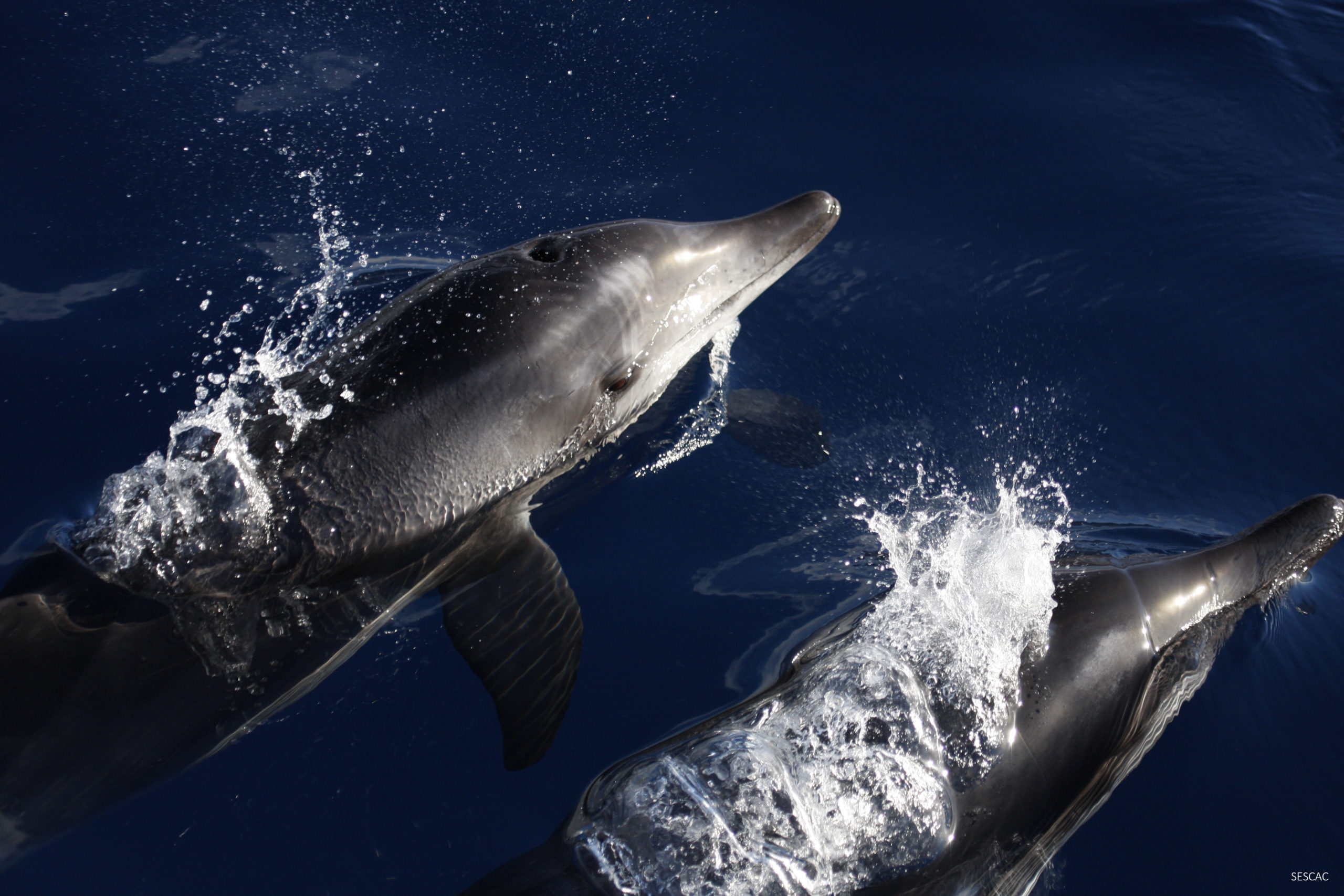


After several oceanographic campaigns, the eastern coasts of Fuerteventura and Lanzarote have shown that they constitute a true marine sanctuary for cetaceans where up to 28 different species of beaked whales, fin whales, sperm whales, killer whales, dolphins and pilot whales can be found, a third of all cetacean species in the world, which represents an extraordinary biological value.
Likewise, the research of the INDEMARES project, coordinated by the Biodiversity Foundation of the Ministry of Agriculture, Food and the Environment, has for the first time comprehensively studied the seamounts of the south of Fuerteventura and has concluded that it has an unusually high richness of biodiversity. Before the project, there were only a few specific studies on the geological structure of the banks or on the environment and formation of the Canary archipelago, so the territory was practically unknown. Before starting the research, it was expected that the Amanay and El Banquete banks would have a relatively poor biological richness due to the geographical location in the open sea and at high depths.
The area in which the banks are located is mainly influenced by the Canary Current, which is a derivation of the Gulf Stream, and by the coastal outcrops of water on the northwest shelf of the African continent. The trade winds sweep the surface of the sea, favouring the upwelling of waters from deeper layers (upwelling), loaded with nutrients. This mechanism means, in general, that the eastern area of Lanzarote and Fuerteventura has a higher productivity than the rest of the archipelago.
Thus, it was surprising to see that thanks to the characteristics of the area, in which currents are intercepted and the oceanographic conditions of the environment are altered, what seemed to be a “desert” in the depths, is transformed into an oasis of life in the open sea in which 771 different species have been identified so far .
On the rocky bottoms , 14 communities have been identified, 13 of them included in the “Reefs” category of the Habitats Directive, where we find habitats dominated by the black coral Antipathella wollastoni that forms dense gardens, and the community of algal calcareous concretions (rhodoliths) and folious macroalgae, both located in the shallowest areas of the banks. Bathyal mud habitats with little organic matter and oxygen, where biodiversity is very poor, are characterized by the presence of the solitary coral Flabellum chunii and mudflats with pennatulaceans or sea feathers. These last two habitats have been proposed by the project for the European Commission to include in the Directive as sensitive.
With the proposal of a Site of Community Importance (SCI) at the European level, an area of almost one and a half million hectares of high ecological value is protected, thanks to the results of the LIFE+ INDEMARES project.