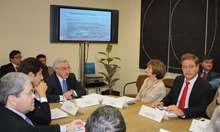


The vice-president of the Biodiversity Foundation, a public foundation of the Government of Spain, under the Ministry of the Environment, Rural and Marine Affairs, Juan Carlos Martín Fragueiro, today chaired the first meeting of all the partners of the LIFE INDEMARES project.
The European Commission recently selected the project “Inventory and designation of the Natura 2000 Network in Marine Areas of Spain” that the Biodiversity Foundation had submitted for funding to the 2007 call for LIFE+ Nature.
The objective of this project – one of the projects that has received the most funding in the history of the European Commission’s LIFE funds – is to obtain sufficient scientific information to preserve large areas of the Spanish marine environment through the designation of Sites of Community Importance (SCI) and Special Protection Areas for Birds (SPAs) of the Natura 2000 Network. The work will begin on January 1, with an expected duration of 5 years.
The actions have a total cost of 15,405,727 euros, of which the EC will contribute 50 percent. The Biodiversity Foundation will allocate 2,636,811 euros, and the rest will be financed by 10 other partners, including the Directorate General of Fisheries Resources and Aquaculture and the Directorate General of Natural Environment and Forest Policy of the Ministry of the Environment, Rural and Marine Affairs, as well as the Spanish National Research Council and the Spanish Institute of Oceanography. It also has the support of the Merchant Navy of the Ministry of Public Works, the Navy Headquarters of the Ministry of Defence and the Secretary of State for the European Union of the Ministry of Foreign Affairs.
Today’s meeting, which was held at the headquarters of the Biodiversity Foundation, was attended by senior officials from the Ministry of the Environment, Rural and Marine Affairs and representatives of all the organisations that will also play an important role in the project’s actions, such as OCEANA, WWF/Adena, Alnitak, the Coordinator for the Study of Marine Mammals, the Spanish Society for the Study of Cetaceans in the Canary Islands and SEO/BirdLife.
CONSERVATION AND SUSTAINABILITY IN FISHERIES MANAGEMENT
The tasks will be carried out in ten large study areas: Creus Canyon, Ebro-Columbretes Delta, Menorca Channel, Seco de los Olivos, Alborán Island and Alborán volcanic cones, Cádia Chimneys, Banco de Galicia, Avilés Canyon, Banco de la Concepción, and Gran Canaria-Fuerteventura Area. The work will begin on January 1, with an expected duration of 5 years.
It is also planned that management guidelines will be drawn up for the proposed sites and awareness-raising actions will be undertaken on the importance of the conservation and sustainable use of marine biodiversity. The project also aims to strengthen compliance with the international conventions on the sea signed by the Government of Spain (OSPAR and Barcelona).
Natura 2000 is the European ecological network of biodiversity conservation areas. It is made up of Special Areas of Conservation, designated in accordance with the Habitats (SCI) and Birds (SPA) Directives. It aims to ensure the long-term survival of species and habitats in Europe, helping to halt the loss of biodiversity caused by the adverse impact of human activities. It is the main instrument for nature conservation in the European Union.
The LIFE+ financial instrument contributes to the development, implementation and updating of EU environment and nature conservation policy and legislation. It also seeks to integrate the environment into other Community policies and to achieve sustainable development in the European Union.
This project is of great relevance for the fulfilment of Spanish obligations in relation to the Natura 2000 Network in marine areas and with the European Marine Strategy. The conclusions of this work will also serve for the application of policies that make it possible to reconcile the conservation of marine biodiversity and the sustainability of fisheries management.